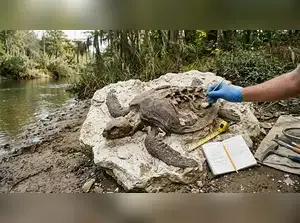
A routine fishing trip along a waterway in Monroe County, Alabama, led to the discovery of a remarkably preserved fossil belonging to an ancient sea turtle species that lived roughly 32 million years ago. Members of the Coleman family noticed unusual bone structures embedded in limestone while fishing and reported the find to local experts, which initiated a formal paleontological investigation.
Researchers later identified the fossil as a previously unknown species of leatherback sea turtle and formally named it Ueloca colemanorum. The discovery was announced in 2025 and has drawn attention because of the specimen’s unusually complete condition. Fossils belonging to leatherback turtles are rarely preserved in such detail, making this discovery valuable for studying the evolutionary history of marine reptiles. According to reports from paleontologists studying the specimen, the fossil dates to the late Eocene epoch, a time when much of what is now Alabama was covered by shallow seas. Geological evidence from the region indicates that coastal waters supported diverse marine ecosystems, including sharks, whales, and ancient sea turtles.
Researchers affiliated with sea turtle research organizations explained that this anatomical structure is the reason complete leatherback fossils are exceptionally rare. Fossil specimens often preserve only fragments of bone rather than intact skeletal structures. The fossil discovered in Alabama contains enough preserved material to allow scientists to analyze the arrangement of the shell and other anatomical features in detail. The unusually complete condition of Ueloca colemanorum therefore provides researchers with new information about the physical structure of ancient leatherback turtles and the ways their bodies adapted to marine life millions of years ago.
The study of these anatomical features allows researchers to reconstruct evolutionary relationships among ancient sea turtles and to understand how they adapted to ancient ocean environments. Marine ecosystems during the Eocene were warmer than modern oceans and supported large populations of marine reptiles, fish, and early marine mammals. Scientists can now refine timelines describing when different turtle lineages appeared and how they spread across ancient oceans.
The naming of the fossil also reflects collaboration with the Poarch Creek Indians, a Native American tribe whose ancestral lands include the region where the fossil was found. Scientists selected the name Ueloca by combining Muscogee language words meaning “water” and “turtle,” honoring the area's cultural heritage. The species name colemanorum recognizes the Coleman family for their role in identifying the fossil. Such naming practices demonstrate how paleontological research can incorporate cultural recognition while documenting scientific discoveries.
The discovery of this fossil adds to the scientific record of those ecosystems and provides researchers with rare physical evidence of leatherback turtle evolution. Each well-preserved specimen helps scientists refine the broader history of marine reptiles and understand how ocean ecosystems changed over millions of years. Fossil discoveries such as this one demonstrate that valuable scientific evidence can still emerge from unexpected places. A single observation along a riverbank can reveal new details about ancient oceans and the animals that once inhabited them, expanding the historical record of life on Earth.
Researchers later identified the fossil as a previously unknown species of leatherback sea turtle and formally named it Ueloca colemanorum. The discovery was announced in 2025 and has drawn attention because of the specimen’s unusually complete condition. Fossils belonging to leatherback turtles are rarely preserved in such detail, making this discovery valuable for studying the evolutionary history of marine reptiles. According to reports from paleontologists studying the specimen, the fossil dates to the late Eocene epoch, a time when much of what is now Alabama was covered by shallow seas. Geological evidence from the region indicates that coastal waters supported diverse marine ecosystems, including sharks, whales, and ancient sea turtles.
Why are leatherback fossils rarely preserved
Leatherback turtles differ from most other turtles in the structure of their shells, which affects how often their remains become fossils. Instead of a single rigid shell made of fused plates, leatherbacks have a flexible structure composed of thousands of small bones called ossicles embedded in thick connective tissue. Because this connective tissue contains large amounts of collagen, the structure typically decomposes quickly after the animal dies. Scientists studying sea turtle evolution have noted that this rapid decay prevents most leatherback remains from fossilizing in recognizable form.Image Credit: x/@grok
New information about leatherback turtle evolution
Paleontologists studying the fossil believe it may help clarify how leatherback turtles evolved over tens of millions of years. According to research reports describing the discovery, the specimen exhibits several anatomical traits that differ from those of modern leatherback turtles. Scientists analyzing the fossil concluded that these differences indicate the presence of more than one evolutionary branch within the leatherback turtle family, known scientifically as Dermochelyidae. Earlier interpretations of the fossil record suggested a more straightforward evolutionary lineage, but the Alabama fossil provides evidence that multiple related groups of leatherback turtles may have coexisted.The study of these anatomical features allows researchers to reconstruct evolutionary relationships among ancient sea turtles and to understand how they adapted to ancient ocean environments. Marine ecosystems during the Eocene were warmer than modern oceans and supported large populations of marine reptiles, fish, and early marine mammals. Scientists can now refine timelines describing when different turtle lineages appeared and how they spread across ancient oceans.
Citizen discovery and cultural collaboration
The fossil also highlights how discoveries sometimes emerge through cooperation between scientists and local communities. The Coleman family’s decision to report the fossil allowed professional researchers to examine the site and safely recover the specimen for study. Citizen discoveries have played an important role in paleontology because fossils are often first noticed by people exploring landscapes where ancient rock formations are exposed. Researchers involved in the study acknowledged that such discoveries can significantly expand scientific knowledge when they are carefully documented and preserved.The naming of the fossil also reflects collaboration with the Poarch Creek Indians, a Native American tribe whose ancestral lands include the region where the fossil was found. Scientists selected the name Ueloca by combining Muscogee language words meaning “water” and “turtle,” honoring the area's cultural heritage. The species name colemanorum recognizes the Coleman family for their role in identifying the fossil. Such naming practices demonstrate how paleontological research can incorporate cultural recognition while documenting scientific discoveries.
Public display and scientific importance
The fossil of Ueloca colemanorum is currently on display at the McWane Science Center in Birmingham, Alabama, where visitors can observe the remains and learn about its discovery. Exhibits at the center explain how scientists study fossils and reconstruct ancient ecosystems using geological and biological evidence. Alabama is known among paleontologists for sedimentary rock formations that preserve fossils from ancient marine environments. These formations record periods when the region was submerged beneath shallow seas that supported diverse marine life.The discovery of this fossil adds to the scientific record of those ecosystems and provides researchers with rare physical evidence of leatherback turtle evolution. Each well-preserved specimen helps scientists refine the broader history of marine reptiles and understand how ocean ecosystems changed over millions of years. Fossil discoveries such as this one demonstrate that valuable scientific evidence can still emerge from unexpected places. A single observation along a riverbank can reveal new details about ancient oceans and the animals that once inhabited them, expanding the historical record of life on Earth.