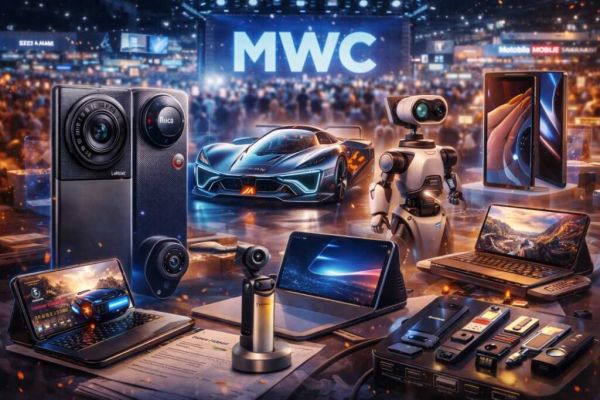
Barcelona’s Mobile World Congress has always been a place where the phone industry shows its next ideas to the public. This year the event felt slightly different. The devices were still there, of course, but the show floor also had dancing robots, camera-heavy phones that resemble professional equipment, and laptop concepts that look more like engineering experiments than finished products.
The gathering, held in Barcelona from March 2 to March 5, brought together phone makers, chip companies, and computer brands eager to show what they are building next. Phones still dominated the announcements, but laptops, tablets, and experimental devices shared nearly equal attention.
One theme ran through nearly every presentation: artificial intelligence. Companies repeatedly described new hardware as built around machine learning tasks that run locally on devices rather than entirely through cloud services. While many companies used the same language to describe these ideas, the hardware on display suggested that manufacturers are trying different ways to bring those features into everyday products.
Among the most talked-about devices was a new smartphone from Xiaomi. The Xiaomi 17 Ultra focuses heavily on photography, continuing the company’s effort to position its top model as a camera substitute. The phone includes a one-inch sensor for the main camera and a large telephoto system built around a 200-megapixel sensor.
The phone also includes a mechanical zoom ring placed around the camera module. The control is meant to mimic the feel of adjusting a lens on a traditional camera. Xiaomi partnered with Leica again for the imaging system, continuing a partnership that has appeared in several recent phones.
Alongside the smartphone, Xiaomi also revealed a Leica-branded device known as the Leitzphone. It carries many of the same technical specifications as the Xiaomi 17 Ultra but features a more retro look and additional camera interface options inspired by Leica’s photography style.
Xiaomi did not limit its announcements to phones. The company presented two tablets, the Pad 8 and Pad 8 Pro, each measuring under six millimeters thick. Both include large batteries and high-refresh-rate displays intended for gaming and media use.
In a more unusual move, Xiaomi also presented a concept hypercar created for the Vision Gran Turismo project. The car will appear in the Gran Turismo racing game rather than on public roads. It features a futuristic cockpit layout and aerodynamic bodywork that appears intended mainly as a design exercise.
While Xiaomi focused on imaging hardware, another company at the show took a different route. Honor drew attention with a smartphone that looks partly like a robot.
The device, referred to as the Robot Phone, includes a camera mounted on a small gimbal arm that extends from the rear of the phone. During demonstrations in Barcelona, the camera module moved like a tiny robotic head, turning to track objects or nodding in response to gestures.
Honor said the gimbal uses a stabilization system that allows the camera to follow motion while recording video. The company also said the system can track subjects automatically, keeping them centered in the frame.
The Robot Phone is not yet ready for sale, but Honor said it intends to release the device later this year. The company also displayed a humanoid robot during its presentation, which walked on stage and performed a brief choreographed dance.
Honor also introduced a new foldable smartphone known as the Magic V6. The device is notable for its thin design when opened and its use of a large battery that incorporates silicon materials in its construction.
The phone includes a Snapdragon processor, multiple high-resolution cameras, and a folding display that allows the device to operate both as a standard phone and a small tablet. While the concept of foldable phones is no longer new, manufacturers continue to compete on thickness and battery capacity.
Lenovo’s presence at the event was less about finished products and more about ideas. The company arrived with several concept devices meant to show how laptops and gaming hardware might change in the coming years.
One concept, called the Legion Go Fold, combines a handheld gaming console with a folding screen. The display expands to roughly eleven inches when fully opened but can fold down to a smaller size similar to a tablet.
The device also includes detachable controllers and accessories that allow it to function as a small laptop. In demonstrations, the console could be placed upright with a keyboard attached, turning it into a portable workstation.
Lenovo also displayed a concept laptop that uses removable ports. The system allows users to swap connectors such as USB-C, HDMI, or USB-A depending on the devices they want to connect.
Another experimental device from Lenovo included a small desktop robot intended to assist with office tasks. The robot can display images using a built-in projector and respond to simple voice instructions.
Motorola appeared at the show with a more traditional product announcement. The company shared new details about an upcoming foldable phone known as the Razr Fold.
The device includes a Snapdragon processor, a large battery, and memory configurations reaching 16 gigabytes of RAM. Motorola did not provide a release date but indicated that the phone will compete with other high-end foldables already on the market.
Several smaller companies used the event to show unusual hardware ideas. One example came from Tecno, which displayed a modular smartphone concept. The phone allows different attachments to connect magnetically, including additional camera modules, a battery pack, and gaming accessories.
Concept devices have long been a part of the Barcelona event. Many never reach store shelves, but manufacturers use them to test reactions and explore new hardware arrangements.
The show floor also reflected the growing overlap between computing categories. Phones now contain processors once reserved for laptops, while laptops increasingly rely on chips originally built for mobile devices.
Battery technology also appeared frequently in announcements. Several manufacturers highlighted silicon-based batteries that allow higher capacity in thinner devices. This development has become important as companies try to make foldable phones lighter while maintaining long usage times.