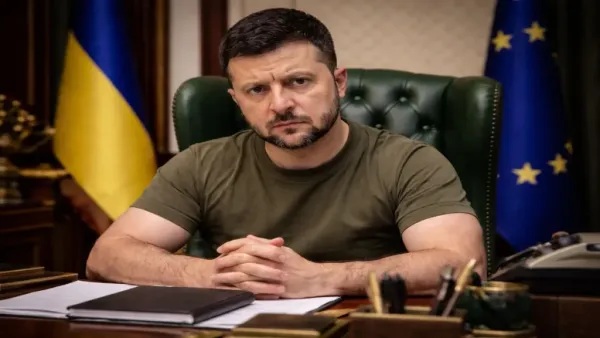
The current unrest in the international politics has shifted the war in Ukraine to a broader international scope, particularly following the increasing tensions in the Middle East. According to President Volodymyr Zelenskyy, a further escalation of US-Israel-Iran conflict might divert Western interest and armed forces to Ukraine. Although he packaged his concerns in a diplomatic manner, he brought out the underlying concern, which is based on the extent of political, military, and economic assistance of the United States and its allies in the war effort of Ukraine. This leads to the old question: has it turned into an independent national defense of Ukraine or is it now no longer isolated of Western support, especially the U.S.?
The war started intensifying in 2022 and Ukraine has been relying on foreign aid to resist the invasion of Russia. The Western governments have provided billions of dollars in military aid, advanced weapons, intelligence sharing and logistics. The US has played the most central role in supporting it by supplying air-defense systems, artillery, ammunition and training that influence the battlefield. The resilience of Ukraine is still high, and its war infrastructure is increasingly showing a wider Western strategic approach.
This fact was evident based on the recent statements by Zelenskyy. He cautioned in case the United States escalates its military presence in Iran, that Washington may turn to the Middle East and cut on the shipment of air-defense missiles and other significant outfits to Ukraine. Instead of lamenting the U.S. priorities, it was a very prudent and very clear statement: redirection of U.S. resources would exert instant pressure on Ukrainian defense resources.
This quote reveals a harsh reality of the contemporary war in a globalized world. When a nation is dependent on foreign assistance, the strategic uncertainty, besides the enemy, is also introduced by the changing priorities of the allies. The fact that Zelenskyy is concerned demonstrates that the calculations of the battlefields of Ukraine are currently tied to the decisions that are made in Washington partially. Provided that the U.S. missile arsenal is deployed more in the Middle East, the stock left to support the Eastern Europe will be lower, highlighting the interdependence of Ukraine defense on Western supply chains.
Another interesting feature of his remarks is the previous demand on 100 to 200 Tomahawk missiles. Such a request was not fulfilled, but as Zelenskyy himself mentions now, similar weapons are actively employed on the activities of Iran. This contrast shows how rapidly one can shift strategic priorities, as something that was requested previously will be ignored in favor of a new crisis that needs to be resolved.
These changes bring up more general concerns regarding the organization of war effort in Ukraine. It is quite natural that a country struggling to survive needs external assistance but the amount of aid provided by the West developed a system of reliance that influenced the requirements of the strategy. The dependence on this can be highlighted by concerns of Zelenskyy about shortages of either Patriot or THAAD batteries. These high-tech systems are mostly produced by the American manufacturers, and they are the foundation of the defense against missiles and drones in Ukraine. In case of changes in priorities in production or the redistribution of supplies elsewhere, Kyiv will have to change its defense planning.
Ukraine has developed its domestic defense sector, particularly in drones and battlefield technology, yet it is not in a position to manufacture all the advanced weaponry necessary in the modern warfare. Long range strike platforms and high end missile defense still depend on western allies. This imbalance poses a strategic issue: Ukraine has to increase domestic capacities, at the same time not to destroy political and diplomatic connections that ensure further Western assistance.
The place of international narratives can also be seen through the statements of Zelenskyy. Although Ukrainian leaders openly request additional weapons and American support, allegations that Russia is supporting Iran in countering Washington are often discussed in the Western media. The supposed Moscow and Tehran cooperation in intelligence about American actions in the Persian Gulf creates headlines and political discussion in the Western capitals, which influence the masses.
Conversely, the governments in the West have been overt and vocal in providing Ukraine with a large-scale military assistance over the years and toothed their horn in the domestic rhetoric. A careful pick of the news is evident when Russia is suspected to be collaborating with a different state in another conflict, it is usually presented in a way that is destabilizing or provocative. According to observers, international responses to military alliances may seem prejudiced; alliances and collaboration are natural instruments of states, but the manner in which they are served to the people may affect their judgments of legitimacy and accountability. The controversy about supposed Russian support of Iran explains how geopolitical narration can influence the perception of countries and wars on a global scale.
The other aspect of the remarks by Zelenskyy is the economic effects of war on the globe. He cautioned that the war with Iran would lead to a rise in oil prices and this could be favorable to Russia since it is a major oil exporter. Increase in the energy prices tends to boost the revenues of the countries where oil and gas are major exports. Zelenskyy proposed that the sanctions and trade restrictions should be properly managed by the international community to ensure that these processes do not contribute to strengthening the economic stance in Moscow.
There are a lot of other factors that affect energy markets other than one conflict. The very war in Ukraine replicated the flows of energy in the world, in terms of sanctions, disruptions in supply, and alterations in trade patterns. There has been an adaptation of strategies of importation in countries across the world that are looking to find alternative suppliers or new transportation paths. These changes reflect the interdependence of contemporary economic systems. The actions of conflicts in one area can affect the prices of commodities and shipping routes as well as the financial markets way beyond their local geographical location.
The issue of oil prices expressed by Zelenskyy thus points at the larger strategic picture that the war in Ukraine is being fought. It is no longer just a localized war between two neighboring states but now it is a part of a complicated system of geopolitics, where large powers, economic blocs, and evolving security agendas are involved. The decisions made in Washington, Brussels, Beijing or Tehran can all affect the course of the conflict in a way that is not dramatic but quite meaningful.
This international aspect simply transcends to discussions on the type of war that was fought. Proponents of Ukraine believe that the West help is a way of solidarity with a nation that is protecting its sovereignty and territorial integrity. However, critics occasionally term the war as a proxy war among the larger geopolitical blocks. The comments of Zelenskyy, especially his fear that the attention of the American population would be diverted in a different direction, serve to emphasize just how integrally the war effort of Ukraine is tied to the global processes.
It is also indicative of a larger trend in the contemporary warfare: the war is turning into a matter of networks of alliances and not on national capacity. Intelligence sharing, common technological participation, coordination of economies, and diplomatic pressures are some of the elements included in military activities today. There is no existent war that is independent of world politics. Even the conflicts which start as local struggles may soon be involved into international struggle over power.
In such a setting, smaller or medium-sized states usually rely on bigger allies to balance their strategies. It is not only Ukraine that is dependent on this. Since times immemorial, countries which are confronted with greater enemies have turned to the assistance of foreign allies. The difficulty is how to control that support without letting it take over the whole system of national defense policy. The comments by Zelenskyy imply that this is the challenge that Ukraine is now facing.
His words concerning training Ukrainian commanders in the event of shortages show that Kyiv also realizes the dangers of creating and moving to international priorities. Military planners should expect the situation, when they can hardly expect the external supplies, which are delayed or limited. This is one of the preparations of responsible wartime leadership. They also show how strongly the strategic calculations of Ukraine have their connection with the decisions made much further than Ukraine.
The changing situation in the world thus begs significant questions on the future course of the conflict. When the international attention is split among several crises, it will be harder to provide uniform assistance to Ukraine. The Western world politics might have an impact on the rate and magnitude of military assistance. Foreign policy is influenced by elections, economic pressures and even domestic priorities.
The most significant problem will be the strike between the exterior assistance and internal stamina in the case of Ukraine. Domestic manufacture of defense, enhancing economic stability and continued diplomatic interaction with numerous partners will continue to be crucial. Simultaneously, Western governments should put into consideration long-term consequences of their promises. It is psychologically and tactically tricky to withdraw after a nation is intensively engaged in backing a war effort.
In conclusion, the recent statements of Zelenskyy are an eye opener in to the contemporary geopolitics. They demonstrate the level of interdependence of conflicts that arose, the possibility of the destiny of one battlefield depending on the events that happened thousands of kilometers away. They also suggest the complicated interconnection between the state sovereignty and the international alliances in the contemporary warfare.
Ukraine is still engaged in a stubborn war against the Russian forces and its soldiers are the main participants in the battlefield. However, the larger systemic context of that struggle is determined by international politics, alliances, and competing interests of great powers. The fact that Zelenskyy is worried about the American focus on the Middle East thus is not merely a matter of diplomatic communication. They depict the complex nature of the dependencies and expectations upon which the conflict is currently characterized.
Ultimately, Ukraine can be viewed as a reminder that a war in the twenty-first century is not often a clash between a single country and other countries. They are developed in a system of global processes in which military support, economic measures, and political discourses overlap. The balance of attention and resources might change further as new crises appear and the priorities of nations become international. In the case of Ukraine, this issue will be to make sure that the changing nature of the world power politics does not overshadow its fight as it has become accustomed to through alliances.