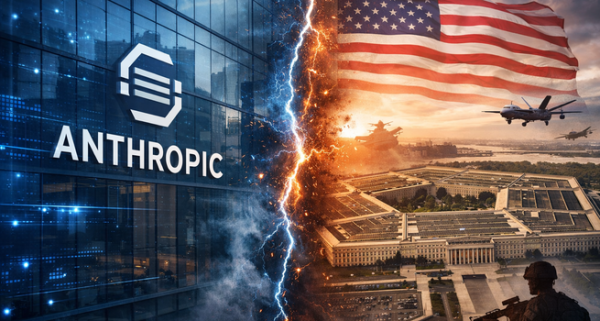
The U.S. Department of Defense has formally labeled the artificial intelligence startup Anthropic a supply-chain risk. The move follows a dispute over limits the company placed on how the military can use its Claude AI model. In a written statement released Thursday, the Pentagon said it had “officially informed Anthropic leadership the company and its products are deemed a supply chain risk, effective immediately.” The label marks a sharp step in a growing conflict between the defense establishment and one of the most prominent AI developers in the United States.
A supply-chain risk designation usually targets foreign companies linked to U.S. rivals. Officials apply it when they believe a vendor could disrupt critical technology or weaken national security. Applying the label to a domestic AI firm is rare and signals how tense the situation has become.
The decision could ripple through the federal contracting system. Many companies that sell technology to the government must follow strict security rules. If a supplier carries a supply-chain risk label, partners often have to stop using that firm’s products in federal work. In practice, the move could force contractors across the defense and intelligence sectors to cut ties with Anthropic.
Pentagon officials framed the issue as one of military authority. In its statement, the department said the armed forces must be able to use tools they purchase for any lawful mission. The statement argued that a private vendor should not control how the military deploys a key capability once it becomes part of government systems.
“From the very beginning, this has been about one fundamental principle,” the Pentagon said. “The military being able to use technology for all lawful purposes.” The statement added that the department would not allow a vendor to “insert itself into the chain of command” by restricting how the military operates.
The clash centers on policies set by Anthropic’s leadership. The company has long promoted strict safety rules for artificial intelligence systems. According to reporting by Bloomberg and POLITICO, Anthropic sought to limit certain military uses of Claude.
Those limits came to a head last week. Anthropic’s chief executive, Dario Amodei, told Defense Secretary Pete Hegseth that the company would not permit two specific uses of its technology. First, it would not allow the AI system to support surveillance of American citizens. Second, it would not allow the model to power autonomous weapons.
Anthropic has not issued a detailed response to the latest action. A spokesperson did not reply to requests for comment following the Pentagon’s announcement. Still, the company signaled earlier that it plans to challenge any supply-chain risk designation in court.
Legal experts expect a difficult fight. The federal government holds wide authority over procurement and national security decisions. Courts often give agencies broad discretion in those areas. Yet Anthropic may argue that the government is punishing the company for setting ethical limits on its technology.
The full scope of the Pentagon’s designation remains unclear. Earlier in the dispute, Hegseth warned that the government might require contractors to stop using Anthropic products altogether. If officials enforce such a rule, the decision could affect a large portion of the AI market tied to federal work.
Industry observers say the case could shape how AI companies deal with the national security community. Many startups now sell models or infrastructure to defense agencies. At the same time, several firms maintain policies that restrict certain military uses of their systems.
Joe Hoefer, head of AI policy at the Washington advocacy firm Monument Advocacy, said the dispute goes beyond one company. In his view, the episode sets a precedent for how the government may handle conflicts with AI developers.
“The real significance here isn’t just the action against Anthropic,” Hoefer said. “It’s the precedent it sets for how Washington will arbitrate tensions between AI developers and the national security community.”
The outcome could influence how the entire AI sector approaches federal partnerships. Companies may face a choice between strict safety limits and access to government contracts. The Pentagon’s decision shows that the balance between those goals remains unsettled.