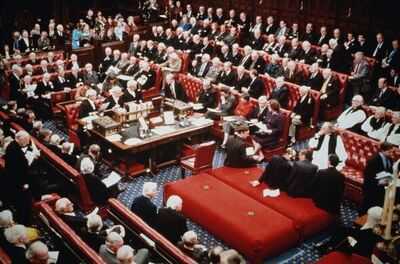
Labour has completed Tony Blair's unfinished revolution by expelling the final 92 hereditary peers from the House of Lords, ending hundreds of years of tradition. The Earl of Devon, whose family have served in Parliament for 900 years, delivered a heartbreaking farewell as he was forced out, complaining that he had received less notice than required underemployment law.
He said: "I think this House, Parliament, and the public more widely will miss us. I will miss this place and would of course love to return, but only on merit and not by dint of my hereditary privilege." The Earl added that hereditary peers should be "proud to sit here as embodiments of the hereditary principle dating back a millennium".
Lords Leader Baroness Smith said the "historic legislation" realised Labour's manifesto pledge to remove the right of all hereditary peers to sit and vote in the upper house.
She said: "This has never been about the contribution of individuals but the underlying principle that was agreed by Parliament over 25 years ago that no one should sit in our Parliament by way of an inherited title."
Baroness Smith added: "Over a quarter of a century later, hereditary peers remain, whilst meaningful reform has stagnated. We have a duty to find a way forward."
The move completes reforms begun by Tony Blair's government in 1999, when more than 650 hereditary peers were removed from the Lords.
Just 92 were allowed to stay as S appointed large numbers of Life Peers slammed at the time as "Tonys Cronys".
Now those final 92 - including Dukes, Viscounts and Earls - have been expelled, with the bill coming into effect at the end of this parliamentary session.
Tory leader in the Lords, Lord True, warned it was a "sad day to see so many dedicated parliamentarians being forced out".
Ensure our latest politics headlines always appear at the top of your Google Search by making us a Preferred Source. Click here to activate or add us as a Preferred Source in your Google search settings

He said: "My view is, and always has been, that the expulsion of sitting members from a sitting Parliament, who have done nothing wrong, is unreasonable and will provide a dangerous precedent for the future."
Lord True added: "Nevertheless, I am glad that an agreement has been reached that will allow some hard-working members of our front bench, members of committees and other experienced legislators to continue their valued and important work in this House on the same terms as everyone else."
The Government offered life peerages to some Conservatives and crossbenchers, meaning a handful of former hereditaries are likely to remain in the chamber.
As a result, the Conservatives withdrew their opposition to the Bill.