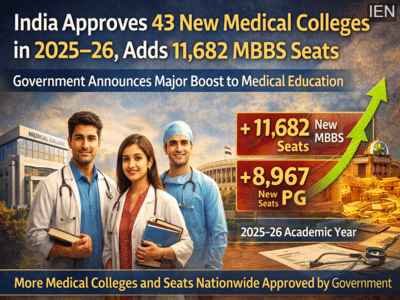
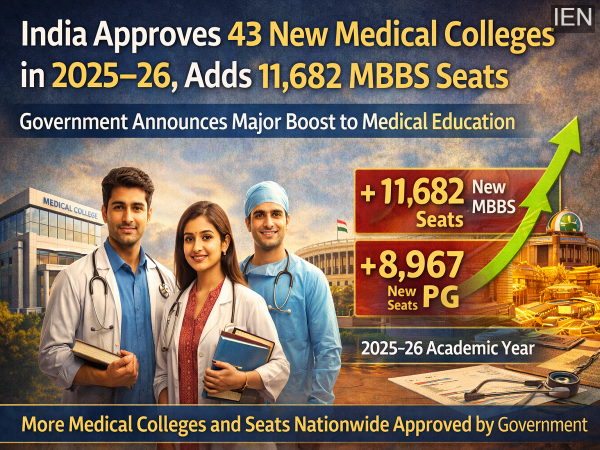
In a major boost to medical education in India, the central government has approved 43 new medical colleges for the academic year 2025–26. Along with this expansion, the country has also seen a significant increase in 11,682 MBBS seats and 8,967 postgraduate (PG) medical seats, according to information shared in the Rajya Sabha.
The details were provided by Union Minister of State for Health and Family Welfare Anupriya Patel in a written reply to a question in Parliament.
The move is expected to expand opportunities for students pursuing careers in medicine while strengthening the country’s healthcare infrastructure.
Government Expands Medical Education CapacityResponding to a query in the Rajya Sabha on March 10, Anupriya Patel said that 43 new medical colleges have been approved across India for the 2025–26 academic session.
Data from the National Medical Commission (NMC) shows that along with the new institutions, thousands of additional seats have been created in medical programs nationwide.
The approved seat expansion includes:
11,682 additional MBBS seats
8,967 new postgraduate (PG) medical seats
These numbers include seats across government medical colleges, private institutions, All India Institute of Medical Sciences (AIIMS), and other institutes of national importance.
NMC Reviews Applications for New CollegesAccording to the government, the National Medical Commission conducts an annual process to review applications from institutions seeking permission to open new medical colleges or increase the number of undergraduate and postgraduate seats.
Medical colleges across the country submit online applications to the NMC, which then evaluates them based on infrastructure, faculty availability, hospital facilities, and academic standards.
Only after detailed inspections and evaluations does the NMC issue:
Letter of Permission (LoP) for approved institutions, or
Letter of Disapproval (LoD) for institutions that fail to meet required standards.
The establishment and approval of new medical colleges follow several regulatory frameworks introduced by the NMC.
These include:
Medical Institutions (Establishment, Assessment and Rating) Regulations, 2023
Undergraduate Minimum Standard Requirements (UGMSR), 2023
Postgraduate Minimum Standard Requirements (PGMSR), 2023
These regulations ensure that newly approved institutions meet minimum infrastructure, faculty strength, hospital capacity, and academic standards before receiving permission to operate.
Focus on Increasing Number of DoctorsThe government has been working to expand medical education capacity in India to address the shortage of healthcare professionals.
According to the Health Ministry, increasing the number of medical colleges and seats will help produce more qualified doctors, which is crucial for improving healthcare services across the country.
The expansion is also expected to benefit students who often face intense competition due to limited MBBS seats in India.
Special Scheme for New Medical CollegesThe central government is also implementing a Centrally Sponsored Scheme (CSS) to establish new medical colleges linked to existing district or referral hospitals.
The scheme focuses particularly on:
Underdeveloped regions
Aspirational districts
Areas where no government or private medical college currently exists
Under this initiative, funding is shared between the central and state governments.
The funding pattern is:
90:10 ratio for North Eastern and special category states
60:40 ratio for other states
Under this centrally sponsored scheme, the government has already approved 157 new medical colleges in three phases.
The total approved cost of these projects is ₹41,332.41 crore.
According to Anupriya Patel, out of the central government’s share of ₹26,715.84 crore, about ₹23,246.10 crore has already been released.
Strengthening Healthcare and EducationThe expansion of medical colleges is expected to improve access to medical education while strengthening healthcare services across the country.
By increasing both MBBS and postgraduate seats, the government aims to build a larger pool of trained doctors, especially in regions that currently face shortages of medical professionals.
For aspiring medical students in India, the addition of new colleges and thousands of seats could significantly improve opportunities in the coming years.