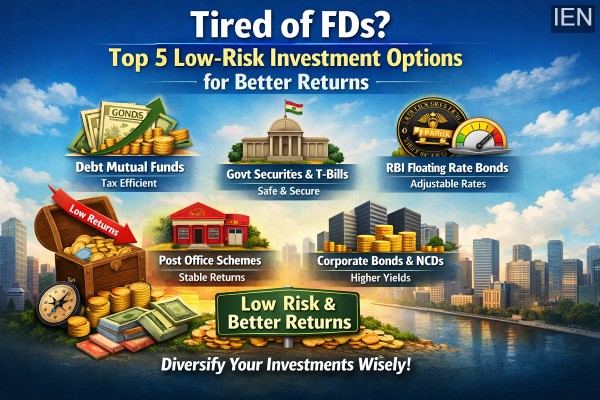
For years, Fixed Deposits (FDs) have been the go-to investment option for risk-averse investors in India. They offer capital safety and predictable returns, making them a popular choice. However, with changing interest rates and evolving tax rules, FDs are no longer the most efficient way to grow your money—especially in higher tax brackets.
If you are looking for safer alternatives that can potentially offer better or comparable returns, here are five low-risk investment options worth considering.
While FDs provide stability, their post-tax returns often fall short, particularly when inflation is taken into account. Interest earned on FDs is fully taxable, which reduces overall gains.
This has led many investors to explore alternatives that balance safety, returns, and tax efficiency.
Debt mutual funds invest in bonds, treasury bills, and other money market instruments. Unlike FDs, their returns are market-linked, so they are not guaranteed—but they can offer better tax efficiency.
Potentially higher post-tax returns
Suitable for short to medium-term goals
More flexible than traditional deposits
These funds are especially useful for investors in higher tax brackets.
Treasury Bills (T-Bills) and G-Secs are issued by the Government of India, making them one of the safest investment options available.
Extremely low default risk
Fixed returns if held till maturity
Available for different tenures
However, prices may fluctuate if sold before maturity.
These bonds offer interest rates that adjust periodically based on market conditions. This helps investors benefit when interest rates rise.
Government-backed security
Regular income
Protection against rate fluctuations
Lock-in period applies
Limited liquidity
Post Office schemes are known for their reliability and consistent returns. Popular options include:
Senior Citizen Savings Scheme (SCSS)
Monthly Income Scheme (MIS)
Public Provident Fund (PPF)
National Savings Certificate (NSC)
Around 4% to 8.2% depending on the scheme
These schemes are ideal for conservative investors looking for steady income and government-backed safety.
Highly rated corporate bonds and Non-Convertible Debentures (NCDs) can offer better interest rates than FDs.
Higher yield potential
Fixed income structure
Credit risk involved
Requires careful selection of issuer
Investors should always check the credit rating before investing.
Selecting the best investment depends on your financial goals, risk tolerance, and tax situation. Here’s a quick guide:
For maximum safety: G-Secs, Post Office schemes
For tax efficiency: Debt mutual funds
For higher returns: Corporate bonds/NCDs
For rising interest rates: RBI floating rate bonds
Fixed Deposits are still a safe option, but relying only on them may limit your financial growth. Diversifying into other low-risk instruments can help you earn better returns while maintaining stability.
Before investing, always evaluate your financial goals and consult a financial advisor if needed. A smart mix of options can help you beat inflation and build long-term wealth more effectively.
Don’t put all your money in one place—diversification is the key to balancing risk and returns.