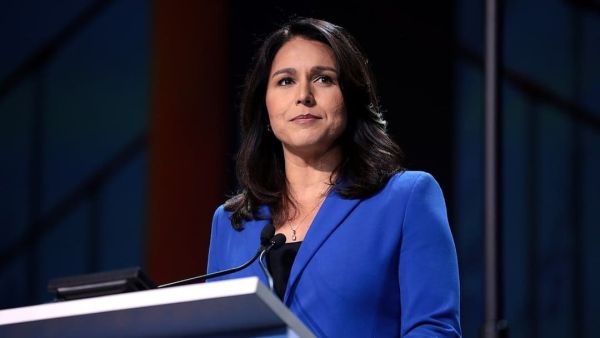
Nearly three weeks into the Iran war, officials from the Trump administration testified before the Senate Intelligence Committee on Wednesday, with key remarks from Director of National Intelligence Tulsi Gabbard drawing attention after she sidestepped several questions on the rationale behind the conflict.
The hearing followed the resignation of National Counterterrorism Center Director Joe Kent, who stepped down over the war, claiming Tehran posed no imminent threat to the United States and that the conflict was initiated due to pressure from Israel.
During last year’s 12-day conflict between Iran and Israel, the US launched “Operation Midnight Hammer,” targeting three nuclear facilities in Iran.
Since then, US President Donald Trump has repeatedly claimed that Washington had “obliterated” Iran’s nuclear programme. The claim has been reiterated by administration officials even during ongoing negotiations with Tehran.
However, questions persist over the nature of the threat posed by Iran if its nuclear capabilities had indeed been dismantled.
In his State of the Union address, Trump said Iran was attempting to rebuild its programme, while White House envoy Steve Witkoff claimed Tehran was “a week away from having industrial-grade bomb-making material.”
Yet, during Wednesday’s hearing, Gabbard contradicted these assertions.
“As a result of Operation Midnight Hammer (in June), Iran’s nuclear enrichment program was obliterated. There has been no efforts since then to try to rebuild their enrichment capability,” she said.
She further stated that the intelligence community’s assessment had not changed, indicating that Iran had made no attempt to restart its programme.
The question of whether Iran posed an imminent threat to the US remains unresolved.
Joe Kent, in his resignation letter, maintained that Iran posed no threat and that the war was driven by external pressure.
Meanwhile, the Trump administration has continued to justify its actions by citing an “imminent threat.”
During her testimony, Gabbard declined to define what constituted such a threat, stating that it was the President’s prerogative.
“It is not the intelligence community's responsibility to determine what is and is not an imminent threat,” she said.
Her remarks drew a sharp response from Senator Jon Ossoff, who argued that assessing threats falls squarely within the intelligence community’s mandate.
Trump had also claimed in his State of the Union address that Iran was developing an intercontinental ballistic missile capable of reaching the United States.
However, Gabbard’s testimony contradicted this as well, reiterating that intelligence assessments had not changed and that no such developments had been identified.
The US President also expressed surprise at Iran’s retaliation following American strikes.
"They weren't supposed to go after all these other countries in the Middle East. Those missiles were sent to go after them. They hit Qatar, Saudi Arabia, UAE, Bahrain, Kuwait. Nobody expected that. We were shocked. You know, they fought back," Trump said.
However, reports citing US officials indicated that such retaliation had been anticipated prior to the strikes. The possibility of Iran targeting US bases in the Gulf and even closing the Strait of Hormuz had reportedly been assessed.
White House Press Secretary Karoline Leavitt stated that Trump had been “fully briefed” on the possibility of Iran shutting the Strait, adding that the Pentagon has planned for such a scenario “for DECADES.”
Iran, for its part, had repeatedly warned that any escalation or attack would be treated as an act of war.