On a patch of rubble in Abu Dhabi, where little once stood, a quiet sanctuary now offers something rare: a second chance — not just for injured horses, but for the people who care for them. For 33-year-old Russian expat Olga Kulikova, the journey began in 2017 with a single, life-altering encounter. “I met a horse who would forever change my life. His name is Noble.”
At the time, Kulikova was not an equestrian. Despite growing up in the UAE, where horses are deeply woven into the culture, her experience was limited to a single childhood ride. She had studied architecture in the United States and described herself as someone who loved animals — but from a distance. What she did have, she says, was a life that felt like it was “unravelling”. That changed the day she walked into a slaughterhouse in Sharjah with her mother.
Moment that changed everythingAmong goats, sheep and a cow stood a horse — injured, scarred and visibly terrified. “It was a moment I will never forget,” she recalled. “I didn’t think logically… I just knew I couldn't leave him there.” She bought him on the spot, despite having no experience, no stable, and no plan. “There was something in his eyes; it felt like he was asking for help without having a voice."
Stay up to date with the latest news. Follow KT on WhatsApp Channels.
Like many horses in the region, Noble had likely been discarded after becoming “no longer useful” due to injury or behavioural issues — a reality Kulikova says is more common than people realise. What followed was a journey defined not by expertise, but by persistence.
"Day after day, I showed up for him, not knowing what I was doing, just acting out of love.” She began spending hours walking, grooming and simply sitting with him, slowly building trust. At the same time, she immersed herself in learning, taking courses in equine nutrition, biomechanics and sport horse rehabilitation.
Healing that went both waysCaring for Noble did more than save the horse, it reshaped Kulikova’s life. “At that time, I was emotionally struggling, and my life felt like it was falling apart. What Noble gave me was not just distraction, it was purpose.” The daily routine demanded consistency and presence. Over time, she says, it helped her rebuild emotionally. “Horses are incredibly sensitive — they reflect your inner state. If I was anxious, he would react. If I was calm, he would soften. So I had to learn to regulate myself.”
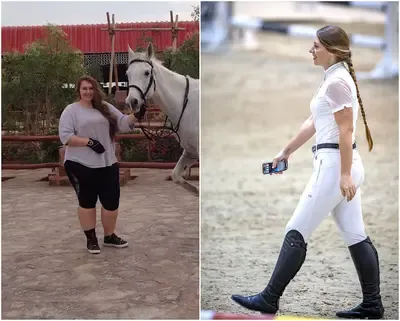
The physical transformation came almost unnoticed. “I became active without forcing it... and that naturally led to losing over 50 kilogrammes.” What began as an act of compassion evolved into something far greater. Kulikova went on to become a professional international show jumper and event rider — a path she says once felt unimaginable. “When I was obese, I could never have imagined that one day I would become a professional show jumper.”
Olga's weight transformation
A turning point marked by traumaAs her bond with Noble deepened, so did the challenges. In 2019, while keeping four rescue horses at a stable in Abu Dhabi, Kulikova says she faced criticism and hostility from others who did not understand her work. “Some believed I was wasting money on horses that had no 'value'.
The situation escalated into what she describes as the most traumatic experience of her life. Noble was stabbed and left severely injured. “He spent two months in the hospital. There were moments when we didn’t know if he would be able to move normally again.”
Today, Noble has survived, but not without scars. “He carries both physical and emotional scars, but he is strong, and our bond is deeper than ever,” she said. "We survived something together." The incident became a defining moment. “It made me realise that if I truly want to protect my horses, I cannot depend on others... I built the stable for Noble.”
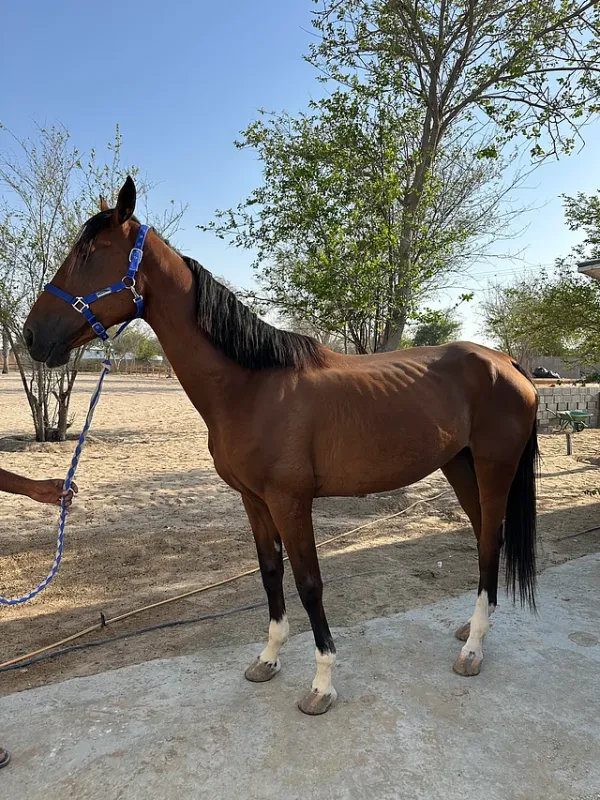
One of Olga's rescues
Building a sanctuary from scratchWith no formal business plan or external funding, Kulikova set out to create her own space — one she could control entirely. “Every dirham I earned went straight into building and maintaining the space.” Together with just two farm workers, she built the facility herself, from over a kilometre of fencing to concrete stables, learning through research, trial and error. “There were challenges with suppliers, incomplete works, and even situations where I was taken advantage of being a young woman,” she explained.
Despite the setbacks, the project grew into what she describes as Abu Dhabi’s first track-system stable — a setup designed to allow horses freedom of movement and social interaction, supporting both physical and behavioural rehabilitation.
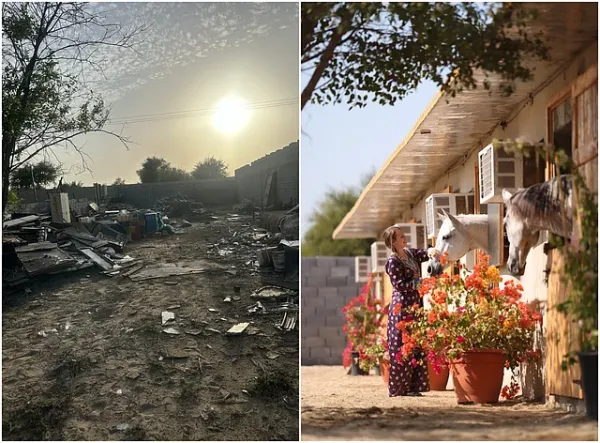
Stable before and after
More than a stableWhat started as a personal mission soon evolved into something broader. “This year, I built a ladies-only horse stable — a sanctuary designed not only for the rehabilitation of horses but also as a safe haven for women… facing depression, loneliness, or emotional struggles.”
The concept is intentionally informal. “When women come here, it’s not a formal ‘therapy session’. It’s something much more natural.” Visitors spend time grooming, walking and simply being around the horses. Over time, Kulikova says, a sense of community forms. “The women who come here don’t just visit — they become part of a close, supportive circle.” Many form bonds with specific horses, creating a sense of connection and responsibility. “That feeling of being needed, of being seen, can be incredibly healing.”
A community taking shapeFor Maryjane Nolan, a university lecturer who moved to Abu Dhabi several years ago, the sanctuary offered exactly that. “I was feeling a bit sad and nervous about all the changes that come from a move.”
She discovered Kulikova’s initiative within her first week in the capital while searching for something positive to do. “Ever since, I’ve been visiting her regularly for riding, spending time with the horses, hand walking, grooming.”
What stood out to her was the environment Kulikova had created. “Olga’s horses are very well-cared for, healthy, and well-trained. They have space to be outdoors and just be horses,” she said. “Noble is her pride and joy.”
Looking aheadToday, the sanctuary operates largely on a flexible, community-based model. Many interactions, particularly groundwork with the horses, are offered free of charge, with plans to introduce a membership structure to sustain the space while keeping it accessible.
Activities range from grooming and basic horse care to light riding, weekly gatherings and desert or beach rides. “It’s less about structured programs and more about meaningful connection,” Kulikova explained.
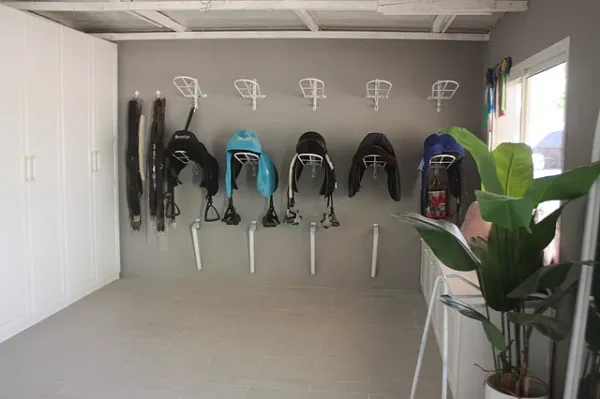
Still, challenges remain. Financial sustainability, scaling the project, and even basic infrastructure, such as electricity needed to manage the UAE’s summer heat, continue to pose difficulties. The sanctuary itself generates no income. Kulikova supports it through freelance architecture work and her own animal transport business.
Yet her vision remains clear: to expand the space into a centre that combines equine rehabilitation with structured women’s wellness programmes. “If there’s one message I hope to leave behind, it’s this: kindness has the power to transform lives.” For Kulikova, that transformation began with a single act — choosing not to walk away from a wounded horse. “Sometimes, saving someone… becomes the very act that saves you.”
Healing with horses: Inside Dubai's new wellness trend Dubai Police's horse riding therapy helps 765 individuals, children of determination UAE: Abused, abandoned horses, donkeys find refuge at RAK shelter built amid mountains