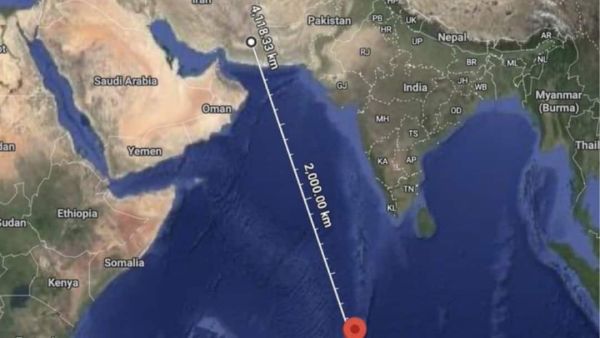
Iran launched two intermediate-range ballistic missiles targeting the strategically important Diego Garcia, a joint U.S.-U.K. military base in the Indian Ocean, in what marks a significant escalation, The Wall Street Journal reported citing US officials.
According to the report, neither missile struck the base. One reportedly malfunctioned mid-flight, while the other was engaged by a US warship using an SM-3 interceptor, though it remains unclear whether the interception was successful.
US officials told The Wall Street Journal that the strike represents Iran’s first known operational deployment of intermediate-range ballistic missiles (IRBMs), signalling an ability to project power far beyond the Middle East and directly threaten US assets.
The targeting of Diego Garcia, located roughly 4,000 kilometres from Iran, suggests Tehran’s missile capabilities may extend further than it has publicly acknowledged.
Iranian Foreign Minister Abbas Araghchi had previously stated that the country had voluntarily capped its missile range at 2,000 kilometres.
However, independent assessments differ. The Wisconsin Project on Nuclear Arms Control, through its Iran Watch program, estimates that Iran possesses missiles capable of reaching up to 4,000 kilometres.
Meanwhile, Israel's Alma Research and Education Center has placed the upper limit closer to 3,000 kilometres, while noting ongoing development efforts for longer-range systems.
Situated on a remote island in the British Indian Ocean Territory, Diego Garcia serves as a critical military hub for the United States. The base hosts long-range bombers, nuclear-powered submarines, and guided-missile destroyers, making it a key asset for projecting power across Asia and the Middle East.
The development comes amid ongoing discussions between the United Kingdom and Mauritius over the future of the Chagos Islands, including Diego Garcia. The talks involve a potential transfer of sovereignty to Mauritius while maintaining a long-term lease for continued US-UK military use.
US President Donald Trump and several Republican lawmakers have expressed opposition to the proposal, citing strategic and security concerns.