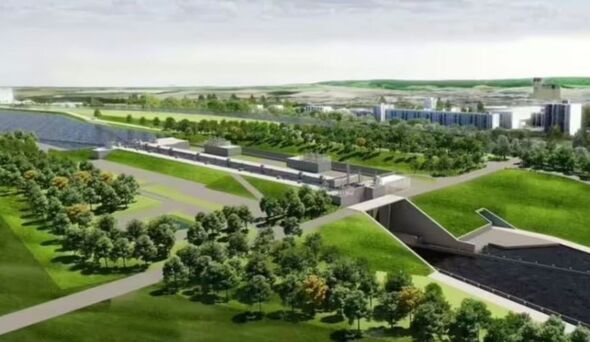
A major new development could see huge changes for Europe. The £3.7 billion canal could connect three of Europe's economies in a game-changing move. The Seine-Nord Europe Canal is a wide-gauge canal, and it's the first new French waterway built in over five decades.
A central link in the Seine-Escaut river link, it will cross Hauts-de-France and allow large barges to travel efficiently between France, Belgium and the Netherlands. The canal will have similarities to the Suez Canal, a sea-level waterway running north-south across the Isthmus of Suez in Egypt, connecting the Mediterranean and the Red Seas. The Suez Canal is one of the busiest shipping lanes.
The Seine-Nord Europe Canal in France will accommodate large barges, increasing capacity from 650 to 4,400 tonnes, enabling the efficient transportation of goods.
On completion, which should be around 2030, the 107km (66-mile) route will connect the Oise River to the Dunkirk-Escaut Canal.
It will allow trade barges to bypass the bottleneck of the Canal du Nord, making it quicker and easier to transport goods by water.
It will also help to reduce road traffic in France by approximately one million heavy goods vehicles per year.
There will be 62 road and rail crossings, as well as three canal bridges. It will also have seven locks, including a junction lock with the Canal du Nord.
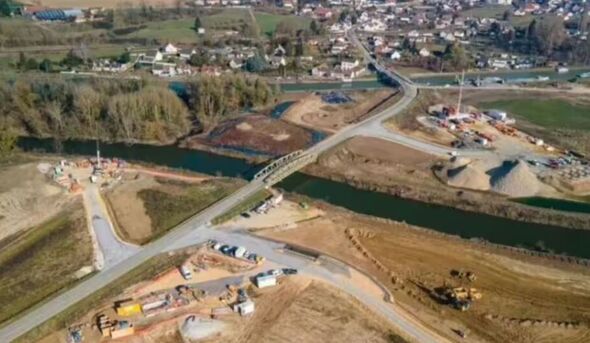
But not only this, there will also be 1,200 hectares of planting and environmental improvements. However, despite what it offers, the plans have faced criticism.
France's own version of Extinction Rebellion has criticised the project, denouncing it as putting economic growth over "ecological purpose."
Other climate activists have also cast doubt over whether the canal will significantly reduce CO2 emissions as the canal executives claim.
Despite the canal's stop-start history, the Société du Canal Seine-Nord Europe is confident its construction timeline can be met and the canal will become operational in 2030.