


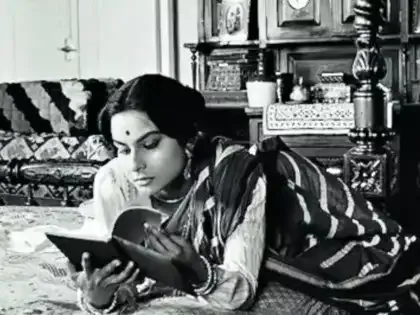
SHE'S A PAGE-TURNER
If we really want to encourage the reading habit, let's start with a truth: there's nothing called reading 'for leisure'. Everything requires effort. After AI began writing, everyone has been discussing reading. 'Indians don't read for leisure, so why do they have so many lit fests?' went one article in a British paper. 'Why are we discussing reading like never before?' an Indian daily expressed.
It's because AI can write for you, but it can't read for you.
So, the reader has become more important than the writer in the reader-writer relationship. It's not so much what you say as what it takes for the reader to 'stay' with you that has made reading gain more than a few notches in the reading-writing hierarchy.
Reading - what to read/not to read - or, even more precisely, the reading habit that makes this knowledge possible, is the new value. The growing consensus is that if you know what to read, you will survive the digital age.
Conversations on fear around AI writing assumes that the writer is central to culture. But culture has always depended just as much on the reader - the person who interprets, questions, and judges, reads the writing on the paper or electronic 'wall'. AI cannot perform this act. It cannot decide significance.
But to encourage the reading habit among digital generations, the language we use is misleading. You can't, for example, tell people to 'read everything'. There is simply too much clickbait stuff out there. Then, we say 'read for leisure'- which may not be the way to sell the habit in an era of a leisure-activity explosion.
Reading is way down the list for leisure and entertainment. Let's be honest. It's never 100% leisure. This is especially true when you pick up a book by an unfamiliar author. I remember reading the opening pages of Arundhati Roy's The God of Small Things and feeling bored into the first 20 pages. I nearly gave up. But didn't. And that persistence paid off. Gradually, it drew me in, until it became unputdownable.
Reading is, among other things, about delayed gratification. Often, it's about discipline. Even if you don't agree with the writer, you persist. When we tell a new reader that reading is leisure, we unintentionally set them up to fail, because the early stages feel like the opposite of any pleasurable act.
At the height of the rivalry between Salman Rushdie and VS Naipaul, the latter was once asked if he had read Rushdie's latest. Notoriously grumpy, he said, 'I'm not a reader. I'm a writer' - his longest remark of the evening. Of course, Naipaul was a reader, because you can't write unless you read. But even the most seasoned reader and writer will not say they find reading or writing easy.
Calling reading a leisurely activity is pretentious. It's as true to say that people read at bedtime to get sleepy rather than to relax. Words matter more than ever, and seduction is not ethical when you are selling the idea of reading books. If we promise pleasure, we must also not hide the effort required to garner that pleasure.
So many young people conclude that they are not readers. Often, what they mean is that they waited for the book to entertain them in the first 10 minutes. Which a book rarely does. It does something stranger. It changes the speed of the mind. It trains patience. It produces a pleasure that is quieter and harder to recognise at first encounter.
The modern difficulty with books is not distraction, but a cultural shift in what we think pleasure should feel like. Almost everything we now consume is designed for immediacy. Effort has become a sign that something is poorly made. Books violate this expectation. They ask for time that cannot be accelerated. You cannot skim your way to immersion. Nor can you outsource concentration.
The decline of reading may not come from the difficulty of books, but from the modern belief that pleasure must be effortless. A book requires the reader to stay long enough for meaning to form. In a world where machines can write endlessly, reading - not writing - may become the last demanding human skill.
It's because AI can write for you, but it can't read for you.
So, the reader has become more important than the writer in the reader-writer relationship. It's not so much what you say as what it takes for the reader to 'stay' with you that has made reading gain more than a few notches in the reading-writing hierarchy.
Reading - what to read/not to read - or, even more precisely, the reading habit that makes this knowledge possible, is the new value. The growing consensus is that if you know what to read, you will survive the digital age.
Conversations on fear around AI writing assumes that the writer is central to culture. But culture has always depended just as much on the reader - the person who interprets, questions, and judges, reads the writing on the paper or electronic 'wall'. AI cannot perform this act. It cannot decide significance.
But to encourage the reading habit among digital generations, the language we use is misleading. You can't, for example, tell people to 'read everything'. There is simply too much clickbait stuff out there. Then, we say 'read for leisure'- which may not be the way to sell the habit in an era of a leisure-activity explosion.
Reading is way down the list for leisure and entertainment. Let's be honest. It's never 100% leisure. This is especially true when you pick up a book by an unfamiliar author. I remember reading the opening pages of Arundhati Roy's The God of Small Things and feeling bored into the first 20 pages. I nearly gave up. But didn't. And that persistence paid off. Gradually, it drew me in, until it became unputdownable.
Reading is, among other things, about delayed gratification. Often, it's about discipline. Even if you don't agree with the writer, you persist. When we tell a new reader that reading is leisure, we unintentionally set them up to fail, because the early stages feel like the opposite of any pleasurable act.
At the height of the rivalry between Salman Rushdie and VS Naipaul, the latter was once asked if he had read Rushdie's latest. Notoriously grumpy, he said, 'I'm not a reader. I'm a writer' - his longest remark of the evening. Of course, Naipaul was a reader, because you can't write unless you read. But even the most seasoned reader and writer will not say they find reading or writing easy.
Calling reading a leisurely activity is pretentious. It's as true to say that people read at bedtime to get sleepy rather than to relax. Words matter more than ever, and seduction is not ethical when you are selling the idea of reading books. If we promise pleasure, we must also not hide the effort required to garner that pleasure.
So many young people conclude that they are not readers. Often, what they mean is that they waited for the book to entertain them in the first 10 minutes. Which a book rarely does. It does something stranger. It changes the speed of the mind. It trains patience. It produces a pleasure that is quieter and harder to recognise at first encounter.
The modern difficulty with books is not distraction, but a cultural shift in what we think pleasure should feel like. Almost everything we now consume is designed for immediacy. Effort has become a sign that something is poorly made. Books violate this expectation. They ask for time that cannot be accelerated. You cannot skim your way to immersion. Nor can you outsource concentration.
The decline of reading may not come from the difficulty of books, but from the modern belief that pleasure must be effortless. A book requires the reader to stay long enough for meaning to form. In a world where machines can write endlessly, reading - not writing - may become the last demanding human skill.
(Disclaimer: The opinions expressed in this column are that of the writer. The facts and opinions expressed here do not reflect the views of www.economictimes.com.)




Kanika Gahlaut
Journalist, author and artist