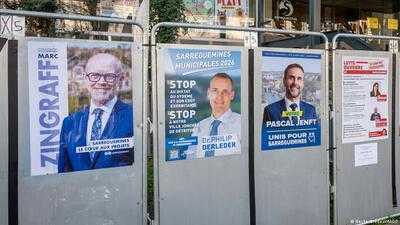
France's far-right National Rally did not do as well as it hoped in recent local elections. But, experts say, mainstream parties can't afford to relax ahead of the 2027 presidential elections.After the first round of the French municipal elections in mid-March, the leader of France's far-right National Rally (RN), Jordan Bardella, spoke of an "historic victory" that would serve as a springboard for the 2027 presidential election. But the results of the second round of local elections, held on Sunday, have put a damper on that. Contrary to what the far-right party's strong results in earlier elections suggested, the RN was not able to secure any kind of major victory. That is even though, according to many polls, it is still in the lead to win next year's presidential election, regardless of whether Bardella runs or whether controversial former party leader Marine Le Pen does. The daughter of Jean-Marie Le Pen, who founded the party under its previous name Front National, has been barred from running for public office for five years after being found guilty of corruption. In July, an appeals court is set to rule whether that verdict stands. In France's local elections, voters in nearly 35,000 villages, towns and cities across the country chose representatives on party lists. To win a mayoral seat, a list must win an absolute majority. This was the case in most constituencies but runoff elections had to be held in about 1,500 municipalities. Candidates on lists that had won at least 10% of the votes were allowed to compete again. 'String of disasters for the RN' The RN will take control over dozens of municipalities but it did not do as well as it had hoped. "The second round was a true string of disasters for the party, particularly in areas that seemed within reach and were considered trophies, such as Marseille, Toulon and Nimes," said Luc Rouban, research director at the Center for Political Research at the Paris university, Sciences Po. The so-called "republican front," a coalition formed during an election by multiple political parties to oppose the far-right RN was "still functioning to a certain extent," he added. According to Anne-Charlene Bezzina, a constitutional law expert and lecturer at the University of Rouen in Normandy, the results reflect a return to familiar territory. "The long-established parties, the conservative Republicans [LR] and the Socialist Party [PS], are firmly anchored in their local communities," she told DW, adding that the local elections often focused on local issues. However this doesn't mean these parties can afford to relax ahead of next year's elections, Bezzina warned. "For one thing, the extent to which the results of local elections can be applied at national level is limited. For another, support for traditional parties is crumbling in rural areas." She also cited the 57% turnout, a record low since 1958 apart from the 2020 election, which took place during the COVID-19 pandemic. Left wing's strategy does not pay off France Unbowed (LFI), the left-wing party that had set out to prove that it should provide the candidate for a united left against the RN in the 2027 presidential elections, did not do as well as hoped either. Pierre Allorant, a professor of legal history at the University of Orleans, told DW that LFI's strategy had not paid off, which doesn't bode well for a bigger left-wing alliance. "Almost every time the PS and the Greens formed an alliance with LFI out of panic, after the first round, they lost," he pointed out. However the socialist PS did manage to prevail in areas where there was no explicit pact with LFI, such as in the French capital Paris. The poor reputation of LFI party leader Jean-Luc Melenchon was a clear liability, Allorant said. said. Melenchon recently caused a stir with remarks widely perceived to be antisemitic. According to some polls, some voters believe the party to be even more anti-democratic than the RN. Given the fragmentation of the party landscape in France, Allorant said that the RN had come actually across as the "only coherent bloc" at the moment. "It's hard to see which strong candidate the other political movements will be able to rally around ahead of 2027," he said. Current French President Emmanuel Macron is not allowed to run for a third consecutive term. "The RN is the only party that is steadily gaining momentum," Bezzina from the University of Rouen agrees. "Even if this is happening more slowly than expected." But for Rouban, the municipal elections didn't actually spell good news for the far-right party. "The RN wanted to position itself at the head of a right-wing alliance with the Republicans, but this alliance was rejected by the Republicans." Instead the latter managed to beat left-wing parties in cities such as Toulouse and Clermont-Ferrand by aligning themselves with France's center-right parties, such as Horizons and the Democratic Movement, or MoDem. "LR has taken the lead in the center and the center-right political spectrum," Rouban said. This has given a boost to a former French prime minister, Edouard Philippe, the founder of Horizons, who was re-elected as mayor of Le Havre. Philippe has already announced his intention to run in the next presidential election and is considered one of the favorites. This article was originally published in German.