
Listen to this article in summarized format
Loading...
××
Subscribe to

Unlock AI Briefing and Premium Content
New Year Offer 24 Hours Left
Subscribe NowAlready a member? Sign In
What's Included
- Exclusive Stories
- Daily ePaper Access
- Smart Market Tools
- Curated Investment Ideas
- Ad-lite Experience
Subscription

New Delhi: Fast moving consumer goods companies are back to the drawing board as executives look to either reduce grammage in packs or increase prices, as international crude oil prices breached the $100 per barrel mark on Monday amid the escalating US-Israel war on Iran.
The development could reverse the sweeping benefits that followed Goods & Services Tax (GST) cuts which had begun to show a couple of months back, with companies raising concerns over global supply disruptions and heightening inflationary pressures again.
ALSO READ: Mideast war: Govt alert over crude oil situation, says EAM Jaishankar; reiterates need for 'dialogue & diplomacy'
At the same time, executives at packaging companies said they have started to source polymers (which dominate FMCG packaging and are derived directly from crude oil) from suppliers other than the Gulf region-such as China, Thailand and Singapore.
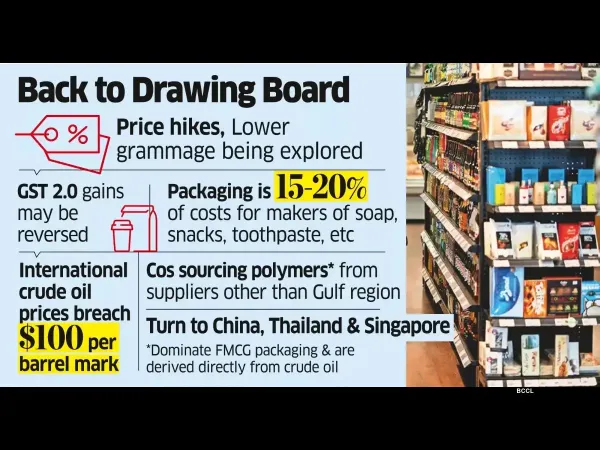
"Packaging alone accounts for 15-20% of our costs. Reducing grammage in small packs and increasing prices of bigger packs are options we are considering if oil prices remain at current levels," said Mayank Shah, vice president of biscuits and confectionery maker Parle Products.
Crude oil derivatives such as polypropylene and polyethylene films are extensively used in packaging of foods, sachets and plastic caps. In addition, Linear Alkyl Benzene (LAB), also a crude derivative, is used in manufacturing detergents and cleaning products, with LAB accounting for at least half of raw material costs in detergents.
Read more: Kharg Island: The oil island in Gulf at the centre of Trump’s Iran war calculations
Executives across the packaging industry said price hikes are inevitable, with supply shortages looming.
"From the last three-four days, the industry has started to source polymers (which dominate FMCG packaging and are derived directly from crude oil) from suppliers other than the Gulf region - such as China, Thailand and Singapore. Before the current crisis, imports of polymers were sourced more or less evenly between the Gulf region and South East Asian countries," said Vimal Kedia, founder and promoter of rigid plastic packaging giant Manjushree Technopack, which divested its operations to Asia-focused private equity fund PAG early last year. "The entire logistics of packaging imports has been disrupted as refineries in the Gulf countries have shut down."
"We will need to do weight reduction in snacks packs, because the impact of disruptions of crude is expected to be long-term. Even if there are alternatives to crude supplies, prices are soaring as demand-supply dynamics have kicked in," said a senior executive at a prominent packaged foods maker.
Companies making soaps, snacks, coffee, noodles, shampoo and other daily essentials had put grammage back in packs after the GST rate cuts last September.
The development could reverse the sweeping benefits that followed Goods & Services Tax (GST) cuts which had begun to show a couple of months back, with companies raising concerns over global supply disruptions and heightening inflationary pressures again.
ALSO READ: Mideast war: Govt alert over crude oil situation, says EAM Jaishankar; reiterates need for 'dialogue & diplomacy'
At the same time, executives at packaging companies said they have started to source polymers (which dominate FMCG packaging and are derived directly from crude oil) from suppliers other than the Gulf region-such as China, Thailand and Singapore.
GST cut benefits negated, concerns rise over global supply disruptions and inflation
"Packaging alone accounts for 15-20% of our costs. Reducing grammage in small packs and increasing prices of bigger packs are options we are considering if oil prices remain at current levels," said Mayank Shah, vice president of biscuits and confectionery maker Parle Products.
Crude oil derivatives such as polypropylene and polyethylene films are extensively used in packaging of foods, sachets and plastic caps. In addition, Linear Alkyl Benzene (LAB), also a crude derivative, is used in manufacturing detergents and cleaning products, with LAB accounting for at least half of raw material costs in detergents.
Read more: Kharg Island: The oil island in Gulf at the centre of Trump’s Iran war calculations
Executives across the packaging industry said price hikes are inevitable, with supply shortages looming.
"From the last three-four days, the industry has started to source polymers (which dominate FMCG packaging and are derived directly from crude oil) from suppliers other than the Gulf region - such as China, Thailand and Singapore. Before the current crisis, imports of polymers were sourced more or less evenly between the Gulf region and South East Asian countries," said Vimal Kedia, founder and promoter of rigid plastic packaging giant Manjushree Technopack, which divested its operations to Asia-focused private equity fund PAG early last year. "The entire logistics of packaging imports has been disrupted as refineries in the Gulf countries have shut down."
"We will need to do weight reduction in snacks packs, because the impact of disruptions of crude is expected to be long-term. Even if there are alternatives to crude supplies, prices are soaring as demand-supply dynamics have kicked in," said a senior executive at a prominent packaged foods maker.
Companies making soaps, snacks, coffee, noodles, shampoo and other daily essentials had put grammage back in packs after the GST rate cuts last September.
The country’s most definitive MSME stage returns on March 24 in New Delhi. Register now for the ET MSME Awards 2025