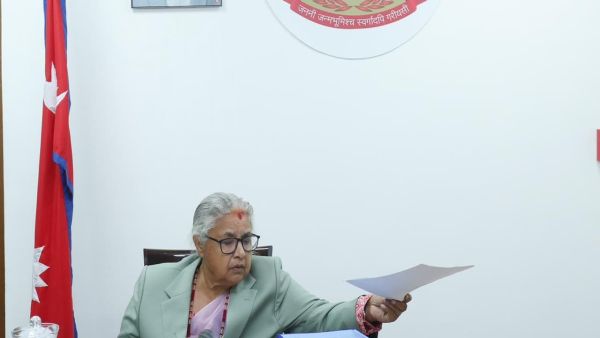
The report of the high-level commission led by former Justice Gauri Bahadur Karki, formed after the Gen-Z protests on September 8 and 9, 2025, has been leaked. Following the leak, the Office of the Prime Minister has announced that interim Prime Minister Sushila Karki has decided to publish the report.

The 907-page report, which has also been obtained by ANI, includes detailed accounts of the Nepal Police, Nepali Army, and protesters deployed across various locations during the two days.
The report also contains the statement of Central Special Task Force (STF) Commander, Police Inspector Samunnat Adhikari, who was responsible for Parliament building security. According to Adhikari, although the protest at Maitighar Mandala on September 8 began peacefully, protesters turned violent, entered the Parliament premises, and committed arson and vandalism. Police attempted to control the situation using tear gas and aerial firing. He further stated that on September 9, the situation became more complex. Many high posts at the Parliament were already damaged, preventing the STF team from fully deploying inside. Despite the challenges, his team was able to protect some critical structures using available weapons and equipment. However, 40,000 litres of diesel, barracks, mess, canteen, CCTV rooms, walk-through gates, and personal belongings of security personnel were destroyed in the fire.
Adhikari highlighted coordination issues between the Nepal Police, Armed Police Force, and the Nepali Army, which affected team morale. He suggested specialised training, technical equipment, real-time threat analysis, and a satellite base in each province to make STF operations more effective in the future. "I have been commanding the STF team with 96 personnel since March 2025, responsible for Parliament security. We did not have a written mandate, but our main duty was the direct protection of the building, MPs, staff, journalists, and visitors. The team had 5.56 mm INSAS rifles, LSW, 9 mm SMG, Type 54 pistols, Petro Beretta, and gas guns," reads Adhikari's statement recorded by the committee in the report obtained by ANI.
As per the report, then-Home Minister Ramesh Lekhak denied issuing orders for police to fire, stating that officers could act based on their discretion and the situation on the ground. "The legal framework and practical practice do not require the Inspector General of Police to take written or verbal orders from the Home Minister for the use of force. I have made this clear in my statement," the report obtained by ANI notes.
Lekhak added that after reports of casualties from police gunfire, he immediately directed officials and security agencies to focus on rescue operations and ensure the safety of citizens. "Upon receiving news of casualties, we held immediate discussions with Home Ministry officials and security agencies to arrange protection of life and facilitate medical treatment for the injured," Lekhak said.
He also acknowledged weaknesses within the state security system and limited dialogue with youth, taking responsibility for gaps under his tenure. "I have reflected on the shortcomings in the state's security system, lack of information collection and analysis, weak communication with the youth, and inadequate preparedness," he said.
The commission also recorded that the security forces had used lethal force during the clashes at Baneshwar, but the spent ammunition and shells were not secured as evidence. "The clash between protesters and security forces at Baneshwar on September 8 involved the use of lethal force. After the incident, the spent ammunition and shells should have been recorded and preserved as evidence. However, no such record appears to exist," the report obtained by ANI states.
The commission noted that the absence of proper records may be linked to the tense situation that persisted in Baneshwar until the evening of September 8, making crowd control a higher priority than evidence collection the following morning. It also highlighted the possibility that the police did not preserve the evidence due to concerns it could be used against them.
The high-level investigation committee also interrogated Rastriya Swatantra Party (RSP) Senior Leader and then Kathmandu Metropolitan City Mayor Balendra Shah, also known as Balen. In his written statement, the Prime Minister-to-be stated that he did not support the Gen-Z protest. Balen said he supported the rally but was not involved in the protest itself.
"On September 8 and 9, 2025, I was at the government residence in Lainchaur. I supported the peaceful rally on September 8, but I was not part of the protest," Balen's written statement to the commission obtained by ANI read. He also said that, at the request of the President and the Army Chief, he helped calm the protest and added that the then government and participating political parties should take full responsibility for all the damage.
"The then government carried out criminal and terrorist activities, and the entire responsibility for the damage must be borne by the government and participating parties," Balen has recorded.
The commission also recorded the statement of Satyaram Joshi, the jailer at Nakkhu Prison in Lalitpur. Joshi told the commission that Rabi Lamichhane, who had been imprisoned for nine months in a cooperative fraud case, escaped from Nakkhu Prison on September 9, 2025. According to Joshi, inmates began shouting and rioting inside the prison from the evening of September 8.
"Around 7 PM, a large crowd gathered outside, throwing stones and setting fires. Inmates inside also started protesting, demanding that if Rabi Lamichhane could leave, why couldn't they? At the District Police Office too, large groups were creating chaos, so additional security could not be sent," Joshi's statement has been recorded in the report obtained by ANI.
He added that during the chaos, television and other media reported that inmates had escaped from Dillibazar and other prisons. "After Rabi Lamichhane broke out of prison, other inmates began fleeing as well. A total of 667 prisoners escaped, of which 409 have returned. The total damage to the prison that day was around Rs 4.5 million," Joshi said.
The high-level investigation committee also recorded the statement from then Prime Minister KP Sharma Oli. In the document obtained by ANI, Oli stated that the Prime Minister is not directly accountable for the incidents that occurred during the Gen-Z protests. "The Prime Minister does not give orders to the police; this responsibility lies with the Home Ministry as the departmental authority. Logically, the Prime Minister is not accountable in this matter," the commission report obtained by ANI cited Oli as saying.
He also noted that the Prime Minister is not directly informed about immediate and emergent events occurring during protests. Additionally, Oli's statement to the commission claimed that on Bhadra 23, groups attempting to set fire to the Parliament had deliberately incited protesters, leading to a situation where lives could have been at risk, suggesting that the violence was part of a planned provocation.
The probe commission formed following the Gen-Z protests on September 8 and 9, 2025, has noted that the role of the Nepali Army was ineffective in controlling the situation. "A lack of coordination among security agencies and delays in decision-making led to significant damage," the report reads.
The report states that, as per constitutional provisions, the army can only be mobilised following a recommendation from the National Security Council and a decision by the Cabinet. However, it noted that necessary decisions were not taken in time despite the seriousness of the situation, allowing it to spiral out of control.
The protests, which began at Maitighar Mandala on September 8, turned violent as they reached Baneshwar, with attempts made to attack the Parliament premises. Despite police using tear gas, water cannons, and firing in the air, the crowd could not be controlled, forcing the use of live bullets, the report said. Following the escalation, Kathmandu Chief District Officer Chhabilal Rijal imposed a curfew.
The report mentions that the army was deployed only in a limited capacity after the situation around Parliament worsened and initially returned after arriving in trucks. It was only later in the evening that the army was redeployed to the Parliament area under police escort. On the second day, September 9, although the curfew remained in place, the army was not effectively mobilised, the report found. Incidents of arson, looting, and vandalism were reported across the country, with even sensitive areas such as Singha Durbar and the Presidential residence suffering damage, while the army's role remained largely inactive.
The commission also pointed out that, despite provisions in the National Security Policy 2016 assigning the army responsibility for protecting key and sensitive areas, this was not effectively implemented. Highlighting serious coordination gaps among security agencies, the report stated that the lack of a clear division of responsibilities and cooperation among the Nepal Police, Armed Police Force, and the army resulted in heavy losses for both the state and the public. It also identified the National Security Council's decision not to declare a state of emergency on the evening of September 8 as a major weakness. The report noted that failure to impose emergency measures and mobilise the army in time led to further damage on the following day.
The commission further pointed out weaknesses in curfew implementation, stating that the curfew should have been continuously enforced from the morning as per the army's recommendation. Instead, intermittent lifting of restrictions allowed protesters to regroup, worsening the situation.
The report has recommended amendments to existing laws to clarify provisions related to army mobilisation, citing ambiguities in the current legal framework. It also stressed the need for regular audits of the security system, stronger protection of sensitive areas, and periodic parliamentary discussions on National Security Council reports. (ANI)
(Except for the headline, this story has not been edited by Asianet Newsable English staff and is published from a syndicated feed.)