AI is taking over conversations everywhere, from offices to airports, from phones to fitness routines. For something as basic as writing an email to acting as our psychologist, most of us count on AI to come to our rescue. And now, it’s quietly stepping into our kitchens too. But the big question still stands: can AI actually replace chefs? Or is it just another tool helping them behind the scenes? We asked chefs to weigh in on it and found out how AI plays out in the kitchen.
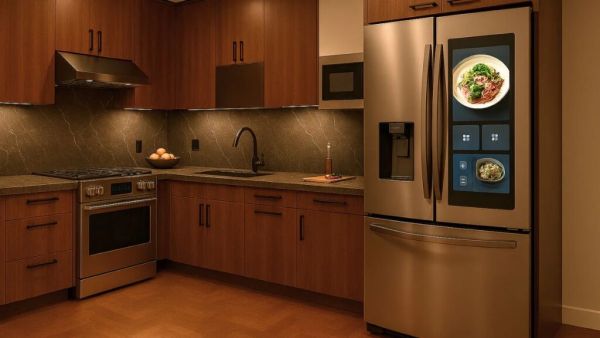
AI is already doing a lot more in kitchens than we realize. It’s not cooking your meal (yet), but it’s making sure everything around it runs smoothly. Think about it. AI can predict how much stock a restaurant needs, reduce food waste, organize recipes and menus, calculate food costs with precision, and even analyze what customers might want to eat.
As Chef Vanshika Bhatia, founder of Petite Pie Shop, puts it, “AI can be a tool used to help out with certain admin work in the kitchen, eg, organizing recipes, food costs, etc. But it can never replace humans, as it cannot taste, feel or use emotion to cook.” And that’s really the point: AI is helpful, but only up to a certain line.
Two Indian Restaurants Make It To Asia’s 50 Best In 2026
If we’re being honest, cooking isn’t just about following a recipe. Have you ever added exactly 1 tsp of salt or 2 cloves of garlic just because the recipe said so? No, we always end up tweaking according to what our tastebuds like. It’s because cooking is an instinctive process. Midway in a recipe, you judge if a squeeze of lemon would bring it all together. Chef Pranav Sharma, The Grammar Room, explains this reality best when he says, “AI replacing humans is a comforting fantasy for people who’ve never actually run a kitchen. Cooking isn’t just about following instructions or executing perfect measurements. It’s about instinct, memory, emotion, and chaos management.”
One of AI’s biggest strengths is how fast it can process information. It can suggest new flavor combinations, pull inspiration from global cuisines, and even help chefs think differently. But there’s a difference between suggesting a dish and understanding it. As Chef Aditya Mohan, Founder-Chef at Refuge, puts it, “Cooking is emotional. It comes from memory, culture, and personal experience, the food you grew up with, the places you’ve traveled, and the flavors you connect with. That’s something AI can’t replicate.”
Photo: Pexels
There’s also something incredibly physical about cooking, the way a chef touches, feels, and understands ingredients. Chef Avinash Martins captures this beautifully, “When a chef cooks, he doesn’t merely cook with just recipes, he cooks with emotions, memorabilia, sentiments and passion. The look, touch and feel of an ingredient by a chef can never be replaced by AI or any advanced cooking apparatus.” It’s that sensory connection that defines great cooking, and no machine can ever come close to replicating that.
Where AI does shine, though, is in handling repetitive work. Tasks that don’t require creativity or deep understanding. Chef Shri Bala, Chef Partner of Nadoo, explains it simply, “AI can do only repetitive work, and creativity has to be done by a person who understands that cuisine, someone who knows the nuances of that cuisine and can play with ingredients within the boundaries of that region.”
Watch: Nauheed Cyrusi Reveals Her Typical Homestyle Iranian Breakfast Ritual With Mother
At the launch of Safeful at AHAAR 2026, when NDTV correspondent Mayank Chaudhary asked if AI could take over the kitchen, Australian chef and restaurateur Matt Moran instantly said, “I don’t think AI can flip a good burger.” At the same time, Chef Sanjeev Kapoor reminds us that technology isn’t the enemy. “Without technology, you cannot survive today,” he says, highlighting how important it is to embrace AI where it helps.
Food is more than just fuel for the body. It’s an exchange of emotions and experiences. Chef Noah Louis Barnes, Co-Founder of Miss Margarita, believes, “AI can definitely support kitchens by making processes more efficient and taking over mundane tasks like chopping or basic prep. But cooking is deeply personal – it’s driven by instinct, emotion, and creativity.” And that’s the part AI can’t replicate.
Not really. What it can do is make kitchens smarter, faster, and more efficient. It can take care of the boring, repetitive, data-heavy tasks. But the heart of cooking, from instinct and emotion to creativity and chaos, will always belong to humans.