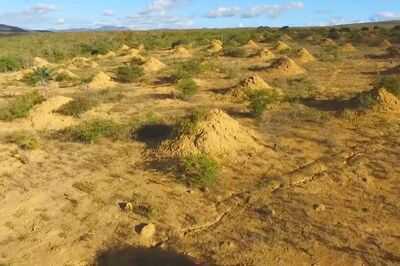
While the notion that the Great Wall of China is visible from space has been debunked as a myth, certain colossal construction projects can be observed from orbit - and not all were built by humans. Syntermes dirus, a termite species found in Brazil, has constructed an enormous collection of 7ft-tall mounds spanning an area equivalent to Great Britain.
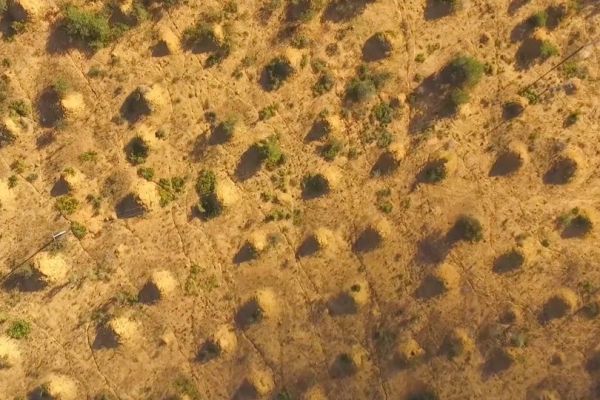
Individual mounds can require thousands of years to finish, reaching nearly 30 feet across. However, there are so many of these so-called "murundas," an estimated two hundred million at the latest tally, that collectively they've become a massive landmark visible from many miles overhead.
While the Great Pyramid of Cheops is frequently celebrated as an architectural marvel, the minuscule termites have shifted approximately 10 km3 (2.4 cu mi) of earth, sufficient to create four thousand piles each matching the size of the renowned Egyptian structure. It's been likened to humans erecting a building four times the scale of the Burj Khalifa, or 320 times as high as Big Ben, entirely without plans, engineers or troublesome health and safety requirements.
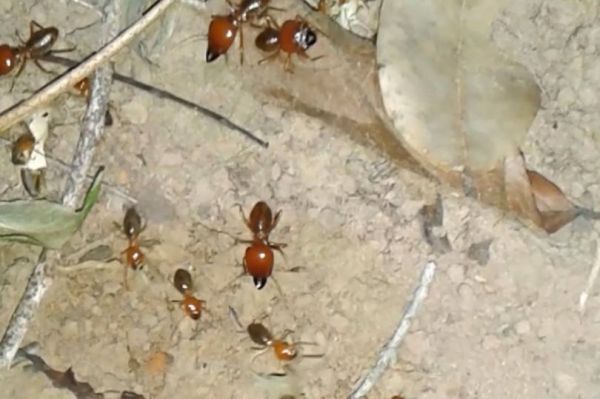
The diminutive insects, measuring just over half an inch in length, subsist almost entirely on decomposing leaves from a solitary tree species. Researchers say their enormous mounds are essentially the rubbish heaps for an extensive network of connected subterranean "cities" stretching for numerous miles. The tough, arid and relatively barren soil in the region is not only ideal for construction, but unappealing to farmers, meaning the mounds have remained undisturbed for, in some cases, up to 4,000 years.
While locals have been aware of the mounds for many centuries, the sheer magnitude and remarkable consistency of the structures was only uncovered relatively recently after they were spotted in satellite imagery.
Stephen Martin from the University of Salford, told New Scientist in 2018: "I looked on Google Earth and realised they're everywhere in this area, but I could find nothing about them online."
The termites gather small, thorny leaves from the neighbouring caatinga forests that only drop once a year, and Martin says there's a frantic rush to collect as many as possible: "It's like if all the supermarkets were open for one day a year - the person with the fastest car would get the most food," he explains.
"You need a network of roads to get to the supermarket as quickly as you can because you're in open competition with other colonies."
Researchers have established that each mound does not represent a distinct colony, as there is no hostility between termites from each "murunda" and their closest neighbours.
However, should termites be removed from their original mound and relocated to one several miles away, a confrontation will inevitably ensue. It remains unclear just how extensive the boundaries of each termite colony are.
While most termite colonies are built around a single egg-laying queen, Stephen Martin and his research team have been unable to find a royal chamber in any of the mounds they have dug up, meaning the structure of the colonies, along with their size, remains a mystery.
Another conundrum, Martin explains, is how the termites manage to stay alive when their food source is only accessible for such a brief window. "We don't know of any [termite] species that hibernate, but maybe they do," he says.