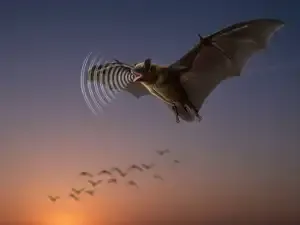
For the past few decades, scientists suspected that the noctule bats might be engaging in some unusual activity in the night sky. They had been collecting evidence of bird feathers in the bats’ feces as early as the 1990s and suspected that the bats might be hunting migrating songbirds.
However, no scientist had actually observed the bats in the process of hunting the birds because they fly high in the night sky and hunt in the darkness.
This puzzle has been unsolved for the past twenty-five years until recently, when scientists finally found evidence of the noctule bats’ activity using modern tracking and audio equipment. According to ScienceDaily and Nature, the noctule bats are not only scavenging bird bodies but are actually hunting and consuming the birds in the air.
The data revealed that the bats were flying at altitudes of more than 1,200 meters, which was much higher than most insect-hunting bats, and that they were actively chasing their prey at the time. According to Scientific American, the scientists used the miniature biologgers to identify the exact moment the bats spotted their prey and started chasing it, thereby capturing the exact moment the bats intercepted the birds.
This new technique in wildlife research has marked a major breakthrough in the field, as it has allowed scientists to study animals that would otherwise be impossible to observe in the wild, especially at night and in the open sky.
The manner in which the hunt is carried out is also quite intricate and specialized in nature. For instance, the greater noctule climbs to great heights where migratory birds fly at night, and it uses echolocation to locate the birds. Once the location of the prey has been identified, the greater noctule descends quickly and catches the prey in the air.
This mode of hunting in the air requires a great amount of precision and speed, where the greater noctule has to change the course of its flight while simultaneously trying to locate the prey in the air. According to Phys.org and The Guardian, the manner in which the greater noctule catches the prey in the air by flying at great speeds has been described as a rare instance where a mammal has managed to catch a vertebrate in the air, thereby differentiating it from the majority of the population of bats that feed on insects in the air.
According to Smithsonian Magazine, one audio recording obtained by the researchers included 21 sounds made by a distressed European Robin, followed by sounds made by the feeding process, which clearly showed the bat catching the bird in flight.
This was the first direct evidence obtained to show this process, which matched the theories obtained earlier.
This has significant implications for the way in which scientists believe that ecosystems function, particularly for nocturnal predators and migratory species. The greater noctule bat is already considered a vulnerable species in parts of Europe, and the relationship that it has with the migratory birds suggests that the survival of the bats has a significant relationship with the migration of the birds.
As has been highlighted in studies by The Guardian and Phys.org, the relationship that has been found has significant implications for the way in which conservation efforts are made, not just to protect the environment but also to protect the migration corridors that are necessary for the survival of both prey and predator species.
According to the research cited in EurekAlert, the fact that this species of bats is at the boundary between hunting insects and vertebrates suggests a wider range of bat behavior than has been perceived in the past.
The success of biologgers in this study is an indication of how technology is changing how scientists investigate nature. Behaviors thought to be impossible to record can now be done so in depth, creating new avenues for understanding how species interact and how they manage to survive.
As ScienceDaily has pointed out, this is a new precedent for how other elusive species can be studied, especially those living in environments that are hard to reach.
A night sky once thought to be quiet and devoid of life is now understood to be an area where much is happening, where predators and prey come together in ways that have remained unknown for so long. The fact that the greater noctule bat is able to catch birds in mid-air is not just an interesting biological fact; it is an indication of just how much of nature is beyond our understanding.
With each new technological advancement, scientists are learning new levels of complexity in understanding how nature functions, how even familiar species can hold new secrets.
However, no scientist had actually observed the bats in the process of hunting the birds because they fly high in the night sky and hunt in the darkness.
This puzzle has been unsolved for the past twenty-five years until recently, when scientists finally found evidence of the noctule bats’ activity using modern tracking and audio equipment. According to ScienceDaily and Nature, the noctule bats are not only scavenging bird bodies but are actually hunting and consuming the birds in the air.
Tracking a Predator in the Dark
The breakthrough was made possible by the miniature biologgers that the scientists used to track the movements of the bats in the night without disturbing their natural behavior.The data revealed that the bats were flying at altitudes of more than 1,200 meters, which was much higher than most insect-hunting bats, and that they were actively chasing their prey at the time. According to Scientific American, the scientists used the miniature biologgers to identify the exact moment the bats spotted their prey and started chasing it, thereby capturing the exact moment the bats intercepted the birds.
This new technique in wildlife research has marked a major breakthrough in the field, as it has allowed scientists to study animals that would otherwise be impossible to observe in the wild, especially at night and in the open sky.
bats
This mode of hunting in the air requires a great amount of precision and speed, where the greater noctule has to change the course of its flight while simultaneously trying to locate the prey in the air. According to Phys.org and The Guardian, the manner in which the greater noctule catches the prey in the air by flying at great speeds has been described as a rare instance where a mammal has managed to catch a vertebrate in the air, thereby differentiating it from the majority of the population of bats that feed on insects in the air.
Audio Evidence That Changed the Debate
Perhaps the most convincing evidence came in the form of audio recordings obtained during the course of the tracking studies. In one instance, researchers obtained audio recordings that included the sounds made by distressed birds, followed by long periods of chewing sounds, which lasted for more than 20 minutes.According to Smithsonian Magazine, one audio recording obtained by the researchers included 21 sounds made by a distressed European Robin, followed by sounds made by the feeding process, which clearly showed the bat catching the bird in flight.
This was the first direct evidence obtained to show this process, which matched the theories obtained earlier.
This has significant implications for the way in which scientists believe that ecosystems function, particularly for nocturnal predators and migratory species. The greater noctule bat is already considered a vulnerable species in parts of Europe, and the relationship that it has with the migratory birds suggests that the survival of the bats has a significant relationship with the migration of the birds.
As has been highlighted in studies by The Guardian and Phys.org, the relationship that has been found has significant implications for the way in which conservation efforts are made, not just to protect the environment but also to protect the migration corridors that are necessary for the survival of both prey and predator species.
A New View of Bat Behavior
The confirmation of the fact that the greater noctule bat preys on birds in the air changes the way in which the dietary habits of bats are perceived. Although some species of bats are known to feed on vertebrates, the level of specialization and consistency is rare and suggests a special ecological niche.According to the research cited in EurekAlert, the fact that this species of bats is at the boundary between hunting insects and vertebrates suggests a wider range of bat behavior than has been perceived in the past.
The success of biologgers in this study is an indication of how technology is changing how scientists investigate nature. Behaviors thought to be impossible to record can now be done so in depth, creating new avenues for understanding how species interact and how they manage to survive.
As ScienceDaily has pointed out, this is a new precedent for how other elusive species can be studied, especially those living in environments that are hard to reach.
A night sky once thought to be quiet and devoid of life is now understood to be an area where much is happening, where predators and prey come together in ways that have remained unknown for so long. The fact that the greater noctule bat is able to catch birds in mid-air is not just an interesting biological fact; it is an indication of just how much of nature is beyond our understanding.
With each new technological advancement, scientists are learning new levels of complexity in understanding how nature functions, how even familiar species can hold new secrets.