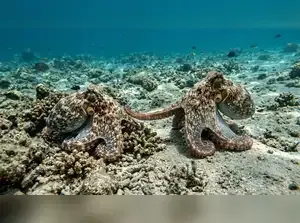
Certain observations have sparked interest in the possibility that octopuses might display some form of empathy, especially toward injured animals. Some observations highlighted by The Guardian suggest that there may be cases where the animals appear to be getting closer to injured partners, which leads to the possibility that these normally solitary animals may display a more complex behavior than was previously expected. Normally, the behavior of the common octopus has been regarded as that of a solitary animal. The interactions that have been observed in the case of the common octopus have mostly been limited to mating or territorial behaviors, which may be aggressive in nature rather than cooperative, as seen in previous studies summarized by ScienceDaily. Some interactions between the animals have been observed, but no evidence of caring behavior has been clearly established.
Octopuses tend to display self-directed behavior when they are injured. Articles across different issues of Neuroscience Journals and ScienceDirect indicate evidence of self-directed behavior, such as grooming and using ink for defense. It is evident that it is a self-directed behavior, not one that is directed towards helping others, despite displaying evidence of high-order neural processing of pain. One of the biggest challenges in understanding the behavior of octopuses is that it is very hard to distinguish between empathy and other motivations. One octopus approaches another for a variety of reasons, and not necessarily for empathy, according to articles in Scientific Reports and Nature.
Empathy would have great implications for understanding invertebrate cognition if it is present. The formation of complex emotional-like behaviors can occur via convergent evolution, according to research done in Frontiers in Psychology. This shows that different neural systems can arrive at the same conclusion. Octopuses with their decentralized nervous systems would have been a divergent evolutionary route to the formation of social behaviors. There is a certain degree of ambiguity when comparing the octopus to other species. Mammals and birds have defined behaviors when it comes to members of their own kind that are injured, which is also accompanied by defined societies. The likelihood of empathy is higher in species that have stable societies, as stated in the articles in Scientific American and Britannica.
This question will also be answered in future studies, since scientists are using underwater monitoring and experiments to examine the behavior of the octopuses in a longer period of time. It is possible to find out if the behavior is related to emotional or behavioral responses by examining the behavior in conjunction with the neural activity, according to the research done by scientists and published in Current Biology. However, the idea of octopus empathy is not yet considered a definitive characteristic of the octopus. It is not enough to describe the helping behavior of the octopuses, even though the new evidence points to the octopus behaviors in a different way than the conventional understanding. What it points to is the fact that the behavior of the octopuses is not as simple as it was thought to be.
Octopuses tend to display self-directed behavior when they are injured. Articles across different issues of Neuroscience Journals and ScienceDirect indicate evidence of self-directed behavior, such as grooming and using ink for defense. It is evident that it is a self-directed behavior, not one that is directed towards helping others, despite displaying evidence of high-order neural processing of pain. One of the biggest challenges in understanding the behavior of octopuses is that it is very hard to distinguish between empathy and other motivations. One octopus approaches another for a variety of reasons, and not necessarily for empathy, according to articles in Scientific Reports and Nature.
Image Credit: Gemini
Empathy would have great implications for understanding invertebrate cognition if it is present. The formation of complex emotional-like behaviors can occur via convergent evolution, according to research done in Frontiers in Psychology. This shows that different neural systems can arrive at the same conclusion. Octopuses with their decentralized nervous systems would have been a divergent evolutionary route to the formation of social behaviors. There is a certain degree of ambiguity when comparing the octopus to other species. Mammals and birds have defined behaviors when it comes to members of their own kind that are injured, which is also accompanied by defined societies. The likelihood of empathy is higher in species that have stable societies, as stated in the articles in Scientific American and Britannica.
This question will also be answered in future studies, since scientists are using underwater monitoring and experiments to examine the behavior of the octopuses in a longer period of time. It is possible to find out if the behavior is related to emotional or behavioral responses by examining the behavior in conjunction with the neural activity, according to the research done by scientists and published in Current Biology. However, the idea of octopus empathy is not yet considered a definitive characteristic of the octopus. It is not enough to describe the helping behavior of the octopuses, even though the new evidence points to the octopus behaviors in a different way than the conventional understanding. What it points to is the fact that the behavior of the octopuses is not as simple as it was thought to be.