Exchange rate runs in discount as war woes tell on various facets of irregular market
Mumbai: Away from the dust, death and debris of the war, a strange story is playing out in the underbelly of the Indian money market.
The dollar-rupee exchange rate in the hawala market has slipped into a discount - something that rarely happens - amid stalled flights, fall in smuggled gold from Dubai, and muted trade and travel to and from the Gulf.
Also Read: Rupee's steep fall- Are India's macro fundamentals strong enough to withstand global shocks?
Persons familiar with dealings in this irregular yet efficient forex market told ET that the going rate is 1-2% below the official exchange rate quoted by banks and registered money changers.
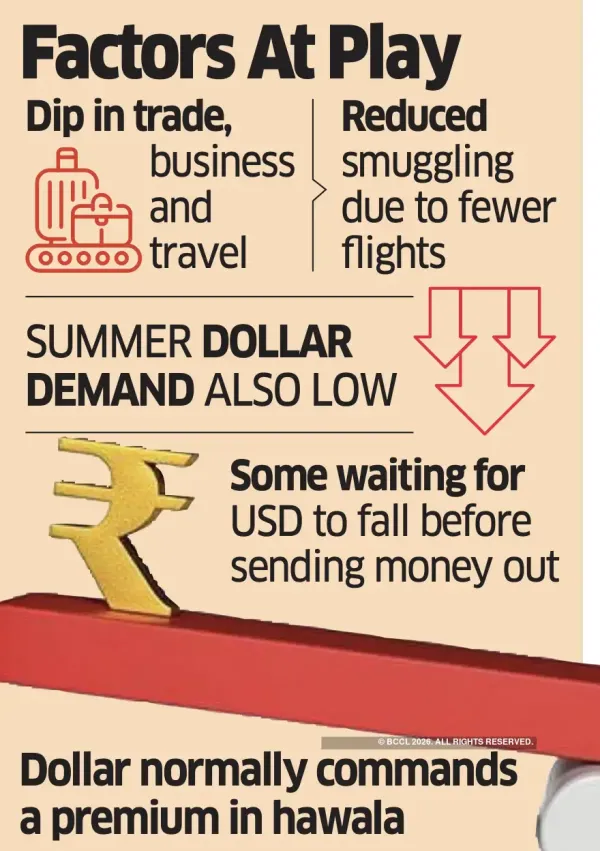
In hawala, the dollar typically commands a premium of around 2%. "The premium started coming down since war began. In the past few days, it has been at a discount," said an exporter.
Unlike in the official payment pathways, where dollars sold to or bought from a local bank for rupees is credited or debited to the bank's nostro (or overseas) account in the US, hawala adjustments are done by agents and their counterparts in the United Arab Emirates (UAE) within this shadowy network.
Also Read: Rupee crosses 94/$1 mark for the first time, ends at 94.81/$ amid volatile crude prices due to US-Iran war
The gold that sneaks in is sold for rupees while the seller in the UAE is paid dollars by the Dubai hawala operator. The latter sources the dollar from migrants and others, who avoid banks to send money to their relatives or businesses in India.
Often dollars come from Indian importers who over-invoice, or overstate, cargo value to move money out. It's a well-oiled informal settlement mechanism for families and parties of Indians in the UAE.
When smuggling slows down, the demand for dollars also dips in that country, impacting the hawala rate.
“Also, the dollar buying that starts before the summer holidays is down as fewer people are planning overseas trips. Many use undisclosed cash to buy dollars in the informal market for foreign holidays. Smuggling and tourism influence the demand and supply of dollars and euros in the hawala market. Both have been hit because of fewer flights and war fears,” said another person in the gold market.
According to a senior chartered accountant, with the rupee touching new lows, those planning to shift money out of India using the hawala channel are waiting for the dollar to fall. “This also reduces the dollar demand in the hawala market. There are multiple factors — just not reduced gold smuggling,” he said.
Smuggling, said a bullion market analyst, is less during a war or border unrest as coast guards, the navy and Customs authorities are on high alert, increasing the risk of the cargo or the vessels being intercepted.
Besides, the war has impacted mined gold flow from Africa to Dubai refineries.
“There is ant-smuggling of gold through smaller airports after the rise in gold price which affected local demand,” said an official with the Directorate of Revenue Intelligence.
The overarching factor, however, is a smaller requirement of the matching dollar in the UAE hawala leg due to a drop in transaction volumes following a fall in business and visitors. Many are holding on to cash due to upcoming state elections and the cash market is tight in cities such as Bengaluru.
Sometimes jitters caused by war and terror attacks unsettle the informal cash market. After the Mumbai 2006 train bombings, the angadias — the age-old cash couriers used by businesses and builders — halted operations as the police carried out random bag checks at railways stations and bus terminus. It lasted for a month. It’s felt that the current hawala discounts, though unusual, may be a temporary phenomenon and the premium may return once the war ends. In the cauldron of the informal money market, cash flows in and out from various pockets for different purposes. Today, there are not enough hands or broth to keep the pot boiling, thanks to the war and the scare in Dubai.
The dollar-rupee exchange rate in the hawala market has slipped into a discount - something that rarely happens - amid stalled flights, fall in smuggled gold from Dubai, and muted trade and travel to and from the Gulf.
Also Read: Rupee's steep fall- Are India's macro fundamentals strong enough to withstand global shocks?
Persons familiar with dealings in this irregular yet efficient forex market told ET that the going rate is 1-2% below the official exchange rate quoted by banks and registered money changers.
In hawala, the dollar typically commands a premium of around 2%. "The premium started coming down since war began. In the past few days, it has been at a discount," said an exporter.
Unlike in the official payment pathways, where dollars sold to or bought from a local bank for rupees is credited or debited to the bank's nostro (or overseas) account in the US, hawala adjustments are done by agents and their counterparts in the United Arab Emirates (UAE) within this shadowy network.
Also Read: Rupee crosses 94/$1 mark for the first time, ends at 94.81/$ amid volatile crude prices due to US-Iran war
The gold that sneaks in is sold for rupees while the seller in the UAE is paid dollars by the Dubai hawala operator. The latter sources the dollar from migrants and others, who avoid banks to send money to their relatives or businesses in India.
Often dollars come from Indian importers who over-invoice, or overstate, cargo value to move money out. It's a well-oiled informal settlement mechanism for families and parties of Indians in the UAE.
Fluctuating Flows
The families and parties of Indians are given rupees received from the sale of smuggled commodities while foreign sellers are handed over dollars received from the former. Such transactions are either done to hide the money trail of trades that evade customs duties, bypass banks that take a long time, or simply out of habit.When smuggling slows down, the demand for dollars also dips in that country, impacting the hawala rate.
“Also, the dollar buying that starts before the summer holidays is down as fewer people are planning overseas trips. Many use undisclosed cash to buy dollars in the informal market for foreign holidays. Smuggling and tourism influence the demand and supply of dollars and euros in the hawala market. Both have been hit because of fewer flights and war fears,” said another person in the gold market.
According to a senior chartered accountant, with the rupee touching new lows, those planning to shift money out of India using the hawala channel are waiting for the dollar to fall. “This also reduces the dollar demand in the hawala market. There are multiple factors — just not reduced gold smuggling,” he said.
Smuggling, said a bullion market analyst, is less during a war or border unrest as coast guards, the navy and Customs authorities are on high alert, increasing the risk of the cargo or the vessels being intercepted.
Besides, the war has impacted mined gold flow from Africa to Dubai refineries.
“There is ant-smuggling of gold through smaller airports after the rise in gold price which affected local demand,” said an official with the Directorate of Revenue Intelligence.
The overarching factor, however, is a smaller requirement of the matching dollar in the UAE hawala leg due to a drop in transaction volumes following a fall in business and visitors. Many are holding on to cash due to upcoming state elections and the cash market is tight in cities such as Bengaluru.
Sometimes jitters caused by war and terror attacks unsettle the informal cash market. After the Mumbai 2006 train bombings, the angadias — the age-old cash couriers used by businesses and builders — halted operations as the police carried out random bag checks at railways stations and bus terminus. It lasted for a month. It’s felt that the current hawala discounts, though unusual, may be a temporary phenomenon and the premium may return once the war ends. In the cauldron of the informal money market, cash flows in and out from various pockets for different purposes. Today, there are not enough hands or broth to keep the pot boiling, thanks to the war and the scare in Dubai.