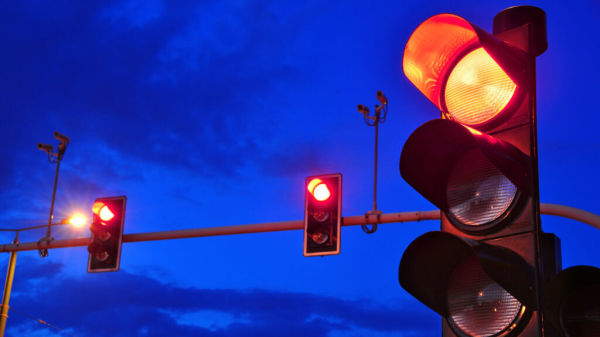
Sometimes, the green light doesn’t stay green long enough at an intersection when there’s a lot of traffic. Other times, you’re stuck at a red light with no traffic, wondering if it’s ever going to turn green. It’s no wonder that many of us are left wondering how traffic lights actually work. If you’ve driven through an intersection at night under flashing lights, there’s actually a good reason for it.
Typically, it’s because there’s very little traffic after a certain point, and a regular cycle just isn’t needed. This can be the case in small towns, or in larger cities, depending on the volume of traffic. The less there is, the more likely the lights will switch from the standard green-amber-red cadence to flashing a single color. These coordinated cycles are often handled by a city’s engineering department.
It’s important to know the difference between flashing amber and flashing red. If the lights are blinking amber at the intersection, that’s a cautionary signal, and you should slow down. While it doesn’t necessarily mean a red light is coming next, taking the proper care when going through the intersection should keep you safe. If the lights are flashing red, regardless of the time of the day, that means you need to stop. Flashing red lights should be treated just like a regularly posted Stop sign. If you don’t stop, and you’re spotted by a cop, you could get pulled over.
Understanding unusual traffic light behavior
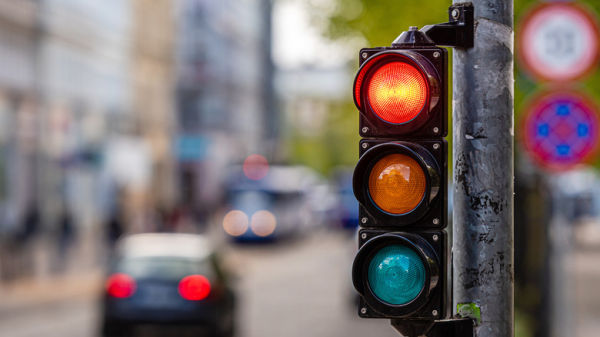
While you may encounter flashing traffic lights for various reasons, that behavior could sometimes be due to a malfunction. Even in the middle of the day during rush hour, you could approach a busy intersection with blinking lights in every direction. When this happens, it could be because the system has switched to fail-safe mode. Triggered by a management device called a conflict monitor, this mode is enabled to prevent accidents when something goes wrong.
Beyond a steady blinking, traffic lights can sometimes switch faster than normal, which may not be due to a malfunction. In fact, this behavior is often intentional, due to the presence of emergency vehicles. It’s known as preemption, and when it’s activated, the system can change, or even replace, the normal signal pattern. This is done to help clear the way for ambulances, fire trucks, and police. If the light just ahead of you turns green but suddenly switches to amber, it could be that an emergency vehicle is coming through.
Despite the situation, traffic lights always respect the green-amber-red sequence. This is true even when the system temporarily adjusts timing or phase order, though researchers have suggested adding a new color. This is also the case for flashing lights, which shouldn’t skip colors or reverse their normal sequence. The regular signal pattern is built-in to keep drivers accustomed to the same flow, while also keeping them safe regardless of the environment.