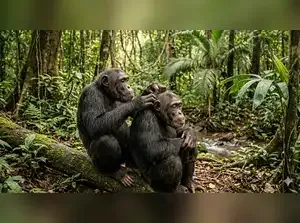
Biologists have been interested in studying primates for quite some time. It is important in order to understand various structures and mannerisms, particularly chimpanzees. They are highly intelligent and live in complex societies and extremely dynamic relationships, and their survival depends on how strong these relationships are. Research conducted recently revealed that same-sex relations help strengthen these bonds, especially under periods of environmental stress. This behavior is not just random but contributes significantly to the cohesion of the group, as indicated by a recent article published in The Guardian (2026). Same-sex relations in 59 species of primates were identified by an analysis published in Scientific American, which included over 1,700 studies. This behavior is rather ubiquitous and not unique. It helps chimpanzees maintain the bonds that are important for cooperation, especially during environmental stress.
Their groups are organized around a fission-fusion system, and constantly have to divide and reunite into groups, and are constantly forced to recreate their relationships. Behaviors that build trust and alleviate tension are essential in such a system. They help people stay connected even when the circles around them are constantly changing, as pointed out by research by Cambridge University Press. Same-sex interactions are more pronounced under conditions that are harsh (The Guardian). These conditions include dry environments with low food availability and high predator concentrations. Chimpanzees can work together more effectively by building stronger relationships during such times.
Chimpanzees in Guinea-Bissau have been seen sharing fermented fruits, as was reported by The Guardian. This form of sharing also shows the social bonding that occurs among the species, similar to how humans bond with one another. Even small acts portray the complexities involved in social bonding, since it has been established that chimpanzees use leaves to clean themselves after some activities, which indicates the importance of hygiene and its effect on social bonding (The Guardian, 2025).
Is this behaviour observed in other primates as well? Sexual activities are used by bonobos to create alliances, whereas baboons use grooming and interaction to form long-term bonds, according to research from National Geographic. These examples, across all species, show us how social strategies are not just limited to reproduction and kinship ties. The social structure of chimpanzees is based on multiple levels of interaction, and bonding occurs through multiple activities. Same-sex activities are one of many methods used by individuals within a species to remain bonded, which provides us with a better insight into how social strategies are integrated into survival mechanisms.
Their groups are organized around a fission-fusion system, and constantly have to divide and reunite into groups, and are constantly forced to recreate their relationships. Behaviors that build trust and alleviate tension are essential in such a system. They help people stay connected even when the circles around them are constantly changing, as pointed out by research by Cambridge University Press. Same-sex interactions are more pronounced under conditions that are harsh (The Guardian). These conditions include dry environments with low food availability and high predator concentrations. Chimpanzees can work together more effectively by building stronger relationships during such times.
Image Credit: Gemini
Chimpanzees in Guinea-Bissau have been seen sharing fermented fruits, as was reported by The Guardian. This form of sharing also shows the social bonding that occurs among the species, similar to how humans bond with one another. Even small acts portray the complexities involved in social bonding, since it has been established that chimpanzees use leaves to clean themselves after some activities, which indicates the importance of hygiene and its effect on social bonding (The Guardian, 2025).
Is this behaviour observed in other primates as well? Sexual activities are used by bonobos to create alliances, whereas baboons use grooming and interaction to form long-term bonds, according to research from National Geographic. These examples, across all species, show us how social strategies are not just limited to reproduction and kinship ties. The social structure of chimpanzees is based on multiple levels of interaction, and bonding occurs through multiple activities. Same-sex activities are one of many methods used by individuals within a species to remain bonded, which provides us with a better insight into how social strategies are integrated into survival mechanisms.