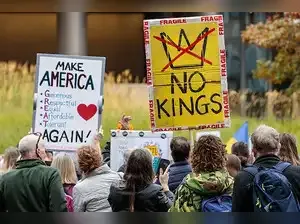
The No Kings Protest has emerged as one of the largest coordinated protest movements in recent times, with more than 3,100 demonstrations planned across the United States and at least 15 other countries on Saturday. As millions prepare to take part, a key question dominates discussions: Who is leading the No Kings Protest?
Despite its massive scale and global reach, the movement is notably leaderless, a feature that organisers say is central to its identity.
Unlike traditional protest movements driven by prominent figures, the No Kings Protest operates through a decentralised structure. It is supported by a coalition of organisations, including Indivisible, MoveOn, and grassroots networks such as the 50501 movement.
Organisers have intentionally avoided naming a single leader, arguing that collective participation is more powerful than personality-driven leadership. The approach is designed to encourage wider engagement and prevent the concentration of influence.
Activists behind the campaign argue that movements built around individuals risk losing momentum if those figures step away. By contrast, a decentralised model allows local groups, unions, civil rights organisations and community networks to take ownership of protests in their respective regions.
Political experts, however, note that while such a structure helps mobilise large numbers, it may pose challenges when it comes to decision-making or negotiating policy outcomes, as per a report by The Guardian.
What began as a symbolic protest quickly evolved into a broader platform addressing multiple concerns, including immigration enforcement, environmental policies, election security, and foreign policy decisions.
By October 2025, the movement had drawn an estimated seven million participants across thousands of events, signalling its rapid expansion and resonance with diverse groups.
Participants have rallied around issues such as:
Each demonstration is organised locally, reflecting region-specific concerns while aligning with the overarching message of the No Kings Protest. This flexible structure has enabled rapid scaling without the need for a central command.
Experts suggest that sustaining momentum may require mechanisms for coordination and decision-making, even within a decentralised framework.
Despite its massive scale and global reach, the movement is notably leaderless, a feature that organisers say is central to its identity.
No Kings Protest: A Mass Movement Without a Central Leader
Unlike traditional protest movements driven by prominent figures, the No Kings Protest operates through a decentralised structure. It is supported by a coalition of organisations, including Indivisible, MoveOn, and grassroots networks such as the 50501 movement.Organisers have intentionally avoided naming a single leader, arguing that collective participation is more powerful than personality-driven leadership. The approach is designed to encourage wider engagement and prevent the concentration of influence.
No Kings Protest: Why the Movement Has No Single Face
The absence of a central leader is not accidental. Organisers describe the No Kings Protest as a “people-powered” initiative aimed at challenging what they view as authoritarian tendencies.Activists behind the campaign argue that movements built around individuals risk losing momentum if those figures step away. By contrast, a decentralised model allows local groups, unions, civil rights organisations and community networks to take ownership of protests in their respective regions.
Political experts, however, note that while such a structure helps mobilise large numbers, it may pose challenges when it comes to decision-making or negotiating policy outcomes, as per a report by The Guardian.
Origins and Rapid Growth of No Kings Protest
The No Kings Protest movement traces its roots to mid-2025, when it first gained attention as a counter-response to a high-profile military parade held in Washington, D.C., coinciding with the birthday of Donald Trump.What began as a symbolic protest quickly evolved into a broader platform addressing multiple concerns, including immigration enforcement, environmental policies, election security, and foreign policy decisions.
By October 2025, the movement had drawn an estimated seven million participants across thousands of events, signalling its rapid expansion and resonance with diverse groups.
No Kings Protest: A Broad Coalition of Causes
One of the defining features of the No Kings Protest is its wide-ranging agenda. Rather than focusing on a single issue, it acts as a unifying platform for multiple grievances.Participants have rallied around issues such as:
- Immigration enforcement actions
- Environmental protections
- Cost of living concerns
- Healthcare and education policies
No Kings Protest: Global Reach and Local Action
While the movement is largely centred in the United States, its influence has extended internationally, with protests planned in multiple countries.Each demonstration is organised locally, reflecting region-specific concerns while aligning with the overarching message of the No Kings Protest. This flexible structure has enabled rapid scaling without the need for a central command.
No Kings Protest: Debate Over Strategy and Future Direction
The scale of the No Kings Protest has drawn both praise and scrutiny. Supporters highlight its inclusivity and ability to mobilise millions, while critics question whether the absence of defined leadership or policy demands could limit its long-term impact.Experts suggest that sustaining momentum may require mechanisms for coordination and decision-making, even within a decentralised framework.