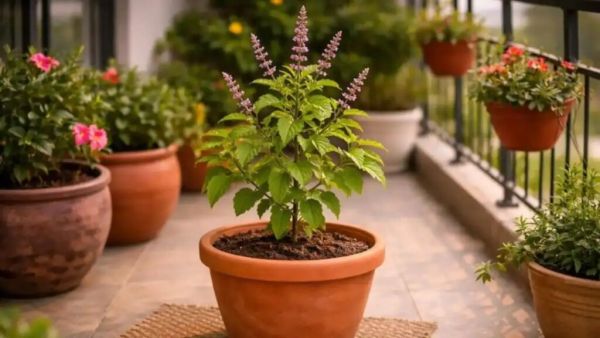
New Delhi: If you want to plant a Tulsi plant in your home, it is necessary to take some precautions while bringing it from the nursery. It is often seen that the plant starts withering or drying up as soon as it reaches home. This problem is common as the plant suddenly moves from the nursery environment to your home environment. If taken care of properly, basil can remain lush and retain its medicinal benefits.
When you bring a plant from the nursery, do not plant it in a new pot immediately. Let it remain in the home environment for the first one or two days and sprinkle light water on the leaves. Due to sudden change of soil, the roots come under pressure, due to which the plant starts drying up. Let it set slowly.
Choose a 6 to 8 inch pot for basil with holes in the bottom for drainage. Prepare soil mixture – 60 percent garden soil, 20 percent cocopeat and 20 percent vermicompost. Cocopeat helps retain moisture, while vermicompost nourishes the plant.
First put 3-4 inches of soil in the pot, then place the plant in the middle and fill soil all around. Press gently so that there are no air bubbles. Leave 2 inches of empty space above the pot so that it is easy to add water and fertilizer.
Immediately after planting, add half a teaspoon of Epsom salt and half a teaspoon of humic acid. Epsom salt protects the plant from repotting shock and keeps the leaves green. Humic acid strengthens the roots. Use it only once every month.
Water the plant thoroughly after planting. Initially, keep it in a semi-shaded place, where there is no strong sunlight. Water only when the top soil looks dry. Excessive watering can cause the roots to rot.
If the plant is infested with black insects, mix half a teaspoon of turmeric and a little dishwashing liquid in water and spray it. Turmeric is anti-bacterial and drives away insects. After spraying, do not use plain water for 24 hours.