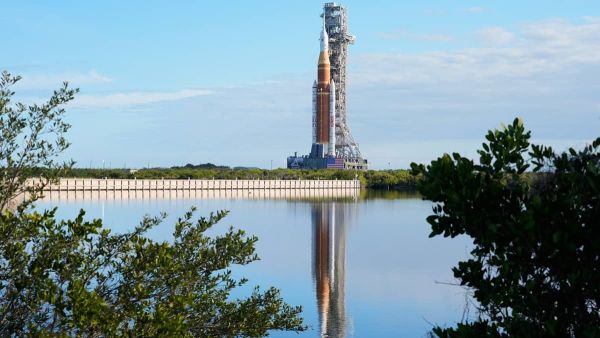
NASA is gearing up for a historic milestone, with its long-awaited Artemis 2 mission currently scheduled to launch on April 1.
As per NASA, the first crewed flight around the Moon in more than half a century will mark a major step in its broader plan to return humans to the lunar surface and eventually enable crewed missions to Mars.
According to NASA, Artemis 2 is scheduled to lift off at 6:24 p.m. EDT (2224 GMT) on April 1 from Launch Complex 39B at Kennedy Space Center in Florida. The launch will take place aboard the Space Launch System (SLS), NASA’s most powerful rocket to date.
The space agency has a two-hour launch window on April 1, extending until 8:24 p.m. EDT.
Backup launch opportunities are available daily through April 6, with an additional window on April 30 if required. NASA officials have noted that up to four launch attempts can be made within the initial six-day window, depending on weather and technical conditions.
The space agency has also said it has other launch windows in May, June and the rest of the year but has not yet released those windows.
NASA will livestream the launch across multiple platforms, including its official website, NASA+, and YouTube. As per NASA, simulcasts will also be available on major streaming platforms such as Netflix and Amazon Prime, allowing global audiences to witness the mission live.
You'll be able to watch them all here and on Space.com and our VideoFromSpace Youtube Channel.
NASA has selected a four-member crew representing both experience and historic milestones:
The mission will be historic in multiple ways. Koch will become the first woman to travel to the Moon’s vicinity, Glover the first person of colour to do so, and Hansen the first non-American astronaut on a lunar mission.
Artemis 2 will send four astronauts on a roughly 10-day journey around the Moon aboard the Orion spacecraft.
Unlike future missions, the crew will not land on the lunar surface but will orbit the Moon before returning safely to Earth, splashing down in the Pacific Ocean.
The mission builds on the success of Artemis I, the uncrewed test flight conducted in 2022, and will be the first time astronauts fly aboard both the SLS rocket and Orion capsule together.
Artemis 2 is a crucial step in NASA’s Artemis programme, which aims to establish a sustained human presence on the Moon. The mission will test key systems required for deep-space travel, paving the way for future missions that include lunar landings and eventual crewed journeys to Mars.
NASA has indicated that additional Artemis missions are planned in the coming years, making Artemis 2 a foundational mission in the next era of human space exploration.