
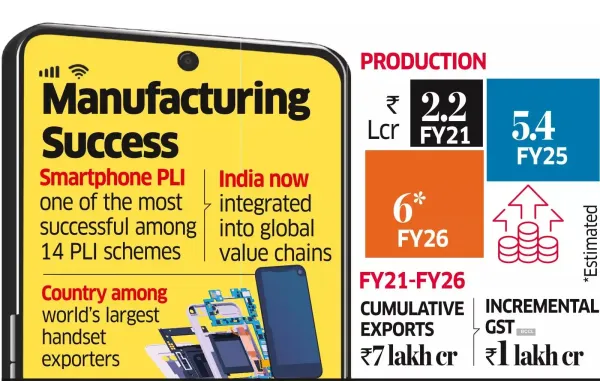
New Delhi: India has produced mobile phones worth Rs 24 lakh crore (over $250 billion) since fiscal 2020-21, with much of the activity stimulated by the government incentive scheme that has had an outsized impact compared with the monetary support.
The fiscal stimulus under the production-linked incentive (PLI) scheme for smartphones is likely to be around Rs 21,000 crore for the FY21-26 period, or less than 1% of the value of production. If the calculation is limited to companies that directly benefitted from the scheme, like Apple vendors Foxconn, Tata Electronics, Samsung and Dixon, the government outgo will still be under 2% against production worth around Rs 11 lakh crore. The math shows that the scheme was highly effective as well as fiscally prudent, industry executives and government officials said.
One of the most effective among the production-linked programmes the government announced across industries, the smartphone PLI scheme was notified in FY21 and is coming to an end on March 31. It has exceeded the targets for both production and exports, with the original goal being production of Rs 10.5 lakh crore and exports of Rs 6.5 lakh crore.
Pankaj Mohindroo, chairman of India Cellular and Electronics Association (ICEA), lauded the scheme as a “progressive policy intervention”.
 Non-beneficiaries Gain Too
“What stands out is the efficiency of this success. PLI stimulus accounts for only about 1% of overall mobile production and roughly 2% of PLI-linked output, underscoring the high return on policy support,” he told ET. Companies that did not get direct government incentives too benefited, as the scheme helped create an entire manufacturing ecosystem in India.
Amid geopolitical uncertainties and the United States’ flip-flop on tariffs, the industry is seeking continuation of the incentives for the next five years and the government, according to officials, is considering a fresh round of the PLI scheme.
GST contribution
The mobile manufacturing industry contributed nearly Rs 1 lakh crore in incremental GST during the scheme tenure. The GST rate for mobile phones was increased to 18% from 12% effective April 1, 2020, coinciding with the PLI scheme.
Unlike other PLI schemes, which were designed to reduce import dependence in large domestic consumption sectors, smartphone PLI was explicitly structured around incremental net sales, global scale and export competitiveness. It replaced the Merchandise Exports from India Scheme, which offered a 4% export incentive, with a performance-linked architecture tied to incremental production.
Officials said the smartphone PLI delivered on key areas like transitioning from import substitution to export leadership, integrating India meaningfully into global value chains and generating scale far beyond domestic demand, offering net-positive fiscal returns to the government. While the scheme was a major success, manufacturing cost still remains 11-14% more in India compared with competitors like China, according to industry executives.
The fiscal stimulus under the production-linked incentive (PLI) scheme for smartphones is likely to be around Rs 21,000 crore for the FY21-26 period, or less than 1% of the value of production. If the calculation is limited to companies that directly benefitted from the scheme, like Apple vendors Foxconn, Tata Electronics, Samsung and Dixon, the government outgo will still be under 2% against production worth around Rs 11 lakh crore. The math shows that the scheme was highly effective as well as fiscally prudent, industry executives and government officials said.
One of the most effective among the production-linked programmes the government announced across industries, the smartphone PLI scheme was notified in FY21 and is coming to an end on March 31. It has exceeded the targets for both production and exports, with the original goal being production of Rs 10.5 lakh crore and exports of Rs 6.5 lakh crore.
Pankaj Mohindroo, chairman of India Cellular and Electronics Association (ICEA), lauded the scheme as a “progressive policy intervention”.
“What stands out is the efficiency of this success. PLI stimulus accounts for only about 1% of overall mobile production and roughly 2% of PLI-linked output, underscoring the high return on policy support,” he told ET. Companies that did not get direct government incentives too benefited, as the scheme helped create an entire manufacturing ecosystem in India.
Amid geopolitical uncertainties and the United States’ flip-flop on tariffs, the industry is seeking continuation of the incentives for the next five years and the government, according to officials, is considering a fresh round of the PLI scheme.
GST contribution
The mobile manufacturing industry contributed nearly Rs 1 lakh crore in incremental GST during the scheme tenure. The GST rate for mobile phones was increased to 18% from 12% effective April 1, 2020, coinciding with the PLI scheme.
Unlike other PLI schemes, which were designed to reduce import dependence in large domestic consumption sectors, smartphone PLI was explicitly structured around incremental net sales, global scale and export competitiveness. It replaced the Merchandise Exports from India Scheme, which offered a 4% export incentive, with a performance-linked architecture tied to incremental production.
Officials said the smartphone PLI delivered on key areas like transitioning from import substitution to export leadership, integrating India meaningfully into global value chains and generating scale far beyond domestic demand, offering net-positive fiscal returns to the government. While the scheme was a major success, manufacturing cost still remains 11-14% more in India compared with competitors like China, according to industry executives.