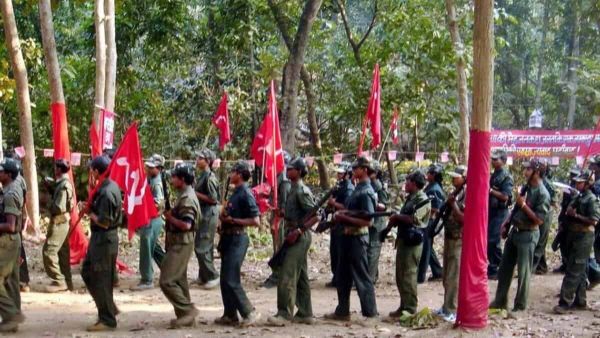
New Delhi: A combination of security pressure and rehabilitation efforts has given a deadly blow to Naxalism, one of the country’s longest-running insurgencies, with more than 10,000 Maoists laying down arms in the last decade and top leadership eliminated, officials said.
The Union Home Ministry had set the deadline to eliminate Naxalism from the country as March 31.
In 2025, 2,300 Maoists laid down arms, and more than 630 cadres chose mainstream life over armed rebellion in the first three months of 2026, official data on LWE surrenders from 2014 to early 2026 show.

According to an official, the government has adopted a unified, multi-dimensional and decisive strategy against Naxalism, replacing the scattered approach of previous governments.
An example is the road entrenchment in the “Red Corridor”, an arc that once stretched from “Pashupati to Tirupati” across Bihar, Chhattisgarh, Jharkhand, Odisha, Maharashtra, and parts of Andhra Pradesh, where contractors refused to work.
The Centre tasked the Border Roads Organisation with building roads in People’s Liberation Guerrilla Army (PLGA) core areas, involving the construction of five key roads and six crucial bridges in these hotbeds of the insurgency.
More than 15,000 kilometres of roads have been constructed in Communist Party of India (Maoist) affected areas, of which 12,250 kilometres have been completed in the last 10 years alone, the officials said.
Fortified police stations increased from 66 in 2014 to 586 constructed in the last 10 years in areas where the insurgents, termed as “gravest internal security challenge”, once called shots.
Additionally, 361 new security camps have been established in the last 6 years, and 68 night-landing helipads have been built to strengthen operational reach.
This has resulted in the number of police stations recording Naxal incidents dropping sharply from 330 across 76 districts in 2013 to merely 52 in 22 districts by June 2025.
The government’s strategy of focusing on a combination of security pressure and rehabilitation efforts has chipped away at the movement’s core, leaving it headless in Chhattisgarh, a first since it started, they said.
In areas where governance was attenuated, and the Maoists cultivated both coercion and consent among marginalised communities, the fruits of government schemes started reaching the common people.
Under the PM-Awas Yojana, the number of houses sanctioned jumped from 92,847 in March 2024 to 2,54,045 in October 2025. During the same period, Aadhar enrollment also rose from 23.50 lakh to 24.85 lakh, and 21.44 lakh Ayushman cards were issued compared to 19.77 lakh.
The government has invested heavily in education and infrastructure, aiming to undercut the socio-economic roots of the insurgency.
Over 250 Eklavya schools have been sanctioned in the last 10 years, of which 179 are functional, along with 11 Central schools and 6 Navodaya schools.
The central government also launched skill development initiatives in 48 Left-Wing Extremism (LWE)-affected districts by sanctioning as many Industrial Training Institutes (ITIs) at Rs 495 crore and approving 61 Skill Development Centres (SDCs).
Among these, 46 ITIs and 49 SDCs are already functional, providing vocational training and employment opportunities to local youth, while reducing Naxal recruitment and integrating remote communities into the mainstream economy, the officials said.
Around 9,000 mobile towers have been installed, including 2,343 that are being upgraded to 4G, the LWE data from the government showed.
The rail connectivity from South Bastar to the central part of Chhattisgarh, a 95 km rail line, was developed between Dallirajhara and Raoghat.
A 140 km rail line will be developed between Raoghat and Jagdalpur, and a survey for a 180 km rail line from Dantewada (Chhattisgarh) to Munuguru (Telangana) has already been completed by the Railways Ministry, connecting the interior areas of Chhattisgarh to major Indian markets, they said.
The downward trajectory of the guerrilla movement over the past decade tells a story of one of sustained political resolve, coordinated security operations, development outreach, and effective rehabilitation policies, resulting in a steady rise in the number of Maoist cadres surrendering and returning to the democratic mainstream, the officials said.
The crackdown on the funding of the Naxals gave a deadly blow to the movement, with the National Investigation Agency (NIA) seizing Rs 40 crore, state authorities seizing an additional Rs 40 crore, and the Enforcement Directorate attaching assets worth Rs 12 crore.
“Simultaneous action has inflicted severe moral and psychological damage on urban Naxals and tightened control over their information warfare networks,” a government statement had said.
The financial and logistical support from the Centre strengthened state capabilities through programmes like the Security Related Expenditure Scheme, which assists states in covering operational costs in LWE-affected districts, it said.
The most consequential factor in constraining the violent movement has been the recalibration of rehabilitation policy.
The revised Surrender-cum-Rehabilitation Scheme provides financial aid, skill development training and housing support for former cadres.