The UAE’s business and investment ecosystem is once again demonstrating its hallmark resilience as policymakers, regulators, global institutions and private-sector leaders move in concert to safeguard stability and sustain growth despite geopolitical turbulence across the region.
From swift liquidity support by the Central Bank of the UAE to continued expansion in financial services, real estate and logistics, the message emerging across markets is clear: the Emirates’ economic model remains structurally strong, diversified and forward-looking.
While the latest regional flare-ups have prompted a temporary recalibration in investor timelines and risk positioning, there is little evidence of capital flight or structural disruption. Instead, economists and advisory firms say the UAE’s institutional credibility, fiscal buffers and global connectivity are reinforcing its role as a safe and reliable hub linking Asia, Europe and Africa.
Coordinated policy response
Authorities have responded quickly to reinforce business continuity and market confidence. The Dubai Chambers convened 13 high-level meetings with Business Groups and Business Councils representing key industries and international investors, bringing together 127 business leaders from sectors ranging from banking and insurance to manufacturing, automotive and consumer goods.
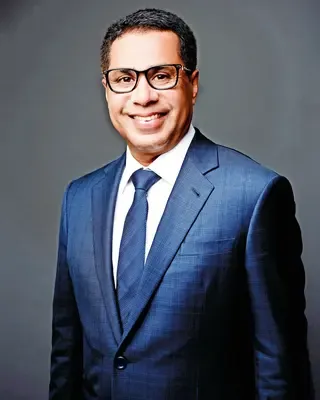
Mohammad Ali Rashed Lootah, President and CEO of Dubai Chambers, said sustained engagement with the private sector remains central to the UAE’s resilience framework.
“Constructive and effective dialogue with Dubai’s business community forms a key pillar in sustaining economic growth and strengthening resilience in adapting to rapid global developments,” he said.
Business leaders echoed the same sentiment. Faizal Kottikollon, Chairman of the UAE-India Business Council (UIBC-UC), and Chairman of KEF Holdings, said the UAE’s strong fiscal buffers, world-class infrastructure and proactive policy coordination between regulators and the private sector position the economy to absorb regional shocks and rebound quickly, reinforcing its reputation as a safe haven for global capital.
“Swift engagement by institutions such as the Central Bank, Dubai Chambers and sovereign investors signals a high level of preparedness to safeguard liquidity, trade flows and business continuity amid geopolitical uncertainty. Together, these strengths reassure investors that the UAE remains one of the region’s most stable and forward-looking economic hubs, capable of turning disruption into opportunity,” said Kottikollon.
Faizal Kottikollon, Chairman of the UAE-India Business Council (UIBC-UC), and Chairman of KEF Holdings
Siddharth Balachandran, Chairman of the Indian Business and Professional Council, described the government’s response as “reassuring and forward-looking,” adding that the country’s preparedness continues to reinforce long-term investor confidence.
Steps to reinforce stability
The Central Bank of the UAE complemented these efforts with a proactive liquidity support package allowing banks to draw up to 30% of their cash reserve requirement balances while also providing additional dirham and dollar funding facilities.
The regulator said the measures were designed to “enhance the resilience of the financial system and support continued lending to the real economy,” ensuring uninterrupted access to credit for businesses and households.
With foreign exchange reserves exceeding Dh1 trillion and reserve balances above Dh400 billion, analysts say the UAE’s financial system entered the current geopolitical phase from a position of exceptional strength. Ratings agencies such as Fitch Ratings have confirmed that GCC banks remain highly capitalised and liquid, supported by strong deposit bases and conservative regulatory oversight.
Markets rebound quickly
Equity markets have already begun reflecting renewed investor confidence after initial volatility. Abu Dhabi’s benchmark index climbed towards 9,556 with trading volumes exceeding Dh1.66 billion, while Dubai’s index surged more than 4% to around 5,505, led by gains in property and banking stocks including Emaar Properties and Emirates NBD.
Economists say the speed of the rebound underscores a defining feature of the UAE’s economic architecture: the ability to restore investor confidence rapidly through policy clarity and institutional coordination.
International lenders are equally supportive. Georges Elhedery, Group Chief Executive of HSBC, reaffirmed the bank’s long-term commitment to the Gulf, describing the region as one of the world’s most attractive growth corridors linking major trade routes across continents.
Strength anchors outlook
Confidence in the UAE’s outlook remains firmly anchored in its sovereign fundamentals. Both S&P Global Ratings and Fitch Ratings have reaffirmed the country’s AA/Stable rating, citing strong fiscal buffers, diversified growth engines and one of the world’s largest pools of sovereign wealth assets.
S&P noted that the UAE’s fiscal and external positions remain among the strongest globally, enabling policymakers to absorb geopolitical shocks without undermining macroeconomic stability.
At the regional level, the International Monetary Fund has similarly highlighted large sovereign wealth assets and diversification reforms as key factors underpinning Gulf resilience, while the World Bank emphasised sustained infrastructure and logistics investment as drivers strengthening long-term growth prospects.
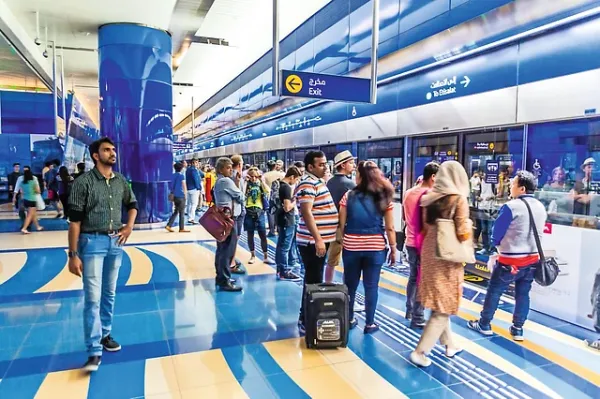 DUBAI, UAE - MARCH 10, 2017: Interior of BurJuman metro station in Dubai, UAE.
Investors pausing, not withdrawing
Advisory firms monitoring capital flows say global investors are adopting a “wait-and-watch” stance rather than exiting the UAE market. Strategic advisory firm GCG Structuring reported that none of its more than 200 investor and business-owner clients had liquidated operations or left the jurisdiction despite regional tensions.
Peter Ivantsov, founder and managing partner of GCG Structuring, said the dominant investor mindset remains forward-looking.
“The questions from investors are not about exits but about positioning for the recovery phase,” he said. “Do not confuse short-term disruption with structural weakness.”
He added that sophisticated investors continue to view regulatory certainty, contract enforcement and systemic stability as critical anchors supporting long-term commitments to the UAE market.
Property sector holds firm
Dubai’s real estate market — traditionally a sensitive indicator of investor sentiment — is also demonstrating notable stability. Data from Smart Bricks shows that 85 per cent of landlords are not considering selling their properties despite regional tensions, signalling sustained confidence in long-term fundamentals.
Residential listings increased only modestly from about 105,300 in late February to roughly 110,800 by mid-March, far below levels typically associated with panic-driven exits.
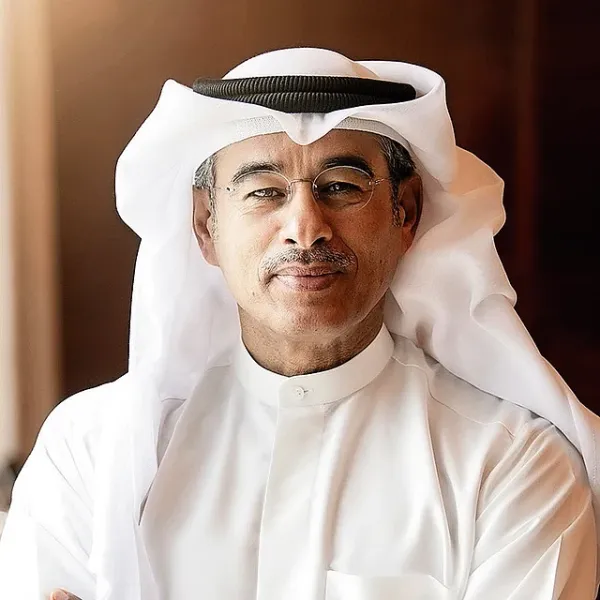
Mohamed Alabbar, founder of Emaar Properties
Transaction activity remains robust. Dubai recorded more than 6,048 residential deals worth Dh20.2 billion over the same period, with nearly two-thirds concentrated in off-plan developments backed by established developers.
Mohamed Alabbar, founder of Emaar Properties, confirmed that instalment collections from off-plan buyers remain strong and capital inflows into the sector continue at healthy levels despite temporary disruptions linked to regional uncertainty.
Consultancies such as Knight Frank and CBRE continue to highlight rental yields of 6–8 per cent across several Dubai communities — among the highest in major global cities — as a key factor sustaining investor appetite.
Financial hub momentum
Another powerful signal of investor confidence is the continued expansion of the Dubai International Financial Centre, which added 1,924 new companies in 2025 alone, reinforcing its position as one of the fastest-growing financial centres globally.
Economists say the DIFC’s growth reflects a structural shift rather than a cyclical surge, as multinational firms increasingly use Dubai as a regional headquarters for operations spanning emerging markets across Africa, South Asia and the Middle East.
Reassuring infrastructure continuity
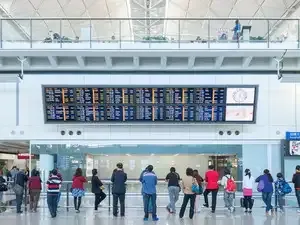
Even amid geopolitical uncertainty, aviation, logistics and digital infrastructure networks across the UAE continue operating seamlessly — a critical factor sustaining business confidence during periods of regional stress.
Analysts note that the country’s ability to maintain operational continuity reflects a governance model built on foresight, diversification and strong coordination between public and private sectors.
The experience echoes earlier shocks, including the global financial crisis and the Covid-19 pandemic, when the UAE’s institutional response helped restore confidence quickly and support economic recovery ahead of many peer markets.
Structural strengths outweigh caution
Some investors have temporarily slowed transaction timelines, particularly in segments such as secondary luxury property markets, but analysts stress that this represents a recalibration rather than a retreat.
Dubai Land Department data illustrates continued momentum. Between March 2 and March 9 alone, the emirate recorded 3,570 property transactions worth Dh11.93 billion — a strong performance during a period of heightened geopolitical uncertainty.
Industry observers say this pattern reflects a maturing investment cycle in which long-term capital is increasingly prioritising income-generating assets over speculative trades.
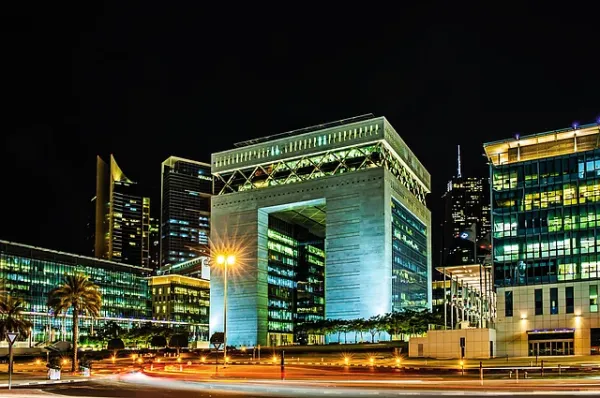
The Gate - main building of Dubai International Financial Centre, the fastest growing international financial centres in Middle East.
Confidence reinforced by institutions
Policy analysts argue that the UAE’s ability to maintain stability during crises reflects not only economic strength but also institutional preparedness. Dr Ebtesam Al Ketbi, President of the Emirates Policy Centre, said the country’s response to regional escalation demonstrated a sophisticated crisis-management model capable of protecting both infrastructure and financial stability.
She noted that the UAE has successfully ensured continuity across vital services while reinforcing confidence in the sustainability of its development trajectory.
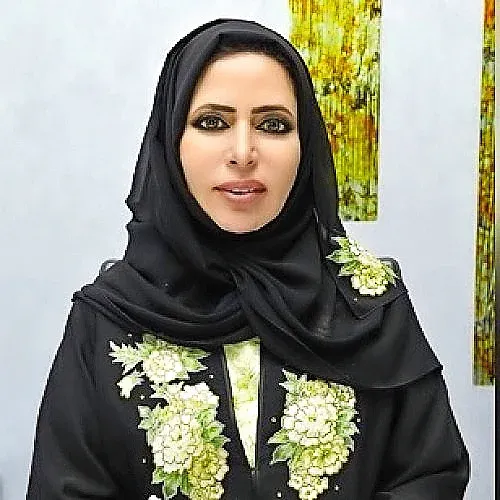
Dr Ebtesam Al Ketbi, President of the Emirates Policy Centre
The broader lesson for investors, economists say, is that the Emirates’ resilience is structural rather than episodic — supported by diversified growth engines, strong sovereign buffers, regulatory clarity and global connectivity.
As regional tensions evolve, these strengths continue to shape investor perceptions of the UAE as a dependable safe haven for capital and enterprise. For global businesses assessing risk in an uncertain geopolitical landscape, the country’s performance under pressure is sending a consistent signal: stability in the UAE is not temporary — it is embedded in the system.