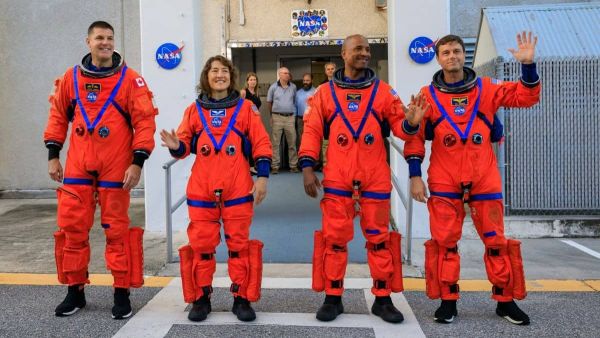
NASA’s Artemis II mission, beginning April 1, will mark humanity’s return to deep space with a crewed journey around the Moon. But during this mission, there will be a phase often referred to as a “period of loss”, a moment when communication between the spacecraft and Earth temporarily breaks down. Despite the ominous name, this is a planned and well-understood part of lunar missions.
The “period of loss” refers to a temporary loss of communication signal between the Orion spacecraft and Earth. This happens when the spacecraft passes behind the Moon relative to Earth, physically blocking radio signals.
NASA expects this blackout to last around 40 minutes. During this time, no voice, video, or telemetry data can be transmitted between the astronauts and mission control because the Moon itself acts as a barrier to communication signals.
This is not a malfunction or failure. It is a predictable limitation of current space communication systems, which rely on line-of-sight radio links.
Artemis II follows a lunar flyby trajectory, where the Orion spacecraft travels around the far side of the Moon before returning to Earth.
When Orion moves behind the Moon, it enters a region where Earth-based communication networks such as NASA’s Deep Space Network cannot reach it. Even with advanced systems, including experimental laser communication payloads, the fundamental issue remains the same: signals cannot pass through the Moon.
This is why every crewed lunar mission, including those during the Apollo era, experienced similar communication blackouts.
Operationally, the impact is significant but manageable. During the blackout:
This places a greater emphasis on crew training and onboard systems. Artemis II astronauts are trained to operate independently during this phase, relying on pre-planned procedures and automated systems.
At the same time, the spacecraft continues to function normally. Navigation, propulsion, and life-support systems operate without needing constant input from Earth.
Several outcomes are possible during the period of loss, most of them routine:
The period of loss is not just a limitation. It is also a test. Artemis II is the first crewed mission beyond low Earth orbit in over 50 years, and operating without continuous ground support is a key capability for future missions.
As NASA moves toward long-duration missions to the Moon and eventually Mars, communication delays and blackouts will become more common. Artemis II provides an opportunity to evaluate how crews and systems perform under these conditions.