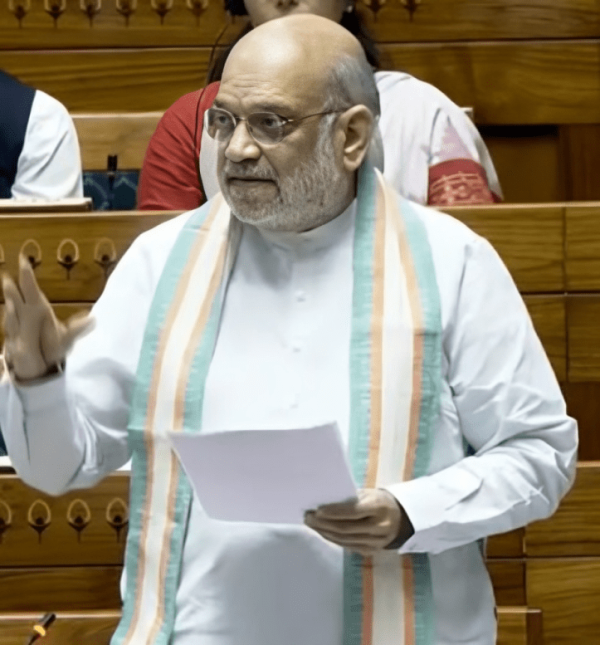
The discussion on a serious national issue like Naxalism in the Lok Sabha in New Delhi heated up the political atmosphere. During this time the Union Home Minister Amit Shah Attacking the Congress strongly, he raised many questions on the policies and functioning of its rule. In his speech, he said that despite being in power for decades, Congress has failed in proper development of tribal areas.
The Home Minister said that in the areas where Naxalism was most effective, people there could not get basic facilities like permanent houses, drinking water, education and banking services on time. He raised the question why these areas were not developed despite such a long rule. Shah claimed that the current government, led by Narendra Modi Now, rapid development work is going on in these areas and concrete steps are being taken to root out Naxalism.
During his speech, Shah also mentioned the issue of recently killed notorious Naxalite Hidma. He alleged that after the incident, inflammatory slogans were raised at some places and such material was shared on social media. In this context, Congress leader Rahul Gandhi He also said that his silence on such matters raises many questions.
The Home Minister also alleged that Rahul Gandhi, many times in his political career, has been in contact with people and organizations who are considered sympathetic to the Naxal ideology. Citing some public programs and meetings, he said that the seriousness of these relations cannot be ignored.
Other than this, Amit Shah He also mentioned the National Advisory Council (NAC) formed during the UPA government. Describing it as an extra-constitutional institution, he said that it is headed by Sonia Gandhi and some of its members and their associated organizations were accused of being associated with pro-Naxal ideology. Shah said that influencing policy making through such institutions was worrying for the democratic structure.
former home minister P. Chidambaram Citing an old statement of Shah also raised questions on the policies of Congress. He said that at that time the government’s stance towards Naxal violence seemed weak, which boosted the morale of these organizations and they became more active.
Shah also said that the present government has paid equal attention to security as well as development in Naxal-affected areas. Many schemes have been launched to increase roads, electricity, internet connectivity and employment opportunities. He said that development is the only permanent solution to Naxalism and the government is continuously working in this direction.
During the debate on this issue in the Lok Sabha, opposition parties also raised questions on the government and alleged that Naxalism has not been completely eradicated. He expressed concern about security strategies and implementation at the ground level. However, the ruling party rejected these allegations and said that there has been a significant decline in the incidents of Naxal violence in the last few years.
During this debate, many heated exchanges were seen in the House. The round of allegations and counter-allegations continued between the two sides, which made it clear that the issue of Naxalism still remains a sensitive and important topic in the country’s politics.
Experts believe that the solution to the problem like Naxalism is not possible only through security forces, but it requires comprehensive reforms at the social, economic and political levels. Permanent peace can be established in these areas only through the availability of education, employment and basic facilities.
Overall, this debate in the Lok Sabha not only highlights the current form of Naxalism, but also shows that there are deep differences among political parties on this issue. While on one hand the government is calling its efforts effective, the opposition is considering them incomplete and inadequate. In the coming times, it will be important to see what concrete steps are taken in this direction and how effective their impact on the ground proves to be.