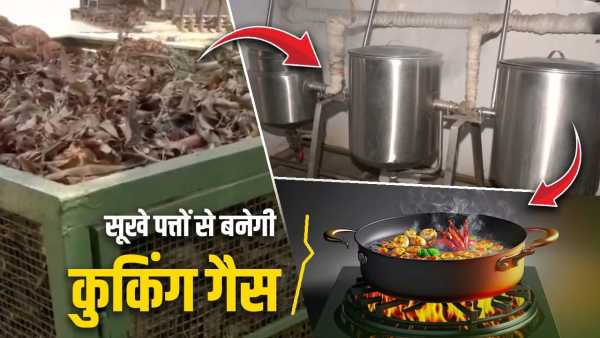
Indian Institute of Technology Bombay (IIT Bombay) has found an alternative to LPG and PNG. The institute has developed indigenous technology to convert dry leaves and twigs into cooking gas. This technology is not only cheap but can also prove to be very beneficial for the environment. This achievement has been achieved after about 10 years of research. Through this new technology, dry leaves can be converted into energy. This will not only provide an alternative to fuel but will also reduce pollution. Professor Sanjay Mahajani of the Department of Chemical Engineering, IIT Bombay has explained the working of this technology and how cooking gas can be made from dry leaves.
Professor Sanjay Mahajani of the Chemical Engineering Department of IIT Bombay said that this project was started in 2014. The main objective of this research was to find out how to convert natural waste into useful energy. A large quantity of dry leaves and twigs, which were generally considered useless, were stored in the institute's premises. Scientists decided to turn this problem into an opportunity. After working on different experiments and designs for many years, this technology was made successful. Now this model is ready for use on a large scale and in future it can be implemented in other places also.
#WATCH | Mumbai, Maharashtra: The Indian Institute of Technology (IIT) Bombay has developed an indigenous technology to combat the rising prices and potential shortages of LPG (cooking gas). Through its patented biomass gasification technology, the institute has successfully pic.twitter.com/rVVIFDrKGV
— ANI (@ANI) March 31, 2026
In this technique, first of all dry leaves and twigs are converted into small pellets. For this, they are pressed and given a solid form so that they can be used easily. After this these pellets are put into a special type of gasifier. Here they are heated in a controlled environment due to which they turn into gas instead of burning directly. This entire process is called gasification. This process is different from normal burning because it uses energy more effectively and losses are less.
Professor Sanjay Mahajani says that the gas produced by this process is called producer gas. It mainly contains carbon monoxide and hydrogen gas. This gas is burnt immediately, releasing a lot of energy. This energy is used to convert water into steam. This steam can then be used in canteens and other steam-based cooking systems. In this way food can be cooked without LPG. This technology can prove to be very useful especially for big institutions and community kitchens.
Professor Sanjay Mahajani said that generally direct burning of dry leaves causes a lot of smoke and pollution. Especially in this, a lot of particulate matter is released which is harmful for health. But in this new technology, the gasifier has been designed in such a way that the emissions are very low. When producer gas burns, the smoke coming out of it is very less and clean. This has less impact on the environment. Besides, energy is also used in a more efficient manner, making this technology sustainable and beneficial.
The use of this technology has already started in the campus of IIT Bombay. The steam generated here is being used for cooking and other needs in the canteen. This has reduced dependence on LPG and also reduced expenses. Apart from this, the waste accumulated in the campus is also being utilized properly. This model shows how institutions can better utilize their resources and become self-reliant.
In a country like India where LPG prices are continuously increasing, this technology can become a big solution. Especially in rural areas and small towns where dry leaves and biomass are easily available, it can be used on a large scale. This will not only reduce the energy crisis but will also help in environmental protection.