April Fool’s Day: Every year with the arrival of spring comes the day of 1st April, when people start playing fun pranks with their friends and family. It is celebrated as April Fools’ Day across the world. But have you ever wondered how this fun tradition started? Interestingly, historians do not agree about the exact origins of this tradition. Let’s take a look at some of the major theories behind this.
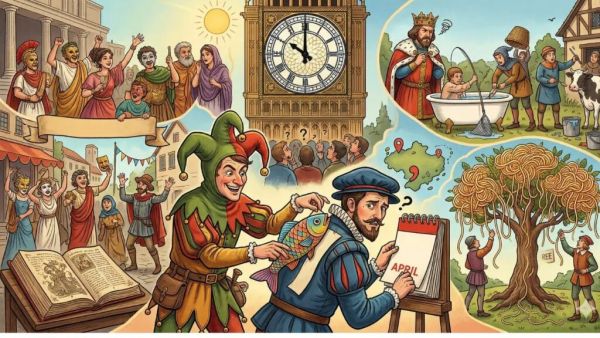
The most popular theory among historians is to 16th century France. At that time the New Year was celebrated around the spring equinox, i.e. on 1 April. Later the calendar was changed and the new year started starting from January 1. Those who learned of this change late or who wanted to maintain the old tradition continued to celebrate on April 1 and were ridiculed. Such people came to be called April Fools. In France, this day is still called Poisson d’Avril, where children stick paper fish on each other’s backs.
Some experts believe that the day has its roots in the ancient Roman festival of Hilaria, where people celebrated the change of seasons by dressing up and having fun. At the same time, according to British folklore, it started in the 13th century from Gotham village in Nottinghamshire. When King King John attempted to build a hunting lodge on village land, the villagers performed strange acts to prove he was mad. The king’s soldiers considered him a fool and returned. It is said that this day is celebrated in the memory of this cunningness of the villagers.
An interesting rule that dates back to 1851 is that April Fool’s pranks are only valid until 12 noon on April 1st. It is believed that the truth behind the joke should be told after 12 noon. If someone pranks even after 12 o’clock, he is considered the biggest ‘fool’.
Spaghetti Growing on Trees (1957): One report claimed that spaghetti grows on trees in Switzerland. The audience believed this to be true and started asking about ways to grow trees.
Fantasy San Serif Island (1977): An entire travel guide was printed for a fictitious island called a san serif, which was actually shaped like a semi-colon (;).
Digital Big Ben (1980): London’s famous Big Ben clock will now become completely digital, over which people had created a lot of uproar.