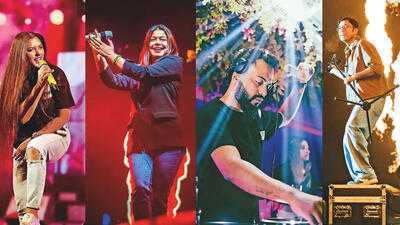
Kolkata’s musical heartbeat pulses through its streets, stages, and studios, shaping artistes across genres and generations. As CT turns 25, musicians Somlata, Iman Chakraborty, Anupam Roy, Oh Arya, Arcane, Indrayuddh Majumdar, and Sambit Chatterjee talk about how the city inspires, challenges, and defines their artistic journeys.
SOMLATA:
Rooted in Kolkata’s rich cultural fabric, Somlata says Bengal and its music have shaped her artistic sensibility. Growing up on songs by Anjan Dutt, Kabir Suman and Nachiketa, along with the musical evolution from adhunik Bangla gaan to band culture, she says, “These influences defined the way I perceive, think about, and listen to music”. She recalls how, during Pujo, people eagerly awaited the albums of their favourite artists, calling it a time that now feels nostalgic. Equally vivid are her childhood memories of neighbourhood rehearsals during Poila Boishakh and other occasions, where makeshift stages brought together music, dance and theatre. It was here that the “dream of singing with a mic in hand” first took shape, a dream that, today, makes her journey feel “truly surreal”.
Stage dynamics
Over nearly 15 years, Somlata says live performance has shifted from instinct to structure. Early on, the focus was on “singing correctly, keeping rhythm”, and setlists. However, now, as she puts it, live performances are more of an act: “From staging and audience interaction to visuals and lighting, everything is pre-planned. Things are much more detailed now, unlike then.”
ARCANE
Shiladitya Bose aka Arcane’s journey into EDM began near his school – where Music World introduced him to artistes like Armin van Buuren, Deadmau5, and Skrillex. “These were sounds completely different from India’s pop and rock scene,” he says. Already learning drums and tabla, he wanted “to find a way to combine all of that,” and realised music was something he wanted to pursue. Starting professionally in Kolkata, he faced challenges experimenting with a new sound, where audiences expected Bollywood remixes, but he adds, “once people experienced it, they loved it
.”
Electronic shift
Over 12 years, Arcane has seen EDM perception shift: “People have become more open to experimental sounds.” Playing at fests across India and observing international artistes helped him grow. He adds, “Streaming platforms allow listeners to explore global music and discover various sub-genres,” shaping both his craft and audience.
SAMBIT CHATTERJEE
Sambit says, “One of the first pieces I ever made as a kid came from recording sounds around Southern Avenue, using an old Walkman.” He adds, “I was also surrounded by music at home, especially through my father (Pt Subhen Chatterjee) and his band Karma.” For him, the city itself is a living soundscape, the rhythm of which doesn’t conform to the speed of the outside world – a quality he loves.
Appreciative yet discerning
Calling Kolkata audiences “strict” yet deeply appreciative of originality, he notes they don’t follow trends blindly, even if that makes selling tickets harder. While newer festivals and big gigs draw crowds, he urges listeners to support independent shows, reminding them to “give independent musicians a chance.”
INDRAYUDDH MAJUMDAR
Born and raised in Kolkata, Indrayudh Majumdar ’s musical sensibilities were shaped by the city’s diverse soundscape – from Rabindra Sangeet, Nazrul Geeti, folk traditions to Bangla band music and the works of Salil Chowdhury and RD Burman. He reflects, “I owe much of my musical sensibility to the city,” and credits Kolkata for nurturing experimentation: “Whenever I present something, it is received with openness.” Beginning his professional journey at 26, he learned to shed inhibitions, recognising that Kolkata audiences “know the quality of music instinctively.”
The Mecca
of music
“The city has always been the Mecca for Indian classical music,” he notes, recalling how most legends – be it Pt Ravi Shankar, Ustad Ali Akbar Khan, or Girija Devi, to name a few – were either from Kolkata or spent a substantial part of their lives in the city. Talking about the current scenario, he observes that over the last decade, classical concerts, such as his Swara Samrat Festival, have drawn younger audiences compared to earlier times.
OH ARYA
Born into a musical family, Aryaditya Bose began learning the tabla at just five. While learning, he noticed “there are a lot of verbal interactions with music, which are very similar to what we do in rap – you say syllables with words, and in tabla, you say syllables too.” This natural connection drew him into hip hop, and he soon discovered a passion for producing beats for other artistes, including Paradox during lockdown. Reflecting on that moment, he said, “I felt this was the right direction, so I dove into it,” eventually merging classical music with rap to create his own identity. He added that friction with tradition “used to fuel my music journey.”
Best of both worlds
Oh Arya describes his hip-hop style as “a mix of two worlds,” pointing to songs like his latest release – Jhal, which blend classical samples with trap drums. He enjoys embedding cultural anecdotes, noting, “I like to bring these two worlds together and experiment with unique flows and words,” representing his Bengali roots while staying true to hip hop’s evolving landscape.
ANUPAM ROY
Rooted in Kolkata, Anupam reflects on how the city influenced him long before he could influence it, saying, “I was born and raised here. All my thoughts, all my words are shaped by this city.” Looking back, he recalls “the Kolkata Book Fair at the Maidan” as a formative space, first with his parents and later with friends, where books “naturally found their way” into his music. From the distinct energy of College Street to early film experiences at New Empire and Chaplin, he notes how these “small things” shaped his outlook. “The most distinctive bit was the city’s soundscape. Passing through any lane, you could hear someone practising on the harmonium, an FM playing, and so on. The neighbourhood cultural life makes Kolkata inescapable,” he says.
Soundscape in transition
Observing audience behaviour in Kolkata, he says, “what works in the market is what dominates the soundscape, in turn shaping listening habits.” On the other hand, he notes that live music remains a “largely disorganised industry” despite efforts to structure it. Turning to the broader Indian context, he says, “the last decade saw many women-centric films do well,” but feels “this decade is more inclined towards aggressive, macho content,” hoping for another shift around the corner.
IMAN CHAKRABORTY
Performing professionally for over 12 years now, Iman’s musical journey began much earlier. Considering herself a live performer before a playback singer, she says, “The artiste-audience equation is reciprocal. What an artiste performs on stage depends on how the audience responds.” She adds that ticketed shows also need revival. Recalling how FM radio – once a catalyst for Bengali music – no longer promotes it, she credits Anupam Roy with changing the scenario by bringing Bangla music back to popular platforms.
Artistic evolution
Tracing her journey, Iman says, “I’ve evolved a lot as an artiste. Having started my career as a Rabindra Sangeet singer, I moved to folk, and when Praktan (2016) happened, it opened many doors for me. I began singing Hindi songs and ghazals, things I didn’t know I could sing.” She adds that those increased her confidence and her desire to create, as she now hopes to include English songs and offer a “365-degree experience” to her listeners.