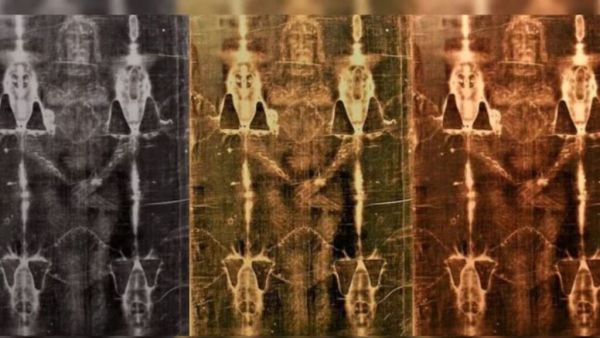
The Shroud of Turin – which believers link to the burial of Jesus Christ after the crucifixion – may have been in contact with people from the Indian subcontinent, a new genomic study has found.
The authors of the study hypothesise that the shroud may have picked up India- DNA from textile trade of the past. This is based on the “unexpected” finding that as much as 38.7% of DNA “contamination” in it came from people with India- maternal lineage .
This is “potentially linked to historical interactions associated with importing linen or yarn from regions near the Indus Valley, referred to as “Hindoyin” according to rabbinic text, ” the authors wrote.
The Indus region being known even from pre-historic times for the quality of its textiles, the researchers said the India- DNA could have come from people there during the import of yarn or linen.
The Shroud of Turin is 4.4m x 1.1m piece of linen that is venerated by Catholics as the cloth used to wrap the body of Jesus Christ after it was taken down from the cross. It bears a faint image of the front and back of a naked man, with impressions seemingly showing wounds consistent with crucifixion.
Its documented history starts 1354 in the new collegiate church of Lirey, a village in France. Over the centuries it has been viewed as a miracle by many and a forgery
by some. Since 1683 it has been kept at the Chapel of the Holy Shroud, in the Italian city of Turin.
Crucially, what the study did not find was at what time in history this contact with Indians happened: as early as 33 AD, which is believed to be the time of the crucifixion; before 1354 when tradition maintains the shroud travelled across the Near East and Anatolia; or post 1354, from when there is clear record of the shroud being venerated in France and Italy.
Apart from the DNA possibly linked to its collector Baima Bollone and the India- maternal DNA, over 55.6% of the human DNA on the shroud corresponded to lineages from the Near East, and less than 5.5% to Western European lineages.
Due to such heavy contamination the researchers could not find the original DNA, meaning they could not conclude whether the shroud indeed was connected to the biblical Jesus of Nazareth.
The shroud bore biological traces of “centuries of social, cultural, and ecological engagement” There were DNA traces from several animals and plants from the Mediterranean region, and even from plants like potatoes and maize which originated in the Americas – all of which point to exposure to several people and places in later centuries.
But, notably, the researchers could not locate a definitive trace of flora linked uniquely to the ancient Near East.
The study led by Italian researcher Gianni Barcaccia is titled ‘DNA Traces on the Shroud of Turin: Metagenomics of the 1978 Official Sample Collection’ and has been published in the pre-print server bioRxiv