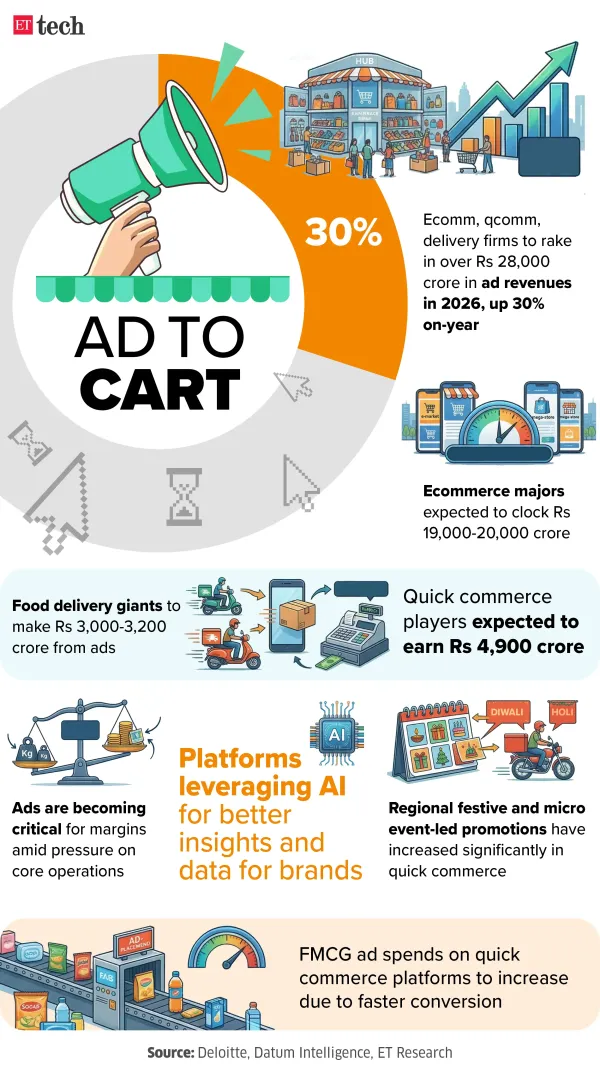
Ecommerce, quick commerce and food delivery platforms are projected to generate more than Rs 28,000 crore in revenue from advertising in 2026, up 30% from last year, making ads a critical margin lever for these entities working on narrow margins.
Ecommerce majors such as Amazon and Flipkart are expected to clock Rs 19,000-20,000 crore in ad revenue in 2026, up from the previous year’s Rs 16,000 crore, according to data shared by Deloitte.
Quick commerce platforms, including Blinkit, Instamart and Zepto, are expected to clock Rs 4,900 crore in ad revenue this year, up from Rs 3,000 crore posted the previous year, according to Datum Intelligence.
Food delivery giants Zomato and Swiggy are expected to clock 20-25% jump in their combined 2025 ad revenue of Rs 2,500 crore, a senior industry executive said.
These platforms, where discovery and purchase are tightly integrated, have emerged as a big online advertising engine. Quick commerce is seeing the fastest ramp-up, aided by high-frequency usage and limited in-app inventory, while ecommerce continues to anchor overall volumes of ad spends.
“Given that quick commerce gives brands the ability to attribute success or failure through data, a lot of campaigns have moved there,” said Anand Ramanathan, partner and consumer industry leader at Deloitte India. “Eventually, quick commerce is going to be critical, probably making up half of all ecommerce spend in the coming years.”
Also Read: ETtech Explainer: Q3 results show Blinkit and Instamart on different paths amid rising competition
Eternal, which owns Blinkit, saw its quick commerce order volumes grow 120% year-on-year to 243.3 million in the October-December quarter while rival Swiggy, which runs Instamart, clocked a 45% rise at 106.4 million orders.
Emails sent to Amazon, Flipkart, Eternal, Swiggy and Zepto did not elicit response until press time on Wednesday.
“Ad revenue is critical for these companies,” Siddharth Jhawar, country manager-India at Tiger Global-backed adtech firm Moloco, told ET. “While ad revenue may look smaller as a proportion of total revenue, it has much higher margins… Without ad revenue, perhaps all platforms will see themselves in losses, because delivery fees and merchant commissions typically do not break even the overall cost,” he added.
Moloco builds tech solutions for consumer internet platforms offering advertising opportunities.
Ashish Dhir, senior director, consumer and retail, at market intelligence firm 1Lattice, said at least 5-6% of the large FMCG company’s ad spends are going into quick commerce. “These spends are increasing because the ad turnaround or the impact is faster. FMCG companies in snacks, food and beverage, ice creams, or even commodities like pulses, or items like dosa batter, are shifting their spend from other sources to other,” he said.
Over the past year, festive sales and micro event-led shopping promotions have increased significantly on quick commerce. Pages for such regional festivals or events, featuring essential products for each occasion, now have brand sponsors and banner ads where consumer goods companies display their brands.
Instamart even has a segment highlighting upcoming events each week.
Also Read: Quick commerce expands beyond groceries with VC funding, but scale questions persist
AI arms insights
As brands are increasing their ad spends, platforms are leveraging artificial intelligence (AI) to help in better tech-driven ads and insights.
For context, executives in the space look at advertising on apps as primarily two processes – sales driven or tech driven. Sales-driven ads are those which are put on the homepage, banner or payments page, directing a user to make a purchase. Tech-driven ads are those in which platforms use data and keywords.
A senior executive at a global advertising firm said extracting more ad revenue at the current GMV is increasingly getting tough for platforms. “Overall ad revenue will be driven by better tech like AI that delivers more relevant ads and the broader platform's growth,” the person said.
GMV, or gross merchandise value, refers to the total value of goods sold on a platform.
Quick commerce platforms have started using AI for providing consumer insights to brands. “We’ve been actively using AI to improve ad monetisation, from finely targeting users based on their consumption patterns to factoring in real-time SKU (stock keeping units) availability within hyperlocal delivery zones,” a Gurgaon-based quick commerce executive said.
In May 2025, Zepto launched a subscription-based analytics tool called Zepto Atom, built on top of Zepto GPT, for brands providing them with real-time insights, customer impressions, conversion rates, and consumption patterns.
Ecommerce majors such as Amazon and Flipkart are expected to clock Rs 19,000-20,000 crore in ad revenue in 2026, up from the previous year’s Rs 16,000 crore, according to data shared by Deloitte.
Quick commerce platforms, including Blinkit, Instamart and Zepto, are expected to clock Rs 4,900 crore in ad revenue this year, up from Rs 3,000 crore posted the previous year, according to Datum Intelligence.
Food delivery giants Zomato and Swiggy are expected to clock 20-25% jump in their combined 2025 ad revenue of Rs 2,500 crore, a senior industry executive said.
These platforms, where discovery and purchase are tightly integrated, have emerged as a big online advertising engine. Quick commerce is seeing the fastest ramp-up, aided by high-frequency usage and limited in-app inventory, while ecommerce continues to anchor overall volumes of ad spends.
“Given that quick commerce gives brands the ability to attribute success or failure through data, a lot of campaigns have moved there,” said Anand Ramanathan, partner and consumer industry leader at Deloitte India. “Eventually, quick commerce is going to be critical, probably making up half of all ecommerce spend in the coming years.”
Also Read: ETtech Explainer: Q3 results show Blinkit and Instamart on different paths amid rising competition
Eternal, which owns Blinkit, saw its quick commerce order volumes grow 120% year-on-year to 243.3 million in the October-December quarter while rival Swiggy, which runs Instamart, clocked a 45% rise at 106.4 million orders.
Emails sent to Amazon, Flipkart, Eternal, Swiggy and Zepto did not elicit response until press time on Wednesday.
“Ad revenue is critical for these companies,” Siddharth Jhawar, country manager-India at Tiger Global-backed adtech firm Moloco, told ET. “While ad revenue may look smaller as a proportion of total revenue, it has much higher margins… Without ad revenue, perhaps all platforms will see themselves in losses, because delivery fees and merchant commissions typically do not break even the overall cost,” he added.
Moloco builds tech solutions for consumer internet platforms offering advertising opportunities.
Ashish Dhir, senior director, consumer and retail, at market intelligence firm 1Lattice, said at least 5-6% of the large FMCG company’s ad spends are going into quick commerce. “These spends are increasing because the ad turnaround or the impact is faster. FMCG companies in snacks, food and beverage, ice creams, or even commodities like pulses, or items like dosa batter, are shifting their spend from other sources to other,” he said.
Over the past year, festive sales and micro event-led shopping promotions have increased significantly on quick commerce. Pages for such regional festivals or events, featuring essential products for each occasion, now have brand sponsors and banner ads where consumer goods companies display their brands.
Instamart even has a segment highlighting upcoming events each week.
Also Read: Quick commerce expands beyond groceries with VC funding, but scale questions persist
AI arms insights
As brands are increasing their ad spends, platforms are leveraging artificial intelligence (AI) to help in better tech-driven ads and insights.
For context, executives in the space look at advertising on apps as primarily two processes – sales driven or tech driven. Sales-driven ads are those which are put on the homepage, banner or payments page, directing a user to make a purchase. Tech-driven ads are those in which platforms use data and keywords.
A senior executive at a global advertising firm said extracting more ad revenue at the current GMV is increasingly getting tough for platforms. “Overall ad revenue will be driven by better tech like AI that delivers more relevant ads and the broader platform's growth,” the person said.
GMV, or gross merchandise value, refers to the total value of goods sold on a platform.
Quick commerce platforms have started using AI for providing consumer insights to brands. “We’ve been actively using AI to improve ad monetisation, from finely targeting users based on their consumption patterns to factoring in real-time SKU (stock keeping units) availability within hyperlocal delivery zones,” a Gurgaon-based quick commerce executive said.
In May 2025, Zepto launched a subscription-based analytics tool called Zepto Atom, built on top of Zepto GPT, for brands providing them with real-time insights, customer impressions, conversion rates, and consumption patterns.