Iran’s Islamic Revolutionary Guard Corps (IRGC) on Thursday, April 2, said it had targeted an Amazon cloud computing centre in Bahrain, marking a significant escalation as the conflict with the United States and Israel expands into critical infrastructure.
Iranian media said the strike formed part of the third phase of the 90th wave of “Operation True Promise 4”, signalling a widening scope of operations beyond conventional military targets.
The Israeli military said it will continue expanding strikes targeting Iranian systems and capabilities as hostilities intensify across multiple fronts.

It said around 20 missiles were launched from Iran and about 150 projectiles from Lebanon towards Israel in the past 24 hours, reflecting sustained pressure from both theatres.
Israel’s military said it carried out a strike on the central headquarters of the IRGC in Tehran, describing it as a key node in Iran’s military network.
According to the military, the facility was used to manage budgets and coordinate activities linked to Iran’s network of armed groups abroad.
Iran fired missiles towards Israel and Gulf Arab states on Thursday, underscoring its continued offensive capability despite US assertions that Tehran’s threat had been significantly reduced.
The strikes, combined with Iran’s influence over the Strait of Hormuz, have disrupted global energy flows and reinforced its strategic leverage.
Esmaeil Baqaei accused the United States and Israel of attacking the Pasteur Institute of Iran, a major public health and research centre in Tehran.
He described the alleged strike as “heartbreaking, cruel, despicable, and utterly outrageous”, calling it an assault on a key scientific institution established in 1920.
Iran’s two largest steel plants have been forced out of operation following repeated US and Israeli attacks, highlighting growing damage to the country’s industrial base.
Khuzestan Steel Company said restoring operations could take six months to one year, while Mobarakeh Steel Company confirmed its production lines have completely shut down.
At least 2,076 people have been killed and 26,500 injured in US-Israeli strikes across Iran since February 28, according to the Iranian Health Ministry.
Iran’s Foreign Ministry said more than 600 schools and educational institutions have also been hit, pointing to the widening civilian impact.
Israel said it has killed around 1,000 Hezbollah operatives, including members of the group’s elite Radwan Force, since the escalation began.
The figures reflect the scale of Israeli operations along the Lebanon front as cross-border hostilities continue.
Israeli air strikes have killed at least 1,345 people, including 125 children and 91 women, with more than 4,000 injured, according to Lebanon’s health ministry.
The growing toll highlights the humanitarian impact of the conflict as strikes continue to hit populated areas.
Nawaf Salam warned that Lebanon is becoming a victim of a “war of others” as tensions escalate.
He said more than 1 million people have been displaced, raising concerns over a broader regional spillover.
Abdul Malik al-Houthi said the Iran-backed group has carried out missile and drone strikes in coordination with regional operations.
He added that the group would not remain on the sidelines as the conflict intensifies.
Mohammad Bagher Qalibaf said around 7 million Iranians are ready to take up arms in the event of a US ground invasion.
He has also issued a series of statements challenging Washington, even as he is viewed as a possible figure in future negotiations.
Kamal Kharazi was severely wounded in an airstrike, while his wife was killed, according to Iranian media reports.
The incident reflects the growing targeting of high-profile figures amid the escalating conflict.
Iranian authorities said five people were detained in Zanjan over alleged links to “hostile” networks.
Officials accused them of acting in coordination with external actors, though further details were not disclosed.
Qatar said it intercepted multiple drones and also wrote to Antonio Guterres condemning Iranian strikes between March 28 and April 1, including one targeting an oil tanker.
Kuwait reported shooting down four drones, while the UAE said it intercepted 19 ballistic missiles and 26 drones, reflecting the widening regional threat.
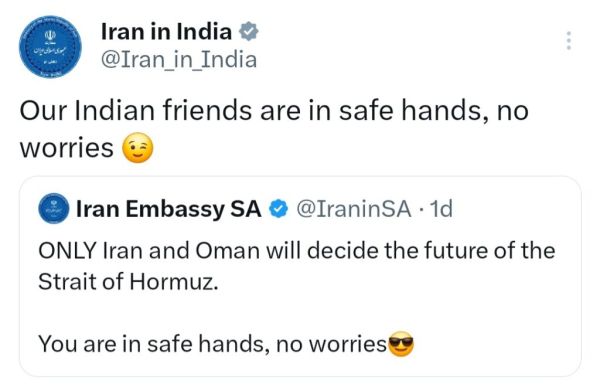
Iran’s mission in India said Indian nationals are “in safe hands” in a post on X aimed at reassurance.
The message echoed a statement by Iran’s embassy in Saudi Arabia that only Iran and Oman would decide the future of the Strait of Hormuz, amid rising tensions over the waterway.
Antonio Guterres warned the conflict could spiral into a broader regional war.
He said the world was “on the edge of a wider war” with potentially severe global consequences.
Brad Cooper said the campaign is making “undeniable progress” in its fifth week.
He pointed to what he described as a visible decline in Iran’s operational capabilities.
Donald Trump said Iran’s largest bridge had been destroyed and warned that further strikes could follow.
He urged Tehran to reach a deal, saying time was running out to avoid further damage.
Shipping through the Strait of Hormuz has dropped from around 3,000 ships per month to just 201 crossings since early March.
The disruption has pushed oil prices above USD 100 per barrel, highlighting the global economic impact.
Britain said around 40 countries are working through diplomatic and economic measures to reopen the strait.
Officials warned that continued disruption is placing pressure on global supply chains and energy markets.
Iran and Oman are drafting a protocol to supervise and coordinate vessel traffic through the strategic waterway.
Officials said the aim is to ensure safer transit rather than impose restrictions.
Mao Ning said Beijing is in communication with all parties and urged a ceasefire.
She added that restoring stability in the Strait of Hormuz is a shared international priority.
Vladimir Putin said Moscow is ready to do everything necessary to help restore peace.
He signalled support for diplomatic efforts aimed at de-escalation.
Randhir Jaiswal said around 10 million Indian nationals in GCC countries are safe.
He confirmed eight deaths and one missing, adding authorities are closely monitoring developments.
Foreign Secretary Vikram Misri will attend UK-led talks on the Strait of Hormuz.
India has evacuated 204 nationals, while 600 troops remain deployed with the United Nations Interim Force in Lebanon.
Austria rejected requests from the United States to use its airspace for operations linked to Iran, citing its neutrality law.
Officials said any future requests would be reviewed individually.
Argentina declared Iran’s chargé d’affaires Mohsen Tehrani “persona non grata” and ordered him to leave within 48 hours.
The move followed what Buenos Aires described as “false and unfounded accusations”.