


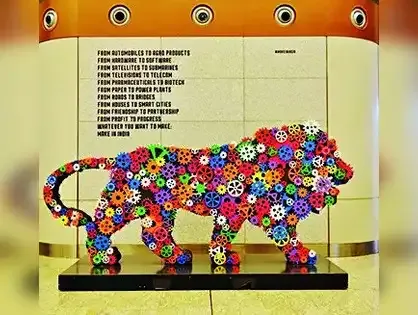
India has set itself an ambitious export target of $2 tn by 2030, evenly split between goods and services. Reaching $1 tn in goods exports in 5 yrs requires nearly doubling current levels and sustained annual growth rate of 11-12%. But in FY25, merchandise exports saw a mere 0.08% growth.
India accounts for just 1.8% of global merchandise exports, ranking 18th worldwide, China commanding almost 8x. Vietnam, with less than 1/10th India's population, reached export levels close to ours in 2024.
India's export geography is also dangerously narrow. The US absorbs nearly 20% of merchandise exports, the UAE a further 8%, particularly challenging given current geopolitical concerns. India contributes just 2.4% of EU goods imports, well behind the US (17.3%), China (14.6%), and Britain (10.1%). The product basket is equally thin. Intermediate goods account for only 27% of merchandise exports against a global average of nearly 50%.
India's labour-intensive exports, despite low manufacturing wages, don't do that well either. Vietnam's apparel exports were about 2.5x India's in 2024, despite 60% higher wages.
A key missing link is institutional machinery to systematically connect Indian exporters with global buyers. This gap can be bridged by a focused trade facilitation strategy, built on three interlocking pillars.
Trade facilitation agency: Trade promotion is fragmented across Invest India, Export Promotion Councils, India Trade Promotion Organisation (ITPO), etc - each siloed, under-leveraged. Result is duplication, jurisdictional ambiguity and gaps in service delivery that particularly hurt small and mid-sized exporters. A single, empowered national agency that owns the full trade facilitation mandate cutting across institutions, ministries and the entire exporter lifecycle is the answer.
South Korea's Kotra (Korea Trade-Investment Promotion Agency), which operates 11 domestic support centres and 131 offices across 85 countries, can be a model. It has some 2,400 employees, hired through a rigorous process and open to international talent. The structure is deliberately comprehensive, with all aspects of trade facilitation organised as different departments under CEO leadership.
Jetro (Japan External Trade Organisation) has rolled out various tech platforms (B2B marketplace for exclusive buyers, special 'Japan Store' on Amazon, etc) to improve visibility for sellers and streamline purchase processes.
To succeed, such an Indian agency will need to hire specialised talent, have a clear geography and product targeting strategy, and an end-to-end tech stack.
Trade fairs: Despite being among the most effective platforms for building B2B relationships and entering new markets, India underinvests in them. Three existing schemes together allocate just Rs 280 cr, a fraction of what smaller economies spend. Australia and South Korea invest roughly 3x and 2x of India, respectively, reflecting high returns such platforms deliver. Globally, 70% of SMEs secure business through face-to-face engagement at trade shows, where the cost of acquiring a qualified lead is estimated to be 1/10th of field outreach.
Funding often falls short by as much as 70% of actual participation costs, and is not tied to export outcomes. scale. A fundamental reset is needed. India must significantly scale up its trade fair support, expanding overall outlay 10x and redesigning schemes to provide higher, cost-shared assistance that caps firm contributions at 30-40%, while linking continued support to measurable export performance.
Sourcing destinations: Even India's leading trade fairs lack depth of international buyer participation that defines a true global sourcing hub. China's 2025 Canton Fair drew 2,90,000 on-site buyers from over 220 countries, and generated more than $25 bn in transactions. Across sectors, dedicated fairs - from furniture to textiles to auto - serve as anchor platforms for global trade.
India's response must be twofold:
This is not about outsized spending but about execution of a holistic approach. India needs a single empowered lead agency to drive this agenda, and a strengthened ITPO is the obvious choice. Without such a strategy, efforts will remain fragmented and India's $2 tn export target will remain aspirational.
India accounts for just 1.8% of global merchandise exports, ranking 18th worldwide, China commanding almost 8x. Vietnam, with less than 1/10th India's population, reached export levels close to ours in 2024.
India's export geography is also dangerously narrow. The US absorbs nearly 20% of merchandise exports, the UAE a further 8%, particularly challenging given current geopolitical concerns. India contributes just 2.4% of EU goods imports, well behind the US (17.3%), China (14.6%), and Britain (10.1%). The product basket is equally thin. Intermediate goods account for only 27% of merchandise exports against a global average of nearly 50%.
India's labour-intensive exports, despite low manufacturing wages, don't do that well either. Vietnam's apparel exports were about 2.5x India's in 2024, despite 60% higher wages.
A key missing link is institutional machinery to systematically connect Indian exporters with global buyers. This gap can be bridged by a focused trade facilitation strategy, built on three interlocking pillars.
Trade facilitation agency: Trade promotion is fragmented across Invest India, Export Promotion Councils, India Trade Promotion Organisation (ITPO), etc - each siloed, under-leveraged. Result is duplication, jurisdictional ambiguity and gaps in service delivery that particularly hurt small and mid-sized exporters. A single, empowered national agency that owns the full trade facilitation mandate cutting across institutions, ministries and the entire exporter lifecycle is the answer.
South Korea's Kotra (Korea Trade-Investment Promotion Agency), which operates 11 domestic support centres and 131 offices across 85 countries, can be a model. It has some 2,400 employees, hired through a rigorous process and open to international talent. The structure is deliberately comprehensive, with all aspects of trade facilitation organised as different departments under CEO leadership.
Jetro (Japan External Trade Organisation) has rolled out various tech platforms (B2B marketplace for exclusive buyers, special 'Japan Store' on Amazon, etc) to improve visibility for sellers and streamline purchase processes.
To succeed, such an Indian agency will need to hire specialised talent, have a clear geography and product targeting strategy, and an end-to-end tech stack.
Trade fairs: Despite being among the most effective platforms for building B2B relationships and entering new markets, India underinvests in them. Three existing schemes together allocate just Rs 280 cr, a fraction of what smaller economies spend. Australia and South Korea invest roughly 3x and 2x of India, respectively, reflecting high returns such platforms deliver. Globally, 70% of SMEs secure business through face-to-face engagement at trade shows, where the cost of acquiring a qualified lead is estimated to be 1/10th of field outreach.
Funding often falls short by as much as 70% of actual participation costs, and is not tied to export outcomes. scale. A fundamental reset is needed. India must significantly scale up its trade fair support, expanding overall outlay 10x and redesigning schemes to provide higher, cost-shared assistance that caps firm contributions at 30-40%, while linking continued support to measurable export performance.
Sourcing destinations: Even India's leading trade fairs lack depth of international buyer participation that defines a true global sourcing hub. China's 2025 Canton Fair drew 2,90,000 on-site buyers from over 220 countries, and generated more than $25 bn in transactions. Across sectors, dedicated fairs - from furniture to textiles to auto - serve as anchor platforms for global trade.
India's response must be twofold:
- Accelerate build-out of large, state- of-the-art exhibition infrastructure, such as New Delhi's Yashobhoomi and Bharat Mandapam, to match global scale.
- Curate 8-10 mega, sector-focused fairs designed as buyer-first, deal-making platforms in areas of strength like apparel, gems and jewellery, pharma, and electronics.
This is not about outsized spending but about execution of a holistic approach. India needs a single empowered lead agency to drive this agenda, and a strengthened ITPO is the obvious choice. Without such a strategy, efforts will remain fragmented and India's $2 tn export target will remain aspirational.





Ashish Dhawan
Founder-CEO, The Convergence Foundation
Nishtha Jain
Nishtha Jain is team lead, Convergence Foundation