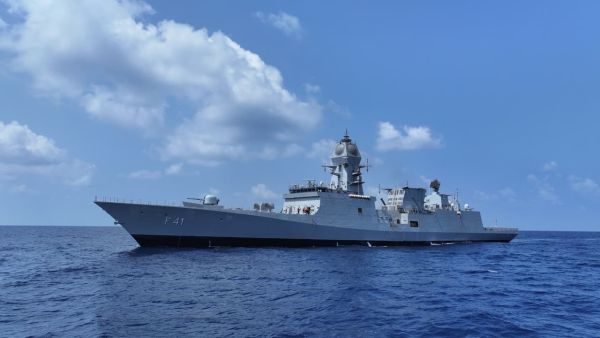
New Delhi: Defense Minister Rajnath Singh on Friday commissioned the fourth ship of the Project 17A class – INS Taragiri – into the Indian Navy in Visakhapatnam, Andhra Pradesh. It is a fine example of the art of modern warship building. The new stealth frigate, weighing approximately 6,670 tonnes, has been designed by Warship Design Bureau and built by Mazagon Dock Shipbuilders Limited. Many small and big Indian companies (MSMEs) have also helped in making it.
Captain Vivek Madhwal, PRO, Indian Navy, said, "It has used advanced stealth technology, which greatly reduces its radar signature. This gives it a lethal edge among the enemies." INS Taragiri has more than 75% indigenous equipment and has been completed well ahead of schedule. It is a great example of India's shipbuilding capability and strong collaboration between public-private companies.
In his address on this occasion, Rajnath Singh described INS Taragiri as not just a warship but a symbol of India's growing technology, self-reliance and tremendous naval power. “This ship can move at high speed and can remain deployed at sea for a long time. It is equipped with systems that can monitor enemy movements, protect itself and can also respond immediately if needed.”
"It is equipped with modern radar, sonar and missiles like BrahMos, which further enhances its operational strength. From heavy engagements to maritime security, anti-piracy, coastal surveillance and humanitarian missions, it fits seamlessly into every role, making it a unique naval platform." Rajnath Singh stressed that India has a coastline of more than 11,000 kilometers and is surrounded by sea on three sides. In such a situation, we cannot think about our development by staying away from the sea.
He said that about 95 percent of the country's trade takes place through sea routes and energy security also depends on the sea. Therefore, building a strong and capable navy is not just an option, but an urgent need. The Defense Minister said that amidst global uncertainties, the Indian Navy remains present round the clock in the Indian Ocean region.
"Whenever tensions rise, the Indian Navy comes forward to ensure the security of merchant ships and oil tankers. It is not only protecting India's national interests, but is also ready to take all necessary steps to protect our citizens and trade routes across the world. It is this capability that makes India a responsible and powerful maritime power."
“We must not be limited to just protecting our coastlines; we must also protect critical sea lanes, choke points and digital infrastructure that are critical to our national interests.”
“When modern ships like INS Taragiri are deployed, they guarantee peace and prosperity for the entire region.” Rajnath Singh also pointed out that whenever a crisis arises, be it an evacuation operation or humanitarian assistance, the Indian Navy always stands at the forefront, symbolizing India's core values and unwavering commitment. “INS Taragiri will further enhance the strength, values and commitment of our Navy,” he said.
On this occasion, Chief of the Naval Staff (CNS) Admiral Dinesh K Tripathi recalled the old legacy of INS Taragiri. He referred to the older Leander-class frigates, commissioned in 1980, which had played a key role in advancing India's anti-submarine warfare capabilities. Speaking on the changing maritime security environment, he underlined the growing complexities in the Indian Ocean region, which are being driven by geo-politics, new technologies and non-traditional threats.