A short-seller report sent MakeMyTrip’s stock to its lowest point in a year. The question at the centre of the controversy—how India’s largest OTA defines profit—was never hidden. It has been sitting in the company’s own SEC filings for four years.
At the heart of the issue is the adjusted margin metric, which has become an analog for profitability in the OTA space. Investor decks, quarterly earnings calls focus on the adjusted margins and not on the operating profit.
MakeMyTrip defines Adjusted Margin in its own 20-F filing with the US SEC as revenue plus customer discounts and cashbacks after subtracting the cost of hotel or package procurement.
It’s the central term in this equation that has drawn significant concern. Discounts given to customers and cashbacks which are actually costs for MMT are added back when calculating Adjusted Margin.
Money that left MakeMyTrip’s accounts, reappears on the margin line under this formula. This non-standard practice is actually quite standard in the technology and online travel space. Companies like MMT — others could also be following similar practices in India — are free to define adjusted margin as per their operational structure.
In FY25 alone, MakeMyTrip collected $978 Mn in actual revenue and added back $302 Mn in discounts and cashbacks. Over four financial years, the total add-back comes to $899 Mn in customer spending that was excluded from revenue under IFRS but included in the company’s headline metric.
The Gap Between Adjustments And RealityThe chasm is most evident in the September 2025 quarter or Q2 FY26.
In that period, MakeMyTrip reported a net loss of $5.7 Mn under International Financial Reporting Standards or IFRS, swinging from a $17.9 Mn profit in the year-ago period. Revenue grew 9% YoY, but the bottom line was hit by $35.9 Mn driven largely by foreign exchange losses tied to INR depreciation. It also included the accounting effects of a $3.1 Bn capital restructuring completed last year to buy back and cancel 34.4 Mn Class B shares held by Chinese investor Trip Group.
While the bottomline showed a $5.7 Mn loss, the company’s own adjusted metric showed a $44.2 Mn operating profit, up 17.9% year-on-year.
MakeMyTrip would argue—and many analysts would agree—that the adjusted figure is the true picture. The finance costs that caused the IFRS loss were largely one-off in nature, driven by restructuring and currency movements.
But only a more granular analysis of the numbers can prove whether the ongoing cost of acquiring and retaining customers was being recorded in the proper manner.
The segment where the adjusted metric seems to have delivered a pronounced outcome is air ticketing. This is MakeMyTrip’s largest vertical by gross bookings. It earns a commission from airlines, charges a convenience fee from travellers, along with upselling insurance, rescheduling, refunds and more.
In FY23, MakeMyTrip reported $147.8 Mn in actual flight revenue under IFRS. After adding back $135.3 Mn in customer cashbacks, which is almost 91% of the revenue, the adjusted margin for the segment came to $280 Mn.
At a unit level, the actual commission retained from every flight booking works out to roughly 4% of gross bookings, but the adjusted metric implies 6.4% take rate. This is what makes up customer discounts and cashbacks, more than half of the actual take rate.
Investors might take the view that is the cost of doing business or a reinvestment in growth that belongs outside the margin calculation, so naturally there is some concern here that MMT could be under some strain here if it has to review its financials in the next quarter.
To its credit, MMT does disclose the nature of this metric. It calls adjusted margin a “non-IFRS” measure that “may not be comparable to similarly titled measures.” It’s only experienced and seasoned investors who might see the explanation for the reconciliation between IFRS revenue and Adjusted Margin in the full 165-page annual report.
Adjusted Margin, by contrast, is the lead number in the press release and is often seen in headlines. As the short-seller Morpheus Research argues this gives investors an incomplete picture and denies them information to exercise judgment that could be consequential for MakeMyTrip’s stock.
Plus, MMT is looking to take its business to a new class of investors as it looks for an IPO in the Indian market.
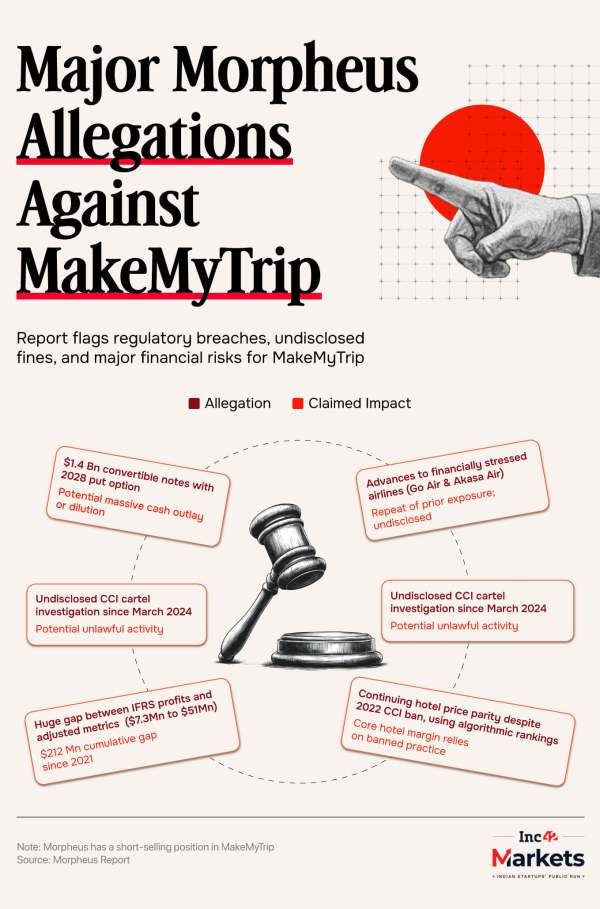
Further, Morpheus Research’s claim is that MakeMyTrip has continued to defy orders from the Competition Commission of India, that it manipulates its booking interface through dark patterns, that it uses upfront deposits to lock hotels into preferential arrangements, and that it inflates its headline profit metric.
In 2022, the CCI fined MakeMyTrip approximately ₹223 Cr (roughly $23 Mn now) and ordered it to stop enforcing “price parity” clauses—arrangements that prohibit hotels from offering lower prices on their own websites. But the company is alleged to have continued this practice, even as its appeal with the CCI is pending.
These allegations could well weigh on the company’s bid for an India listing. MakeMyTrip has not publicly responded to any claims in the short-seller research.
MakeMyTrip’s stock dropped to $32.67 the same day—its lowest point in over a year, and a 71% fall from its twelve-month high of $113.85. Morpheus holds short positions in the stock.
India IPO LoomsTwo weeks before the short report dropped, MakeMyTrip disclosed in its 20-F that it is evaluating a potential listing of MakeMyTrip India on Indian stock exchanges. This would open access to domestic institutional and retail capital for the first time since the company listed on NASDAQ in August 2010.
To prepare, the company has merged RedBus India into MakeMyTrip (India) Pvt Ltd, consolidating key brands under a single Indian entity.
An India listing would also give MakeMyTrip domestically traded equity to use as currency for acquisitions—and the company has been acquiring steadily.
Over the past few years, it has brought in Goibibo and redBus (market consolidation), Simplotel (hotel technology), BookMyForex (travel forex), Savaari (intercity car rentals), Happay (corporate expense management), a minority stake in Atlys (visa processing), and QuestToTravel (corporate travel).
In early March 2026, it announced a majority stake in Flamingo Transworld, a 30-year-old regional tour operator with deep roots in Gujarat, Maharashtra, Rajasthan, and Madhya Pradesh, known for its curated group tours with Indian vegetarian and Jain kitchens and regional-language tour managers.
The company is looking to own a typical Indian traveller’s journey end-to-end, from visas to flight to hotel to tour package to forex. The cashback spending, in this light, can be seen as a rational investment in building the Indian user base.
Nearly 100 Mn Indians have booked on MakeMyTrip, the company claims, which makes each subsequent vertical and user acquisition more valuable for the company.
But it also means that the company’s primary profit metric, the one built on adding back that spending, will soon be presented to an entirely new audience. Indian retail investors encountering MakeMyTrip’s financials for the first time through a DRHP may not have the full context of how adjusted margin is calculated. It also remains to be seen how MMT presents its business performance and metrics in India and how it shows the reconciliation between the adjusted figures and the IFRS.
MakeMyTrip’s discount-led model has competitive implications that extend beyond its own balance sheet.
Smaller OTAs—EaseMyTrip, ixigo, Yatra, Cleartrip—operate in the same market but without the scale to sustain comparable cashback programmes. And even if they do, they may not have the luxury of framing their margins performance in a similar way.
If MakeMyTrip’s spending on discounts eventually moderates, whether due to investor pressure, regulatory action, or a strategic pivot, rivals could find themselves with an open market to run into.
On the other hand, if the CCI proceedings and the recent scrutiny brought on by Morpheus broadens into a sector-wide inquiry, the eye will not fall on MakeMyTrip alone. As seen in the past, the travel industry’s leaders usually tend to direct the herd in terms of pricing, fees and features.
If and when MMT comments on the research, there may be perfectly defensible reasons for the company to have taken such steps.
But the fact is that $899 Mn over four years is not a rounding adjustment and therefore cannot be lightly brushed off.
MakeMyTrip is preparing to tell its story to a new set of investors. A short-seller has told a different version of that story. The CCI proceedings grind on and the stock in the US has hit a low.
The numbers, at least, are not in dispute. If only MMT can now explain what they mean.
MARKETS WATCH: UPCOMING ISSUES, MOVERS & MOREThe post Why MakeMyTrip Became A Short-Seller Target appeared first on Inc42 Media.