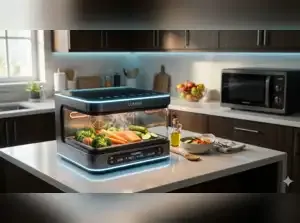
For many years the microwave has been a staple in the kitchen of today. It's the best solution for heating leftovers, defrosting frozen foods as well as cooking quick meals in a matter of minutes. The speed and ease of use have made it indispensable. Now, a brand modern generation of sophisticated multisensor cookware has begun to challenge that power. Compact hybrid ovens will offer not only speed but also something microwaves have been battling: improved taste as well as texture and.
A New Kind of Kitchen Appliance Emerges
The most recent breakthrough isn't a singular product, but rather a whole category of ovens for the countertop that integrate different cooking methods within one device. They incorporate ultra-fast convection, infrared heating as well as, in certain instances the use of low-intensity microwave energy. Instead of relying only using microwaves to stimulate water molecules, they spread energy through a precisely planned mix of strategies.
This method of combining food and cooking allows it to be cooked evenly and maintain its shape. Pizza slices is likely to be served with a nice crust, and cheese that has melted, in contrast to the soggy and rubbery results that are often associated when microwaves are used to heat food. It doesn't matter if it's a tiny piece of chicken or fresh baked muffins the microwave can provide outcomes similar to those of a traditional oven, in about the same amount of time as a microwave.
A prime example is one of the innovations is the Tri-Heat system that is described in reports from industry, which is a combination of convection, infrared as well as conduction using special surfaces such as CrisPlate technology. The initial tests show that these systems are able to heat food faster than standard ovens and produce a more refined quality texture when compared with microwaves.
The Science Behind Better Cooking
The advantages of these hybrid ovens is in the way they employ multiple methods for heat exchange. Traditional microwaves depend on electromagnetic radiation that could cause irregular heating patterns because of static waves in the cavity. It is common for microwaves to produce cold patches and hot spots inside that dish.
Convection methods move hot air in a uniform manner over the food. In contrast, convection systems circulate hot air evenly infrared heating directs heat to the food's surface and allows for the food to brown and crisp. When they are paired with microwaves that are controlled and microwave energy, you get more efficient and well-balanced cooking method.
The scientific literature supports this idea. An investigation into microwave-aided processes that was conducted by Oregon State University in the United States demonstrated that combining microwave energy and different heating methods can accelerate processes while enhancing the uniformity. While the study was is focused on industrial use including material processing, and solar cell production The same concepts are being used in cookware for the kitchen at home.
What Experts Say About the Shift
Food scientists stress the fact that this change isn't focused on replacing microwaves altogether however, it is about improving their capabilities. The Dr. Elena Martinez, a food engineering scientist from the Luxembourg Institute of Science and Technology located in Luxembourg She has said that although microwaves are exceptionally fast, it usually affects texture in food, and can cause uneven distribution of moisture. Through blending microwave speed convection heating and infrared heat, the new technology provides an experience that is more enjoyable.
Researchers studying the electromagnetic properties of food items have revealed one of the major limitations of traditional microwaves. Magneticrons function at a certain frequency which results in irregular heat distribution. The latest models, however utilize solid-state emitters as well as adaptable software that adjusts energy distribution over time. This degree of accuracy is what makes hybrid ovens seem like an enormous technological advancement instead of merely a minor upgrading.
Why Consumers Are Paying Attention
for everyday consumers, the attraction of microwaves comes in three areas that are: convenience, quality and flexibility. People have gotten used to the speed and efficiency of microwaves, but aren't satisfied with their results. According to surveys, a substantial part of people wish that they could cook or crisp food, instead of simply heating the food.
Modern hybrid ovens fill in this issue. They can heat up dishes like lasagna in just two minutes and preserve the taste and texture. They can also serve as mini ovens that are which can be used for baking, roasting and crisping all with a tiny footprint, perfect for kitchens with small spaces.
It also has a technological and aesthetic appeal. The appliances tend to be quieter, more efficient in energy use and come with intelligent sensors that track temperatures and moisture at a real-time rate. This gives you a better cooking experience. In this, the appliance adjusts itself according to the ingredients rather than relying on intuition.
Limitations and the Road Ahead
Although they have their benefits, microwaves have disadvantages. They are still slower than traditional microwaves at a high speed when it comes to simple tasks such as reheating water, or defrosting frozen food items. The cost is another obstacle because hybrid ovens are considerably more costly than standard microwaves.
But the overall direction is apparent. Technology in kitchens is evolving towards smart, multi-purpose appliances that value high-end quality and convenience. With prices decreasing and the technology gets better they are expected eventually to become accessible to more people.
It's not likely to disappear in a flash, but its power cannot be guaranteed. The once-defying symbol of convenience in the modern world is currently being challenged by a newer, smarter and more modern generation of cooking equipment. In the near term, the issue may not to be if these ovens will replace microwaves or not, but rather how rapidly they'll alter what we want from our kitchens.
Image Credit - Gemini
A New Kind of Kitchen Appliance Emerges
The most recent breakthrough isn't a singular product, but rather a whole category of ovens for the countertop that integrate different cooking methods within one device. They incorporate ultra-fast convection, infrared heating as well as, in certain instances the use of low-intensity microwave energy. Instead of relying only using microwaves to stimulate water molecules, they spread energy through a precisely planned mix of strategies.
This method of combining food and cooking allows it to be cooked evenly and maintain its shape. Pizza slices is likely to be served with a nice crust, and cheese that has melted, in contrast to the soggy and rubbery results that are often associated when microwaves are used to heat food. It doesn't matter if it's a tiny piece of chicken or fresh baked muffins the microwave can provide outcomes similar to those of a traditional oven, in about the same amount of time as a microwave.
A prime example is one of the innovations is the Tri-Heat system that is described in reports from industry, which is a combination of convection, infrared as well as conduction using special surfaces such as CrisPlate technology. The initial tests show that these systems are able to heat food faster than standard ovens and produce a more refined quality texture when compared with microwaves.
The Science Behind Better Cooking
The advantages of these hybrid ovens is in the way they employ multiple methods for heat exchange. Traditional microwaves depend on electromagnetic radiation that could cause irregular heating patterns because of static waves in the cavity. It is common for microwaves to produce cold patches and hot spots inside that dish.
Convection methods move hot air in a uniform manner over the food. In contrast, convection systems circulate hot air evenly infrared heating directs heat to the food's surface and allows for the food to brown and crisp. When they are paired with microwaves that are controlled and microwave energy, you get more efficient and well-balanced cooking method.
The scientific literature supports this idea. An investigation into microwave-aided processes that was conducted by Oregon State University in the United States demonstrated that combining microwave energy and different heating methods can accelerate processes while enhancing the uniformity. While the study was is focused on industrial use including material processing, and solar cell production The same concepts are being used in cookware for the kitchen at home.
What Experts Say About the Shift
Food scientists stress the fact that this change isn't focused on replacing microwaves altogether however, it is about improving their capabilities. The Dr. Elena Martinez, a food engineering scientist from the Luxembourg Institute of Science and Technology located in Luxembourg She has said that although microwaves are exceptionally fast, it usually affects texture in food, and can cause uneven distribution of moisture. Through blending microwave speed convection heating and infrared heat, the new technology provides an experience that is more enjoyable.
Researchers studying the electromagnetic properties of food items have revealed one of the major limitations of traditional microwaves. Magneticrons function at a certain frequency which results in irregular heat distribution. The latest models, however utilize solid-state emitters as well as adaptable software that adjusts energy distribution over time. This degree of accuracy is what makes hybrid ovens seem like an enormous technological advancement instead of merely a minor upgrading.
Why Consumers Are Paying Attention
for everyday consumers, the attraction of microwaves comes in three areas that are: convenience, quality and flexibility. People have gotten used to the speed and efficiency of microwaves, but aren't satisfied with their results. According to surveys, a substantial part of people wish that they could cook or crisp food, instead of simply heating the food.
Modern hybrid ovens fill in this issue. They can heat up dishes like lasagna in just two minutes and preserve the taste and texture. They can also serve as mini ovens that are which can be used for baking, roasting and crisping all with a tiny footprint, perfect for kitchens with small spaces.
It also has a technological and aesthetic appeal. The appliances tend to be quieter, more efficient in energy use and come with intelligent sensors that track temperatures and moisture at a real-time rate. This gives you a better cooking experience. In this, the appliance adjusts itself according to the ingredients rather than relying on intuition.
Limitations and the Road Ahead
Although they have their benefits, microwaves have disadvantages. They are still slower than traditional microwaves at a high speed when it comes to simple tasks such as reheating water, or defrosting frozen food items. The cost is another obstacle because hybrid ovens are considerably more costly than standard microwaves.
But the overall direction is apparent. Technology in kitchens is evolving towards smart, multi-purpose appliances that value high-end quality and convenience. With prices decreasing and the technology gets better they are expected eventually to become accessible to more people.
It's not likely to disappear in a flash, but its power cannot be guaranteed. The once-defying symbol of convenience in the modern world is currently being challenged by a newer, smarter and more modern generation of cooking equipment. In the near term, the issue may not to be if these ovens will replace microwaves or not, but rather how rapidly they'll alter what we want from our kitchens.