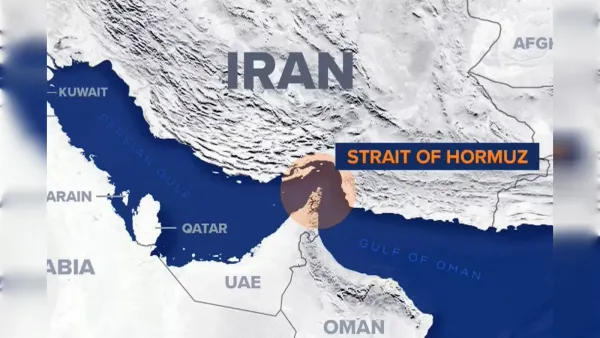
Iran on Monday, April 6, issued one of its strongest warnings yet amid the ongoing conflict with the United States and Israel, declaring that the Strait of Hormuz will “never return to its former state” for the two allies as tensions escalate across the region.
In a statement posted on X, Iran’s Islamic Revolutionary Guard Corps (IRGC) Navy said the strategic waterway — a vital artery for global oil shipments — would undergo lasting changes. The force added that it was in the final stages of operational preparations for what it described as a “new order” in the Gulf, signalling a potential shift in regional security dynamics.
The US–Israel war on Iran entered its 38th day on Monday, with hostilities intensifying across Iran, Israel and Lebanon. Israeli airstrikes targeted several towns in southern Lebanon, including Sultaniyeh, Arzoun, Nabatieh al-Fouqa and Deir al-Zahrani, in an escalation along the northern front.

In response, Hezbollah said it carried out drone and rocket attacks on Israeli military positions near the border, including areas opposite the Lebanese town of Markaba and sites north of Acre. Sirens were activated across northern Israel, particularly in the Galilee region, as rockets were detected and intercepted.
Lebanon’s health ministry reported that at least eight people were killed and 55 others injured in Israeli strikes on Beirut’s Jnah area and the Ain Saadeh hills in Mount Lebanon. The casualties included women, children and foreign nationals, underscoring the growing humanitarian toll.
Iranian state media reported multiple waves of missile launches towards Israeli territory, including three salvos within a short span. Explosions were heard in Haifa and surrounding areas, while Israel’s air defence systems were activated across the north and the occupied Golan Heights.
In Haifa, at least 11 people were injured — one critically — after a missile struck a multi-storey building, causing fires and structural damage. Additional strikes were reported in Tel Aviv and central Israel, with some reports indicating the use of cluster munitions.
Israeli authorities confirmed that early warning systems were triggered and several incoming missiles were intercepted, although debris and shrapnel caused damage in multiple locations.
Inside Iran, explosions were reported in several areas, including the southwestern city of Ahvaz, where officials said the international airport was struck multiple times in a single day. Air defence systems were also activated over Tehran following reports of aerial activity east of the capital.
US President Donald Trump said American forces had carried out a “daring rescue” operation to retrieve a downed pilot from within Iran, involving special forces. He warned that Washington could launch unprecedented strikes on Iranian infrastructure, including power plants and bridges, if Tehran continues to threaten the Strait of Hormuz.
Iranian officials struck a defiant tone. Senior leaders said the country would continue its development despite mounting pressure, while parliament speaker Mohammad-Bagher Ghalibaf warned that US actions risk pushing the region towards broader conflict.
The conflict has increasingly spilled into neighbouring Gulf countries. The United Arab Emirates said its air defence systems intercepted incoming missiles and drones, with authorities attributing loud sounds heard across the country to ongoing interception operations.
Kuwait’s military also confirmed that its air defences were responding to missile and drone threats, urging residents to follow safety instructions.
Amid fears of further escalation, diplomatic channels remain active. Pakistan and Egypt are reportedly facilitating communication between US and Iranian officials in an effort to reduce tensions. Pakistan reiterated its support for de-escalation during high-level contacts with Tehran.
Bahrain has called on the United Nations to adopt a resolution authorising force to reopen the Strait of Hormuz, warning that prolonged disruption could trigger severe economic and humanitarian consequences.
Casualty figures continue to mount as the conflict intensifies, with rights groups and international organisations warning of a worsening humanitarian crisis.
The U.S.-based Human Rights Activists News Agency (HRANA) said at least 3,540 people have been killed in Iran since the war began. Of these, 1,616 were civilians, including at least 244 children.
HRANA said its estimates are based on field reports, local sources, medical and emergency data, civil society networks, open-source material and official statements.
The International Federation of Red Cross and Red Crescent Societies (IFRC) reported that at least 1,900 people have been killed and around 20,000 injured in Iran as a result of US-Israeli strikes. It was not immediately clear whether this figure includes the 104 fatalities reported by Iranian military sources following a US attack on an Iranian warship off Sri Lanka on March 4.
In Lebanon, authorities said at least 1,461 people have been killed in Israeli strikes since March 2, including children, as cross-border hostilities continue.
The escalating conflict has raised alarm worldwide, particularly over its impact on energy supplies and food security. The Strait of Hormuz handles a significant share of global oil shipments, and any sustained disruption could drive up fuel prices and strain supply chains.
The World Food Programme has warned that the crisis could trigger the most severe food emergency since the COVID-19 pandemic, with rising costs and supply disruptions potentially pushing millions more people into hunger.
Iran has accused US and Israeli forces of targeting civilian infrastructure, including schools and research facilities, claiming widespread damage across the country since the conflict began.
In the United States, criticism is also emerging. Congressman Jim McGovern warned that American military actions risk undermining international law and could make global security conditions more fragile.
Israeli Prime Minister Benjamin Netanyahu praised coordination with Washington following the rescue of the American pilot, describing bilateral cooperation as “unprecedented”.
With missile exchanges intensifying, expanding battlefronts and increasing regional involvement, the conflict shows no immediate signs of easing, raising fears of a prolonged crisis with far-reaching global consequences.