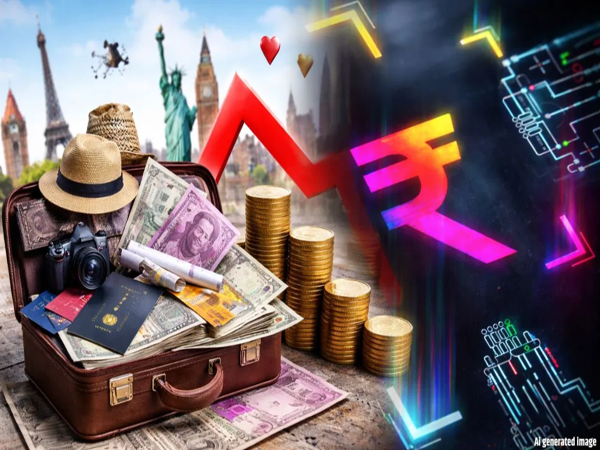
Summer vacations are just around the corner, and many families are busy making preparations to travel abroad. However, if you, too, are planning to pack your bags, it is essential to take a fresh look at your budget. A foreign trip that seemed perfectly affordable just a few months ago has suddenly become significantly more expensive. The primary reason for this is the continuous depreciation of the Indian Rupee against the US Dollar. Over the past year, the Rupee has weakened by approximately 10 percent and is currently hovering near a historic low of 94 to 95 Rupees against the Dollar. Tensions in the Middle East, rising crude oil prices, and the withdrawal of foreign funds have exerted immense pressure on the Rupee. This is having a direct impact on the travel plans of the common person—trips they have been dreaming of and cherishing for months.
**Foreign Travel Becomes Significantly More Expensive**
The impact of this weakness in the Rupee is not felt gradually; rather, it becomes immediately apparent the moment you make your bookings. Simply put, the cost of your tour has increased by 12 to 20 percent. For instance, if you were previously working with a budget of ₹2 lakh, you will now have to spend between ₹2.2 lakh and ₹2.4 lakh for the same trip. Similarly, if you are traveling to an international destination with your entire family and have allocated a budget of ₹6 lakh, the total bill could now climb to as high as ₹7 lakh. This means that, without adding any extra amenities or upgrades to your itinerary, you are effectively having to shell out an additional ₹1 lakh from your own pocket. In statistical terms, a trip costing $3,000—which would have previously cost ₹2.46 lakh—has now risen to ₹2.85 lakh. The most significant surge in costs is being observed in hotel accommodations and local expenses (up by 15 to 20 percent), as well as in flight tickets (up by 7 to 15 percent).
**Travel to the US and Europe: The Most Expensive Options**
This rise in costs is not uniform across all countries. It is directly dependent on your chosen destination for spending your vacation. If you are planning a trip to the United States, the UK, Europe, or the United Arab Emirates (UAE), you are in for a major shock. The currencies of these nations are directly pegged to the US Dollar or the Euro; consequently, travel costs to these destinations have surged by 15 to 20 percent. Conversely, if you wish to keep your budget balanced, Asian countries such as Thailand, Vietnam, or Indonesia could prove to be better alternatives. In these nations, the local currency remains relatively stable—or behaves differently—vis-à-vis the US Dollar, resulting in a more modest increase in travel expenses, ranging from just 9 to 12 percent.
**Navigating the Maze of Hidden Costs**
Beyond flights and hotels, numerous hidden costs—exacerbated by the depreciation of the Rupee—are taking a heavy toll on your wallet. Visa fees, travel insurance premiums, and the forex markups and taxes (TCS) applicable to international credit card usage have all witnessed a substantial hike. Despite this, Indian travelers have chosen to adapt their travel habits rather than cancel their trips entirely. People are now planning shorter getaways instead of extended vacations. Spending on expensive shopping sprees or non-essential luxuries is being curtailed, with travelers prioritizing expenditure solely on essential experiences. All in all, while the enthusiasm for travel remains undiminished, people are now opting for more prudent and value-driven choices.
**How to Alleviate the Financial Burden of Your Trip?**
While you have no control over the Rupee's trajectory, you can certainly mitigate your financial losses by adopting a smarter approach to your travel planning. Avoid last-minute bookings; instead, secure your flights and hotel accommodations well in advance. Rather than purchasing your entire foreign currency (forex) requirement in a single transaction, acquire it in installments to help average out the impact of fluctuating exchange rates. Furthermore, utilizing a prepaid forex card for your expenses abroad is a prudent decision, as it shields you from the sudden, hefty exchange charges that often apply when swiping a credit or debit card overseas. Additionally, ‘all-inclusive’ packages—which pre-determine everything—can also safeguard you against unexpected expenses that may arise during your trip.
Disclaimer: This content has been sourced and edited from TV9. While we have made modifications for clarity and presentation, the original content belongs to its respective authors and website. We do not claim ownership of the content.