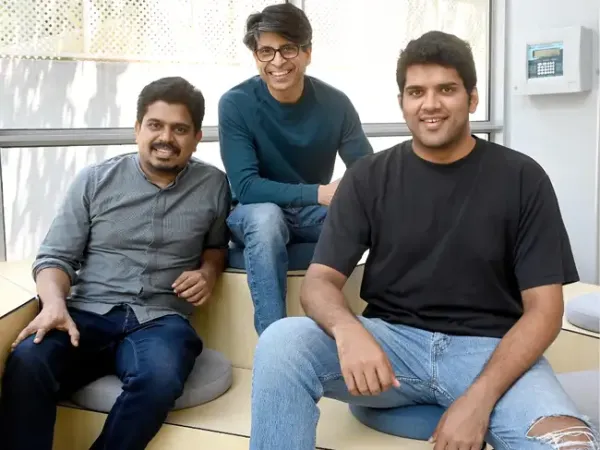
(L-R) Sujith Nair, Pramod Varma and Siddharth Shetty, cofounders, Networks for Humanity (NFH), at their Bengaluru office. (Photograph by ET's Narasimha Murthy)
The architects of India’s digital public infrastructure (DPI), Nandan Nilekani and Pramod Varma, are now attempting their next leap: building a universal, open digital fabric to power global commerce, financial assets, and programmable value flows in an AI-driven world.
Through the non-profit Networks for Humanity (NFH), backed by funders including Google.org, Nilekani Philanthropies, Asian Development Bank, Spectrum Impact, and the Bill & Melinda Gates Foundation, the group is designing what it calls a new global layer of DPI, extending the success of Aadhaar and UPI beyond national boundaries.
At the heart of this effort is a unified “NFH fabric,” combining two earlier building blocks: Beckn Protocol, which enables open, decentralised commerce networks, and Finternet, which focuses on representing and moving assets digitally. Together, they aim to create interoperable rails for identity, payments, assets, and commerce globally.
While Nilekani is the chief patron, cofounder and funder Varma is the chief architect of NFH. Sujith Nair anchors the Beckn Mission, which is a value exchange mission, and has been integrated into NFH. Siddharth Shetty, based in Singapore, anchors the Finternet mission, also integrated into NFH.
NFH has raised about $30 million to fund pilots, partnerships, and ecosystem development. While the underlying infrastructure is relatively lightweight, leaders emphasise that adoption, not technology, will be the biggest hurdle.
The architecture is being designed for an “agentic” future, where AI agents, not humans, will increasingly search, negotiate, and execute transactions. Millions of such agents could continuously optimise prices, match buyers and sellers, and complete transactions autonomously.
“I see AI agents on open networks as a fundamental construct for the widespread diffusion of technology," Nilekani told ET.
Open networks allow many actors and innovators to build applications at the edge using AI, and agents become the interface through which users interact with this ecosystem, he said. "Their real power lies in removing complexity for users. That is central to what NFH is trying to achieve, unlocking inclusion and enabling technology to scale widely," he added.
This marks a shift away from today’s platform-centric internet, dominated by a handful of intermediaries, toward decentralised, interoperable ecosystems where innovation happens at the edge.
The timeline is long: a 10–15-year horizon to reach meaningful global scale. But the ambition is to create a borderless, programmable economic network where individuals and businesses control their data and assets, while transacting seamlessly across geographies.
“If Aadhaar enabled identity and UPI unlocked payments, this new layer aims to integrate identity, money, assets, and commerce into a single open system, built for an AI-driven world," Varma said.
“This is not just about scaling India’s success country by country. It’s about designing-for-humanity scale,” Sujith Nair told ET, describing the initiative as a long-term “big bet.”
NFH’s core proposition is a neutral, open “plumbing layer” where buyers, sellers, service providers, and increasingly AI agents, can discover and transact directly, without relying on centralised platforms.
“If you are on the fabric, you are globally discoverable by default,” Nair said, highlighting how this model eliminates the need for fragmented, country-by-country integrations.
Tokenising everything
A parallel pillar of NFH’s work is building a unified, tokenised financial system. According to Shetty, the goal is to move from fragmented financial rails to a world where all assets, money, securities, property, or even agricultural produce, are digitally represented and transactable.
“We imagine a world where every individual or business has a wallet containing their identity, credentials, and assets,” Shetty said.
In this model, tokenisation extends the logic of dematerialisation in capital markets to all asset classes. AI agents could then act on behalf of users: scanning markets, negotiating rates, and executing transactions in real time.
“Agents can operate 24/7, evaluate hundreds of options, and eliminate inefficiencies,” Shetty said, pointing to use cases such as cross-border remittances and asset trading.
Digital vouchers
Beyond commerce and assets, NFH is also developing programmable digital value systems, including purpose-based vouchers that can be issued for subsidies, education, or climate incentives.
Unlike traditional cash transfers, these vouchers are designed to be traceable, interoperable, and usable across providers, even across borders, potentially transforming how governments deliver benefits.
NFH is already piloting such systems across sectors including agriculture, mobility, tourism, and climate, with deployments in parts of Asia, Africa, and Latin America.
'Pincer'
To address concerns around trust and reliability in open networks, NFH is building verification layers covering identity, catalogues, guarantees, and payments. One such initiative, dubbed “Pincer,” aims to improve transaction certainty by stitching together multiple proofs and assurances.
The organisation is also working with regulators and academic institutions, including the Cambridge Centre for Alternative Finance, to tackle emerging policy challenges, from cross-border compliance to code-based regulation.
“Every new model faces scepticism,” Nair said. “But once people see lower costs and better outcomes, adoption follows.”
Through the non-profit Networks for Humanity (NFH), backed by funders including Google.org, Nilekani Philanthropies, Asian Development Bank, Spectrum Impact, and the Bill & Melinda Gates Foundation, the group is designing what it calls a new global layer of DPI, extending the success of Aadhaar and UPI beyond national boundaries.
At the heart of this effort is a unified “NFH fabric,” combining two earlier building blocks: Beckn Protocol, which enables open, decentralised commerce networks, and Finternet, which focuses on representing and moving assets digitally. Together, they aim to create interoperable rails for identity, payments, assets, and commerce globally.
While Nilekani is the chief patron, cofounder and funder Varma is the chief architect of NFH. Sujith Nair anchors the Beckn Mission, which is a value exchange mission, and has been integrated into NFH. Siddharth Shetty, based in Singapore, anchors the Finternet mission, also integrated into NFH.
NFH has raised about $30 million to fund pilots, partnerships, and ecosystem development. While the underlying infrastructure is relatively lightweight, leaders emphasise that adoption, not technology, will be the biggest hurdle.
The architecture is being designed for an “agentic” future, where AI agents, not humans, will increasingly search, negotiate, and execute transactions. Millions of such agents could continuously optimise prices, match buyers and sellers, and complete transactions autonomously.
“I see AI agents on open networks as a fundamental construct for the widespread diffusion of technology," Nilekani told ET.
Open networks allow many actors and innovators to build applications at the edge using AI, and agents become the interface through which users interact with this ecosystem, he said. "Their real power lies in removing complexity for users. That is central to what NFH is trying to achieve, unlocking inclusion and enabling technology to scale widely," he added.
This marks a shift away from today’s platform-centric internet, dominated by a handful of intermediaries, toward decentralised, interoperable ecosystems where innovation happens at the edge.
The timeline is long: a 10–15-year horizon to reach meaningful global scale. But the ambition is to create a borderless, programmable economic network where individuals and businesses control their data and assets, while transacting seamlessly across geographies.
“If Aadhaar enabled identity and UPI unlocked payments, this new layer aims to integrate identity, money, assets, and commerce into a single open system, built for an AI-driven world," Varma said.
“This is not just about scaling India’s success country by country. It’s about designing-for-humanity scale,” Sujith Nair told ET, describing the initiative as a long-term “big bet.”
NFH’s core proposition is a neutral, open “plumbing layer” where buyers, sellers, service providers, and increasingly AI agents, can discover and transact directly, without relying on centralised platforms.
“If you are on the fabric, you are globally discoverable by default,” Nair said, highlighting how this model eliminates the need for fragmented, country-by-country integrations.
Tokenising everything
A parallel pillar of NFH’s work is building a unified, tokenised financial system. According to Shetty, the goal is to move from fragmented financial rails to a world where all assets, money, securities, property, or even agricultural produce, are digitally represented and transactable.
“We imagine a world where every individual or business has a wallet containing their identity, credentials, and assets,” Shetty said.
In this model, tokenisation extends the logic of dematerialisation in capital markets to all asset classes. AI agents could then act on behalf of users: scanning markets, negotiating rates, and executing transactions in real time.
“Agents can operate 24/7, evaluate hundreds of options, and eliminate inefficiencies,” Shetty said, pointing to use cases such as cross-border remittances and asset trading.
Digital vouchers
Beyond commerce and assets, NFH is also developing programmable digital value systems, including purpose-based vouchers that can be issued for subsidies, education, or climate incentives.
Unlike traditional cash transfers, these vouchers are designed to be traceable, interoperable, and usable across providers, even across borders, potentially transforming how governments deliver benefits.
NFH is already piloting such systems across sectors including agriculture, mobility, tourism, and climate, with deployments in parts of Asia, Africa, and Latin America.
'Pincer'
To address concerns around trust and reliability in open networks, NFH is building verification layers covering identity, catalogues, guarantees, and payments. One such initiative, dubbed “Pincer,” aims to improve transaction certainty by stitching together multiple proofs and assurances.
The organisation is also working with regulators and academic institutions, including the Cambridge Centre for Alternative Finance, to tackle emerging policy challenges, from cross-border compliance to code-based regulation.
“Every new model faces scepticism,” Nair said. “But once people see lower costs and better outcomes, adoption follows.”