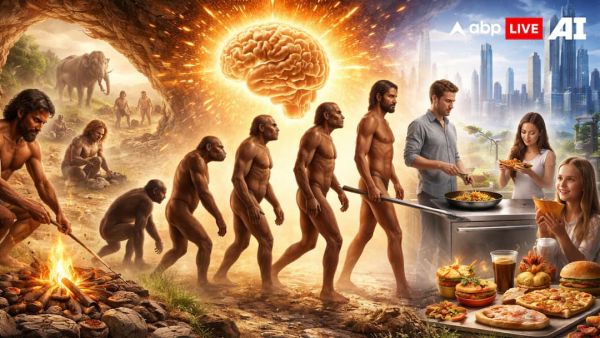
Somewhere in the deep past, long before cities, scriptures or even structured speech, an ancestor of ours did something astonishingly simple, yet utterly revolutionary. They held food over fire and waited. That pause, between hunger and consumption, may have changed everything.
Cooking is so ordinary today that it barely registers as remarkable. Yet in evolutionary terms, it marks one of the sharpest departures between humans and the rest of the animal kingdom. No lion roasts its prey. No chimpanzee grills tubers. Across millions of species, only one learned to deliberately transform food with heat.
Evolutionary Biologist Scott Travers writes in Forbes, “Cooking is so embedded in our daily lives that it’s very easy to overlook just how strange it is. As ordinary as it might seem, from an evolutionary perspective, a human standing over a flame and deliberately transforming food with heat is exhibiting an unprecedented behaviour.”
And in doing so, we may have transformed ourselves.
When early members of the genus Homo, likely Homo erectus, began using fire, they didn’t just invent a new way to eat. They outsourced part of digestion to the environment.
Travers cites a study published by the Department of Anthropology, Harvard University that showed how “No human foragers have been recorded as living without cooking, and people who choose a ‘raw-foodist’ life-style experience low energy and impaired reproductive function. This suggests that cooking may be obligatory for humans. The possibility that cooking is obligatory is supported by calculations suggesting that a diet of raw food could not supply sufficient calories for a normal hunter–gatherer lifestyle.”
In short, cooking breaks down proteins, softens fibres, and gelatinises starch. In simple terms, it pre-digests food. That means more calories, less effort.
And evolution noticed. And reprogrammed us, accordingly. Compared to other primates, humans have:
These are not random quirks, they are signatures of a species that no longer needs to chew for hours or ferment tough plant matter endlessly. A gorilla may spend up to 10 hours a day eating raw vegetation. Humans? A fraction of that.
The real beneficiary, however, sits inside the skull, though. A ‘No-brainer’ really!
Our brains are extraordinarily expensive organs, consuming about 20 per cent of our energy. Without calorie-dense food, such a brain would be an evolutionary liability. Cooking changed that equation. It unlocked more energy per bite, making large brains sustainable, and eventually advantageous.
This idea, often linked to the work of primatologist Richard Wrangham, is known as the “cooking hypothesis”: we didn’t just start cooking because we were smart, we became smart because we cooked.
Cooking didn’t act alone. It set off a feedback loop that still defines us:
And around the fire, something else began to simmer, society.
Fire extended the day, creating a shared space for storytelling, planning, and teaching. Anthropologists often point out that the hearth may have been humanity’s first classroom. Language, culture, and cooperation likely deepened in its glow.
Even taste, something we dismiss as trivial, played a role. As food became more flavorful, it encouraged experimentation, preference, and eventually cuisine. According to food writer John McQuaid, taste itself may have been a “bootstrapping mechanism” for human intelligence, rewarding us for discovering better ways to eat.
In other words, cooking didn’t just feed the body. It fed curiosity.
But here’s the twist: what began as an advantage may have become a constraint.
Humans today are not just creatures who cook, we are creatures who need cooked food.
Studies show that a strictly raw diet makes it difficult for humans to maintain weight and energy levels. Unlike other animals, we are poorly adapted to extracting sufficient calories from uncooked food alone. Our smaller guts and weaker jaws, once evolutionary upgrades, now limit us.
In that sense, cooking didn’t just elevate us, it locked us in. We traded independence for efficiency.
This raises an uncomfortable question: did cooking make us stronger, or more fragile?
If early cooking was a revolution, modern cooking may be an overcorrection.
Today, we no longer just cook, we refine, process, engineer. Sugar, once rare, floods diets. Calories are abundant, effortless, and immediate. And the same evolutionary wiring that once helped us survive now betrays us.
Our brains still crave energy-dense food because, for most of our history, it was scarce. But in a world of excess, that craving leads to obesity, diabetes, and metabolic disease.
Ironically, the very trait that made us human, our ability to manipulate food, now threatens our health.
Some movements, like raw-food diets or paleo eating, attempt to reverse this trajectory. But science suggests extremes don’t work either way. Humans are not gorillas. Nor are we adapted to hyper-processed diets.
We exist in a narrow evolutionary sweet spot, and we’ve drifted away from it.
So where does this leave us? A well-researched piece in the National Geographic tries to answer this. Cooking is no longer just about survival. It’s about identity, culture, even technology. From molecular gastronomy to lab-grown meat, we are redefining what “food” means.
But evolution hasn’t stopped.
Our genes are still responding. Research shows that human metabolism differs when processing cooked versus raw foods, even at the level of gene expression. Some adaptations may have reduced immune stress from raw meat, while others improved starch digestion (think of increased amylase genes in humans).
This suggests something profound: we are not just users of cooking, we are products of it.
Looking ahead, the next phase of human evolution may not come from nature alone, but from our continued manipulation of food:
In a way, we are becoming the architects of our own evolution.
The answer is not so simple. Cooking made us who we are:
But it also made us dependent, vulnerable to excess, and increasingly detached from natural limits.
It is both evolution and a subtle form of devolution, a trade-off rather than a triumph. The fire that once lit our path forward still burns. The question is no longer whether we can control it.
It is whether we can control what we choose to do with it. Because in every meal we prepare, we are not just feeding ourselves. We are continuing a story that began with a spark, and deciding, in small but significant ways, what it means to be human.