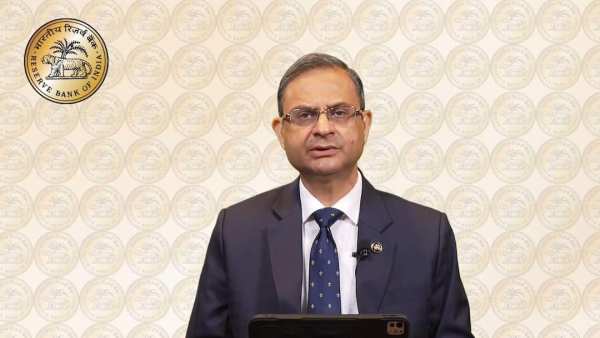
In a closely watched policy decision, the Reserve Bank of India (RBI) on Wednesday retained the benchmark repo rate at 5.25 per cent, while unveiling fresh GDP projections under a new data series.
The central bank projected GDP growth for FY27 at 6.9 per cent, while estimating growth for FY26 at a stronger 7.6 per cent under the revised series.
RBI Governor Sanjay Malhotra said the previous year’s growth estimate of 7.6 per cent reflects strong underlying momentum in economic activity, supported by robust consumption and investment, favourable financial conditions, and ongoing structural reforms.
However, the governor flagged emerging headwinds that could weigh on the FY27 outlook. He pointed to elevated energy and commodity prices, along with potential supply disruptions linked to the Strait of Hormuz, as key risks that could impact growth going forward.
He added that the government has been proactive in ensuring the availability of critical inputs across sectors to minimise the impact of supply chain disruptions.
Despite external risks, Malhotra highlighted that domestic growth drivers remain resilient. Sustained momentum in the services sector, the continuing impact of GST rationalisation, and healthy balance sheets of financial institutions and corporates are expected to support economic activity.
Providing a detailed outlook, the RBI projected GDP growth for FY27 across quarters as follows:
Q1: 6.8 per cent
Q2: 6.7 per cent
Q3: 7.0 per cent
Q4: 7.2 per cent
The projections indicate a gradual pickup in growth momentum through the fiscal year.
The decision to keep rates unchanged was taken unanimously by the Monetary Policy Committee (MPC), chaired by Governor Sanjay Malhotra.
The MPC also retained its ‘neutral’ stance, signalling a data-dependent approach as it navigates global uncertainty and evolving inflation dynamics.
With the latest policy decision, key rates remain as follows:
Standing Deposit Facility (SDF): 5 per cent
Marginal Standing Facility (MSF): 5.5 per cent
Bank Rate: 5.5 per cent
The central bank’s move reflects a preference for continuity amid mixed global signals and steady domestic growth conditions.
The April decision follows the February 2026 policy review, where the RBI had also maintained status quo after cumulative rate cuts of 125 basis points during FY26.
At the time, the MPC had highlighted the need to assess the transmission and impact of earlier rate cuts before considering further action, a stance that continues to guide policy.
The latest projections come at a time when policymakers are balancing resilient domestic demand with rising external headwinds. While growth remains steady, global uncertainty and inflation risks continue to shape the RBI’s cautious policy approach.
The updated GDP estimates under the new series provide a fresh baseline for assessing India’s economic trajectory in the coming fiscal year.