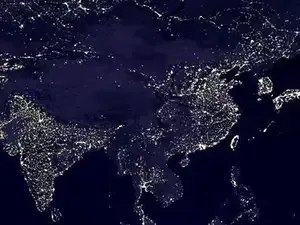
Earth is getting brighter, according to a new research. As per data from daily satellite observations, artificial lighting is causing continued nighttime brightening globally. While areas like sub-Saharan Africa and Southeast Asia are seeing rapid increases in nighttime brightness, parts of Europe are intentionally dimming lights to save energy and reduce light pollution.
Between 2014 and 2022, researchers recorded a 16% overall rise in global nighttime illumination. However, this increase hasn’t been uniform. Instead, it reflects a shifting pattern, with some regions brightening and others dimming based on local conditions. In 2022, the United States had the highest total light output globally, followed by China, India, Canada and Brazil.
The rise in brightness is largely driven by urban expansion, infrastructure growth and improved access to electricity in rural areas.
On the other hand, dimming happens for very different reasons. Sudden drops in lighting are often linked to natural disasters, power outages or armed conflicts. More gradual reductions tend to be intentional, resulting from policies promoting energy efficiency, adoption of LED lighting and efforts to curb light pollution.
“For decades, we assumed the Earth was simply getting brighter at night as populations and economies grew,” Zhe Zhu, a remote sensing expert at the University of Connecticut and lead author of the study published in Nature, told Reuters. “But our findings show that nighttime light patterns are far more dynamic.”
According to Zhu, the planet’s illuminated landscape is constantly changing—expanding, shrinking and shifting over time.
The study analyzed more than a million daily images captured by a U.S. government Earth-observing satellite and processed by NASA. Earlier research had relied mainly on monthly or annual composite images.
The sharpest increases in brightness were seen in developing regions, particularly across sub-Saharan Africa and Southeast Asia. Countries such as Somalia, Burundi and Cambodia led this growth, followed by others including Ghana, Guinea and Rwanda.
“This isn’t just urbanization—it reflects a major expansion in energy access,” Zhu explained. “Entire regions are transitioning from near-total darkness to being part of the global power network.”
In contrast, significant declines in lighting were recorded in countries like Lebanon, Ukraine, Yemen and Afghanistan, where conflict and infrastructure breakdown have disrupted electricity supply. Similar patterns were observed in Haiti and Venezuela, where prolonged economic instability has affected power reliability.
“In Ukraine, we saw a sharp and sustained drop in light that coincided with the escalation of the conflict in February 2022,” Zhu noted, referring to Russia’s large-scale invasion.
Europe, meanwhile, saw a 4% overall decline in nighttime brightness. This trend is largely due to technological upgrades and environmental policies.
“The shift from older streetlights to more efficient, directional LED systems, along with strict energy-saving measures and dark-sky initiatives, is driving this change,” Zhu said, adding that Europe presents a clear and organized pattern of dimming.
France, in particular, has emerged as a leader in reducing unnecessary nighttime lighting. Study co-author Christopher Kyba of Ruhr University Bochum highlighted the country’s policy of turning off streetlights late at night in low-activity areas as especially notable.
In the United States, overall lighting increased by 6% during the study period, but the trend varied regionally. The West Coast saw rising brightness linked to population growth and economic activity, while parts of the East Coast and Midwest dimmed due to shifting urban patterns and adoption of energy-efficient lighting in cities such as Washington, D.C., and Chicago.
Artificial lighting has evolved significantly since gas lamps first illuminated cities in the early 19th century, followed by electric lighting later on. Today, the glow from cities often obscures the night sky and the stars once visible above.
“Light pollution has serious ecological impacts,” Zhu warned. “It disrupts nocturnal wildlife, affects migration patterns and interferes with human biological rhythms.”
Between 2014 and 2022, researchers recorded a 16% overall rise in global nighttime illumination. However, this increase hasn’t been uniform. Instead, it reflects a shifting pattern, with some regions brightening and others dimming based on local conditions. In 2022, the United States had the highest total light output globally, followed by China, India, Canada and Brazil.
The rise in brightness is largely driven by urban expansion, infrastructure growth and improved access to electricity in rural areas.
On the other hand, dimming happens for very different reasons. Sudden drops in lighting are often linked to natural disasters, power outages or armed conflicts. More gradual reductions tend to be intentional, resulting from policies promoting energy efficiency, adoption of LED lighting and efforts to curb light pollution.
“For decades, we assumed the Earth was simply getting brighter at night as populations and economies grew,” Zhe Zhu, a remote sensing expert at the University of Connecticut and lead author of the study published in Nature, told Reuters. “But our findings show that nighttime light patterns are far more dynamic.”
According to Zhu, the planet’s illuminated landscape is constantly changing—expanding, shrinking and shifting over time.
The study analyzed more than a million daily images captured by a U.S. government Earth-observing satellite and processed by NASA. Earlier research had relied mainly on monthly or annual composite images.
The sharpest increases in brightness were seen in developing regions, particularly across sub-Saharan Africa and Southeast Asia. Countries such as Somalia, Burundi and Cambodia led this growth, followed by others including Ghana, Guinea and Rwanda.
“This isn’t just urbanization—it reflects a major expansion in energy access,” Zhu explained. “Entire regions are transitioning from near-total darkness to being part of the global power network.”
In contrast, significant declines in lighting were recorded in countries like Lebanon, Ukraine, Yemen and Afghanistan, where conflict and infrastructure breakdown have disrupted electricity supply. Similar patterns were observed in Haiti and Venezuela, where prolonged economic instability has affected power reliability.
“In Ukraine, we saw a sharp and sustained drop in light that coincided with the escalation of the conflict in February 2022,” Zhu noted, referring to Russia’s large-scale invasion.
Europe, meanwhile, saw a 4% overall decline in nighttime brightness. This trend is largely due to technological upgrades and environmental policies.
“The shift from older streetlights to more efficient, directional LED systems, along with strict energy-saving measures and dark-sky initiatives, is driving this change,” Zhu said, adding that Europe presents a clear and organized pattern of dimming.
France, in particular, has emerged as a leader in reducing unnecessary nighttime lighting. Study co-author Christopher Kyba of Ruhr University Bochum highlighted the country’s policy of turning off streetlights late at night in low-activity areas as especially notable.
In the United States, overall lighting increased by 6% during the study period, but the trend varied regionally. The West Coast saw rising brightness linked to population growth and economic activity, while parts of the East Coast and Midwest dimmed due to shifting urban patterns and adoption of energy-efficient lighting in cities such as Washington, D.C., and Chicago.
Artificial lighting has evolved significantly since gas lamps first illuminated cities in the early 19th century, followed by electric lighting later on. Today, the glow from cities often obscures the night sky and the stars once visible above.
“Light pollution has serious ecological impacts,” Zhu warned. “It disrupts nocturnal wildlife, affects migration patterns and interferes with human biological rhythms.”