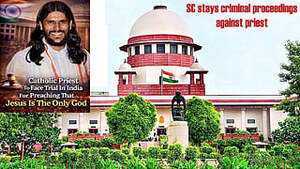
New Delhi | The Supreme Court on Friday stayed criminal proceedings and summons against a priest, who claimed that Christianity was the only true religion.
A bench of Justices Vikram Nath and Sandeep Mehta issued notice to the Uttar Pradesh government on a plea of Reverend Father Vineet Vincent Pereira challenging the March 18 order of the Allahabad High Court for quashing criminal proceedings against him.
Senior advocate Siddharth Dave, appearing for the priest, said police have invoked section 295A of the IPC, which deals with deliberate and malicious acts intended to outrage religious feelings.
The bench said it is issuing notice on the plea seeking the Uttar Pradesh government's response.
Dave said criminal proceedings and summons issued against him shall be stayed.
The bench agreed to the request and stayed the proceedings.
On March 18, the Allahabad High Court, while dismissing the plea of Father Pereira, observed that claiming a particular religion to be the "only true religion" is wrong in a secular country like India and may amount to disparaging other faiths, thereby attracting provisions of law.
It said such statements prima facie fall within the ambit of Section 295A of the IPC, which deals with deliberate and malicious acts intended to outrage religious feelings.
"It is wrong for any religion to claim that it is the only true religion as it implies a disparagement of other faiths," the order said.
According to the FIR lodged by Uttar Pradesh police, the applicant allegedly held prayer meetings where he repeatedly stated that Christianity was the only true religion, which hurt the sentiments of members of another community.
During the probe, the investigating officer found no evidence of illegal religious conversion but proceeded with filing a chargesheet over allegations of criticising other religions.
Father Pereira's counsel contended before the high court that he had been falsely implicated and that no offence under Section 295A IPC was made out.
He also submitted that the magistrate took cognisance of the chargesheet without proper application of judicial mind.
Opposing the plea, the state government before the high court had argued that the matter involved disputed questions of fact that required examination of evidence during trial.
It had also submitted that at the stage of taking cognisance, the court only needs to determine whether a prima facie case exists and is not required to conduct a detailed analysis.
The high court had noted that India is a secular nation where people of different faiths coexist, and emphasised that Section 295A specifically addresses acts done with deliberate and malicious intent to outrage religious sentiments.
It had held that at this stage, it cannot be said that no prima facie case is made out against the applicant and clarified that a magistrate is not expected to conduct a mini-trial or examine the defence while taking cognisance of the case.