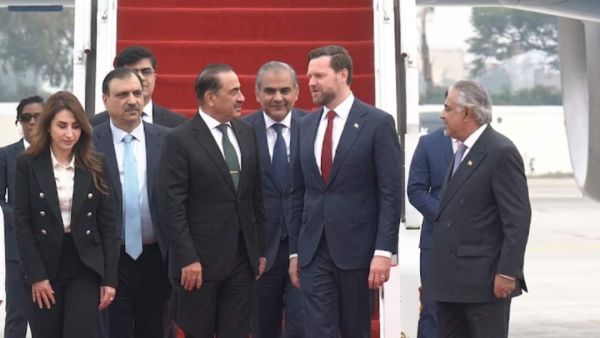
US-Iran Talks In Pakistan: Top officials from the United States and Iran convened in Islamabad on Saturday for critical negotiations aimed at ending a devastating conflict that has shaken the Middle East and beyond. The war has already claimed thousands of lives, disrupted global energy flows and triggered volatility in international markets.
Pakistan, which is hosting the talks, has expressed confidence in its role as a neutral facilitator, emphasising that it maintains trust with both sides and remains hopeful about progress.
Leading the US delegation, Vice President JD Vance struck a measured tone before departing Washington. He indicated a willingness to engage constructively, stating that the United States was ready to “extend the open hand” if Iran approached the negotiations in good faith. At the same time, he warned that any attempt by Tehran to delay or manipulate the process would not be tolerated.
One of the most contentious issues on the table is the ongoing violence in Lebanon. Iran has made it clear that meaningful negotiations cannot proceed unless the US commits to a ceasefire in Lebanon and ensures an end to Israeli military operations.
The conflict involving Hezbollah has been particularly deadly, with nearly 2,000 people reported killed since March. Iran’s President Masoud Pezeshkian has vowed continued support for Hezbollah, while Benjamin Netanyahu has insisted there is “no ceasefire” with the group.
The US has suggested that Israeli operations may become “more low key,” even as separate talks between Israel and Lebanon are scheduled to take place in Washington next week.
Sanctions relief remains another major sticking point. Tehran is demanding the release of frozen assets and the lifting of long-standing economic restrictions. However, the US has indicated that any easing of sanctions would depend on Iranian concessions, particularly regarding its nuclear and missile programs, as per Reuters.
Iran is also pressing for recognition of its sovereignty over the Strait of Hormuz and the right to impose transit fees—demands that Washington has firmly rejected.
Further complicating matters, Iran is seeking compensation for war-related damages and insists on retaining its uranium enrichment program. US President Trump has ruled out any compromise on enrichment, describing it as non-negotiable. Meanwhile, both Washington and Israel are pushing for significant reductions in Iran’s missile arsenal, a demand Tehran has dismissed outright.
The negotiations are expected to continue through Saturday, though officials acknowledge they could extend into Sunday or beyond. Iran’s Supreme National Security Council has indicated that discussions may last up to 15 days following last week’s ceasefire announcement.
Despite the urgency, the path to peace remains fraught with challenges. Deep divisions over Lebanon, sanctions, nuclear policy, and control of key maritime routes continue to test the limits of diplomacy.
As talks unfold in Islamabad, the world watches closely. Whether the fragile truce can evolve into a durable agreement—or collapse under the weight of competing demands—remains an open question.