Physical artificial intelligence (AI) startup Humyn Labs, which is building data infrastructure for systems, said it will deploy $20 million to scale its human intelligence layer as demand for real-world training for robotics data grows globally.
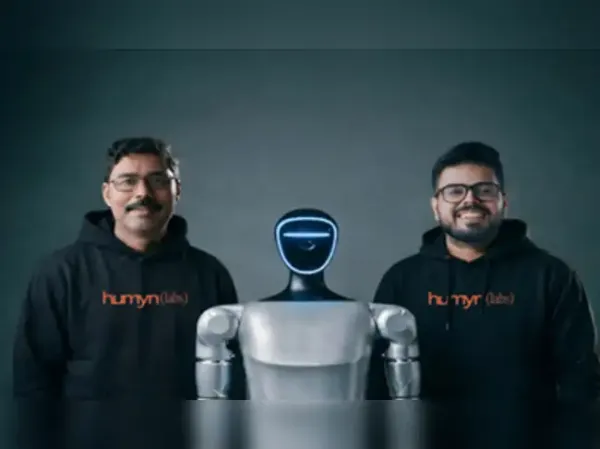
The company, founded by former Nazara Technologies CEO Manish Agarwal and Ishank Gupta, said the $20 million will be deployed towards building data inventory and infrastructure, including equipment, storage systems, and upfront investments in data collection.
The development comes as robotics and physical AI companies face a key constraint — limited availability of high-quality, real-world human data and systems that can train beyond controlled environments. Humyn Labs will expand its data collection operations across India, Southeast Asia, Latin America, and the Middle East while building robotics labs and voice datasets.
“Every real-world AI system will need continuous human data to train and validate, making this a foundational, always-on infrastructure layer,” Agarwal told ET. “The demand is immediate and global.”
Agarwal explained that unlike text and code datasets, which can be scraped from the internet, physical AI systems depend on real-world human activity — how people move, interact with objects, and navigate environments.
“There are three clear use cases where robots will scale — hazardous environments, deterministic factory settings, and areas with labour shortages,” the cofounder said, adding that none of this works without large volumes of real human data. Even something as basic as folding cloth requires massive datasets.
Research has shown that real-world human data significantly outperforms synthetic or simulation-based datasets in training robotics systems, creating a rush among companies to secure such inputs.
Building a ‘middleware’ for robotics
Humyn Labs wants to position itself as an infrastructure layer connecting real-world data to AI labs, rather than a robotics manufacturer.
“A lot of people think this is about supplying human labour. It’s not,” Agarwal said. “If you’re just doing worker arbitrage, your margins will get squeezed. The real value lies in building a tech pipeline — capturing, structuring, and delivering data in formats robotics labs can actually use.”
The company is building what it describes as a middleware layer to process raw human activity into structured datasets for training AI models.
Voice is also emerging as a key interface for human-robot interaction, and Humyn Labs said it is investing in multilingual datasets.
“Robots will be controlled through voice and conversation. But beyond a handful of global languages, models struggle,” Agarwal said. “Context, dialect, accent — these become critical, especially in markets like India, Brazil, or Indonesia.”
The company is currently working across 33 languages, with a focus on underrepresented regions.
Gupta, in a prepared statement, said the Global South presents a structural advantage. “This isn’t just where data comes from; it’s where the future of AI will be built,” he said.
The startup is working with 15-18 customers globally, largely in the US, and has built a pipeline of $45-50 million. “In the last five months, we’ve already delivered a few million dollars of projects,” the cofounder said, adding that the company is targeting $100 million in annual recurring revenue (ARR) by December if execution remains on track.
While demand is strong, execution remains complex, Agarwal agrees.
“One hour of video data is about 8GB. Now imagine collecting hundreds of hours daily across locations with limited internet,” Agarwal said. “This is as much a logistics problem as it is a tech problem.” The company is building pipelines for data collection, validation, annotation, and quality control, with a focus on reducing dependence on manual processes.
“If you take poor-quality raw data, it’s garbage in, garbage out. And then your costs of fixing it shoot up,” he added.
With the global AI training data market projected to reach $25 billion by 2030, physical AI validation is emerging as one of its fastest-growing segments. Humyn Labs is betting that the next phase of AI will be defined not just by models, but by the human intelligence used to train them.
The company, founded by former Nazara Technologies CEO Manish Agarwal and Ishank Gupta, said the $20 million will be deployed towards building data inventory and infrastructure, including equipment, storage systems, and upfront investments in data collection.
The development comes as robotics and physical AI companies face a key constraint — limited availability of high-quality, real-world human data and systems that can train beyond controlled environments. Humyn Labs will expand its data collection operations across India, Southeast Asia, Latin America, and the Middle East while building robotics labs and voice datasets.
“Every real-world AI system will need continuous human data to train and validate, making this a foundational, always-on infrastructure layer,” Agarwal told ET. “The demand is immediate and global.”
Agarwal explained that unlike text and code datasets, which can be scraped from the internet, physical AI systems depend on real-world human activity — how people move, interact with objects, and navigate environments.
“There are three clear use cases where robots will scale — hazardous environments, deterministic factory settings, and areas with labour shortages,” the cofounder said, adding that none of this works without large volumes of real human data. Even something as basic as folding cloth requires massive datasets.
Research has shown that real-world human data significantly outperforms synthetic or simulation-based datasets in training robotics systems, creating a rush among companies to secure such inputs.
Building a ‘middleware’ for robotics
Humyn Labs wants to position itself as an infrastructure layer connecting real-world data to AI labs, rather than a robotics manufacturer.
“A lot of people think this is about supplying human labour. It’s not,” Agarwal said. “If you’re just doing worker arbitrage, your margins will get squeezed. The real value lies in building a tech pipeline — capturing, structuring, and delivering data in formats robotics labs can actually use.”
The company is building what it describes as a middleware layer to process raw human activity into structured datasets for training AI models.
Voice is also emerging as a key interface for human-robot interaction, and Humyn Labs said it is investing in multilingual datasets.
“Robots will be controlled through voice and conversation. But beyond a handful of global languages, models struggle,” Agarwal said. “Context, dialect, accent — these become critical, especially in markets like India, Brazil, or Indonesia.”
The company is currently working across 33 languages, with a focus on underrepresented regions.
Gupta, in a prepared statement, said the Global South presents a structural advantage. “This isn’t just where data comes from; it’s where the future of AI will be built,” he said.
The startup is working with 15-18 customers globally, largely in the US, and has built a pipeline of $45-50 million. “In the last five months, we’ve already delivered a few million dollars of projects,” the cofounder said, adding that the company is targeting $100 million in annual recurring revenue (ARR) by December if execution remains on track.
While demand is strong, execution remains complex, Agarwal agrees.
“One hour of video data is about 8GB. Now imagine collecting hundreds of hours daily across locations with limited internet,” Agarwal said. “This is as much a logistics problem as it is a tech problem.” The company is building pipelines for data collection, validation, annotation, and quality control, with a focus on reducing dependence on manual processes.
“If you take poor-quality raw data, it’s garbage in, garbage out. And then your costs of fixing it shoot up,” he added.
With the global AI training data market projected to reach $25 billion by 2030, physical AI validation is emerging as one of its fastest-growing segments. Humyn Labs is betting that the next phase of AI will be defined not just by models, but by the human intelligence used to train them.