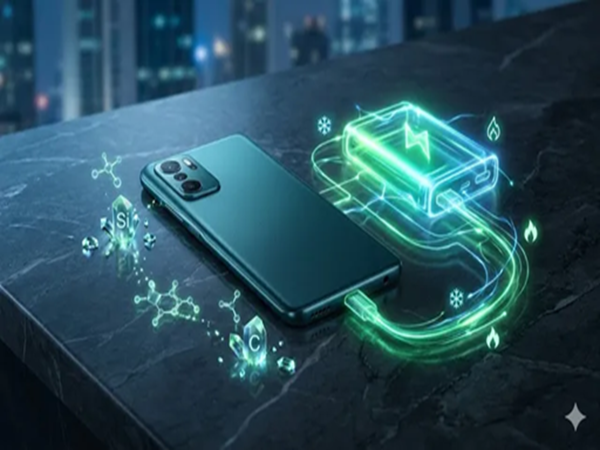
Battery life has always been a primary concern for smartphone users. Charging one's phone daily has become a habit. However, this situation is now changing. Companies are working on a new battery technology that promises to deliver greater battery capacity without increasing the physical size of the phone. This technology is known as the silicon-carbon battery. It is currently being incorporated into new smartphones. Recently, the OnePlus Nord 6 was launched, featuring a 9,000mAh battery. Samsung has also confirmed that it is preparing to introduce silicon batteries in its upcoming smartphones.
How does this battery differ from the rest?
Traditional lithium-ion batteries utilize graphite, serving as the medium through which lithium ions move to generate electricity. In silicon-carbon batteries, however, silicon is used as a substitute for graphite. Silicon is capable of storing many times more lithium ions than graphite. Simply put, much like a room can accommodate a larger number of people, this type of battery can store a significantly greater amount of energy.
Users benefit from these three key advantages:
The most significant advantage of this technology is that battery capacity can be increased without altering the physical dimensions of the phone. This means that while a device of a certain size previously housed a 5,000mAh battery, that same form factor can now accommodate a 6,500mAh battery—or even larger.
With this new technology, companies have a range of options at their disposal. They can pursue one of two strategies: either install a larger battery to extend the phone's battery life, or maintain the existing battery size while making the phone thinner and lighter.
Furthermore, these batteries perform more efficiently across various climatic conditions. Their performance remains stable even in extreme cold or heat. Additionally, the impact of the phone heating up on charging speed is significantly minimized.
Latest Phones with Large Batteries:
OnePlus 15: 7,300mAh
OnePlus Nord 6: 9,000mAh
Realme P4 Power: 10,001mAh
Xiaomi 17 Pro Max: 7,500mAh
Oppo Find X9 Pro: 7,500mAh
When Will This Arrive at Apple and Google?
As of early 2026, neither Apple nor Google has adopted silicon-carbon (Si-C) battery technology in their flagship smartphones. However, both Apple and Google are reportedly actively researching and testing silicon-anode technology. Industry reports indicate that Apple, in particular, is preparing to make a major shift toward this technology within the 2026–2027 timeframe. Meanwhile, Samsung has also conducted tests on carbon-silicon batteries.
Disclaimer: This content has been sourced and edited from Dainik Jagran. While we have made modifications for clarity and presentation, the original content belongs to its respective authors and website. We do not claim ownership of the content.